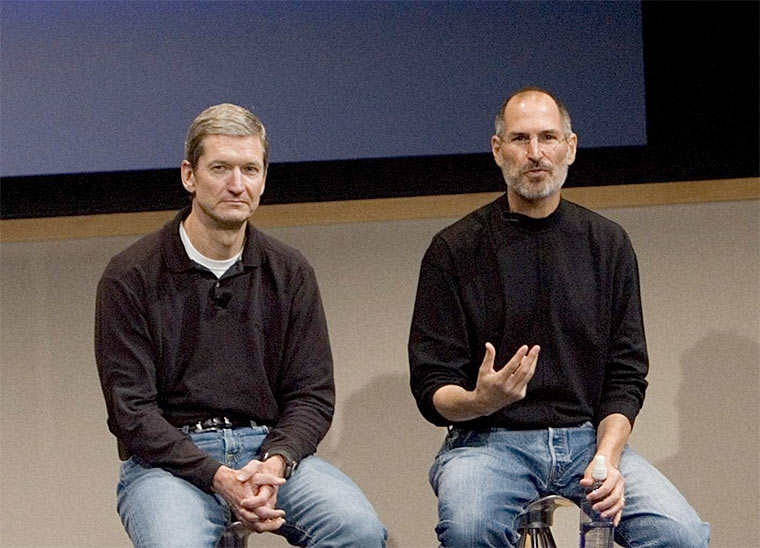
Jobs and his habit of walking
Steve Jobs didn't like sitting in meeting rooms. Whenever he needed to discuss something important, he'd invite the person on a walk. Not to a cafe, not to a room with a projector, just a stroll through the streets of Palo Alto
Walter Isaacson writes in Jobs's biography that for serious conversations, he always preferred a long walk. Some of Apple's key decisions were born on these walks. When Jobs wanted to hire someone or come up with a new product, he stepped outside
And he was far from the only one. Mark Zuckerberg picked up the habit. Jack Dorsey held meetings on foot. Barack Obama also preferred walks for important one-on-one conversations
But why? What's so special about ordinary walking?
Stanford proved it: walking makes you more creative
In 2014, psychologists Marily Oppezzo and Daniel Schwartz from Stanford University ran a series of experiments that gave a clear answer
Participants were split into groups. Some sat indoors, others walked on a treadmill or around campus. Then everyone was given standard creativity tests: for example, come up with as many unconventional uses for an everyday object as possible
The result was surprisingly strong: creative thinking in those who walked increased by an average of 81% compared to those who sat. And interestingly, the effect lingered for a while even after the person sat back down. A walk essentially "charges" the brain ahead of time
This explains why walking meetings are perfect for brainstorming and strategic conversations, but not for reviewing spreadsheets or accounting reports
What happens to your brain on a walk
When you walk, several processes kick off in the brain simultaneously
Blood flow. Walking increases blood flow to the brain by 15-20%. More blood means more oxygen and glucose for neurons. The prefrontal cortex, which handles decision-making and complex thinking, gets extra fuel
Default Mode Network. This is a network of brain regions that activates when you're not focused on a specific task. It's responsible for wandering thoughts, unexpected associations, and those "oh, what if..." moments. Walking shifts the brain into a mode where this network runs stronger
Cortisol. Moderate physical activity lowers the stress hormone. When you're tense, the brain goes into fight-or-flight mode and stops generating new ideas. Walking releases that tension
BDNF. Walking raises levels of Brain-Derived Neurotrophic Factor, a protein that stimulates neuron growth and survival. It's sometimes called "brain fertilizer". A study by Erickson KI et al. (2011, PNAS) showed that one year of aerobic exercise increased hippocampal volume by 2% in older adults and improved spatial memory
Not just Jobs
The idea of thinking on foot is not new. Aristotle taught philosophy while walking with his students through the garden of the Lyceum. His school was called "peripatetic", from the Greek peripatein, meaning "to walk about"
Beethoven took long walks through Vienna with a notebook in his pocket, and many of his themes were born on the move. Darwin walked several laps every day along a path in his garden that he called his "thinking path". When a problem was particularly tough, he would lay out pebbles at the start and remove one with each lap
Nietzsche wrote: "All truly great thoughts are conceived while walking". That's from Twilight of the Idols, 1889
Stanford simply proved scientifically what philosophers, composers, and scientists had known intuitively for centuries
Nature amplifies the effect
If you can choose where to walk, pick a park or a tree-lined street
Gregory Bratman from Stanford showed in 2015 that 90 minutes of walking in nature reduces activity in the subgenual prefrontal cortex, a brain region responsible for rumination, the obsessive replaying of negative thoughts. Walking along a busy road did not have the same effect
A walk in the park doesn't just help you come up with new ideas, it also helps you stop replaying old ones. A double benefit
How to set up a walking meeting
A few practical tips from people who do this regularly:
- Two or three people max. Four people can't fit on a sidewalk, and the conversation splits into pairs
- A loop route. So you end up back where you started rather than three kilometers from the office
- No laptops or slides. Walking meetings aren't for presentations, they're for discussing ideas, strategy, and feedback
- 30-40 minutes. That's enough for 2-3 laps and one good conversation
- Write it down after. Key thoughts are easy to forget if you don't capture them right away when you get back
Takeaway
Jobs didn't walk because it was trendy. He walked because thinking is better on a walk. Stanford confirmed it: creativity jumps by 81%, the brain switches into idea-generation mode, stress drops
You don't need Apple's campus or the streets of Palo Alto. Any route where you can walk comfortably for 30 minutes will do. Next time, instead of scheduling a call, invite a colleague for a walk. Or just step outside and take a stroll before sitting down to tackle a hard problem
The best ideas rarely come at a desk
Sources
- Oppezzo M, Schwartz DL. "Give Your Ideas Some Legs: The Positive Effect of Walking on Creative Thinking." Journal of Experimental Psychology: Learning, Memory, and Cognition, 2014. → APA
- Bratman GN et al. "Nature experience reduces rumination and subgenual prefrontal cortex activation." PNAS, 2015. → PNAS
- Erickson KI et al. "Exercise training increases size of hippocampus and improves memory." PNAS, 2011. → PNAS
- Isaacson W. "Steve Jobs." Simon & Schuster, 2011.

Start counting your steps
Download Qozgal for free — automatic step counting and monthly raffles