Where it came from
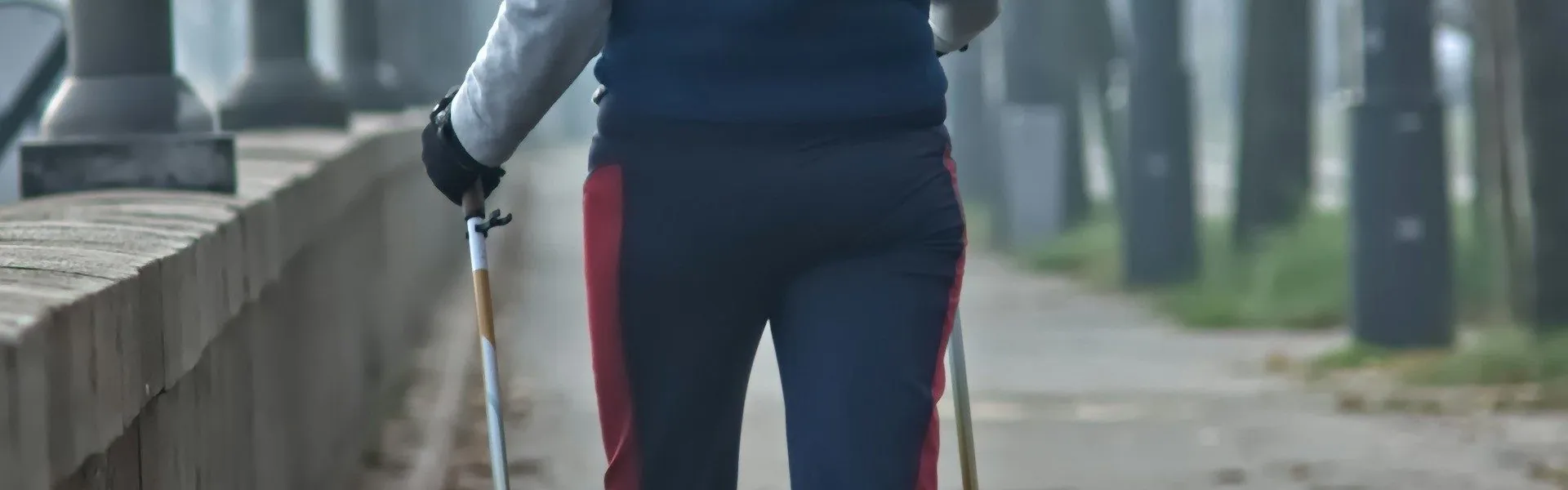
Nordic walking (from the English Nordic walking, Finnish sauvakävely) was born out of ski sport. In the 1930s, Finnish cross-country skiers started walking with shortened ski poles in summer to keep in shape. The world saw it in 1997 when Exel released the first commercial pole specifically for walking — no ski binding, a simplified grip and tip
Over the following 20 years, Finland, Germany and Poland ran hundreds of studies. Their combined finding: at the same movement speed, Nordic walking engages 90% of skeletal muscles vs. 70% in regular walking. That changes everything — calorie burn, cardiac load, effect on the upper body
In Central Asia the trend caught up later. Now, in Almaty, Astana, Bishkek and Tashkent, regular Nordic-walking groups are a common park sight. Among participants are many people 50+, post-knee-surgery, and those with extra weight
What the meta-analyses showed
The most authoritative summary work — Tschentscher et al., American Journal of Preventive Medicine, 2013. They pooled 16 RCTs (randomized controlled trials) and compared Nordic walking with regular walking and a control group
- VO₂max (the main marker of aerobic endurance): Nordic walking +5.5 ml/kg/min, regular walking +3.1. A 70% advantage to poles
- Waist circumference: −3.5 cm vs. −2.1 with the same training time
- HDL ("good" cholesterol): a rise of 4.4 mg/dL vs. 2.3
- Systolic blood pressure: a drop of 5.8 mmHg in hypertensives over 12 weeks
These effects are larger than typical walking-program results and comparable to light-running programs — but without the usual running-related problems with knees and feet
Calories: how much more
The main "selling" argument is calorie burn. Different studies give different numbers depending on technique:
- Cooper Institute, 2002: +20% calories at the same walking speed
- University of Wisconsin-La Crosse, 2010: +18% with "relaxed" technique, up to +46% with "active" technique with strong push-off
- Polish Journal of Sports Medicine, 2013: +28% on average with proper technique
In real numbers: if regular walking at 5 km/h burns 250-300 kcal/hour for a 70 kg person, Nordic walking burns 300-440 kcal/hour at the same speed. Over a 30-minute session — 25-70 extra calories, which over a year of regular practice adds up to 3-7 kg of difference
The key caveat: "+46% calories" is about proper technique with active push-off. If you just carry the poles behind you, like many beginners, the effect will be minimal
Effect on knees and joints
This is what makes Nordic walking unique. The poles take part of the load off the lower body and transfer it to the upper body:
- Knee joint load drops by 26% (Willson et al., 2001)
- Ankle load — by 12-15%
- Lower-back load — by 30% with proper technique, because the poles unload the spine during walking
This is critical for:
- People with knee and hip osteoarthritis
- Post-joint-replacement (with surgeon's approval)
- People with extra weight — regular walking is often painful for the knees, poles make it comfortable
- Older adults at risk of falling — poles give four points of support, not two
In Germany and Poland, Nordic walking is officially recommended as part of rehabilitation after knee surgery, stroke and heart attack
Effect on the upper body and posture
What regular walking doesn't offer at all:
- Active work of the shoulders, biceps, triceps and lats with every pole push-off. EMG studies show arm-muscle activation at 30-50% of maximum with proper technique
- Opening of the chest. Poles automatically pull the shoulders back and straighten the thoracic spine. That's the opposite of "office slouch"
- Core tone. To transfer force from arms to legs through the body, the abs and lower-back muscles engage. No specific exercises needed
- Upper-body osteoporosis prevention. Push-off through the pole loads the wrist, elbow and shoulder — exactly the zones that regular walking doesn't load at all
For people with sedentary jobs this is a huge plus. Regular walking doesn't fix "computer posture," Nordic walking partially fixes it because it physically forces you to open up the shoulders
How to choose poles
Length — the main thing:
- For fitness (moderate pace): height × 0.68. For a 170 cm person — 115 cm poles
- For sport (intense technique): height × 0.70. For a 170 cm person — 119 cm
- For seniors and beginners: height × 0.66. For a 170 cm person — 112 cm
Standard pole sizes come in 5 cm increments (100, 105, 110, 115...). Round down — better short than long
Fixed length vs. telescopic:
- Fixed — lighter, stronger, transmits force better. Downside: doesn't fit different people in one family
- Telescopic — adjusts to height. Good for travel and a family. Downside: 100-150 g heavier, the locks loosen over time
For regular sessions 3-4 times a week — fixed, no question. If you walk only on vacation — telescopic
Material:
- Aluminum — the cheapest. But heavy and worse at absorbing shock
- Aluminum + carbon (mix) — the price/quality optimum, 60-70% carbon
- Full carbon (100%) — best shock absorption and weight, but 2-3× the price
Strap (hand loop) — should have a quick-release system and fit snugly around the wrist. This is a critical detail: a proper strap transfers force to the pole without you having to grip. If a store offers poles with a simple cord loop, that's an outdated model
Tip — should have a removable rubber "boot" for asphalt and a spiked tip for dirt and snow. Without the boot, the pole clatters on asphalt and slips
Technique: 4 key principles
Nordic walking differs from "walking with sticks" precisely because of technique. Without it, the poles are just hiking trekking aids
1. Arm-leg coordination. When the right leg goes forward — the left arm with the pole goes forward. It's a natural pattern (like running). Not "right-right, left-left"
2. Pole angle. The pole is set not vertically but at a ~45° angle to the ground, tip pointing backward, not forward. This creates a base for push-off, not a prop
3. Push, not prop. The main beginner mistake — the pole goes forward and props you up. Correct — the pole goes backward and pushes the body forward. At the moment of push-off the arm straightens at the elbow, the palm opens, and the pole stays in the strap — that's the whole point of the strap
4. Stride length. The stride becomes longer than in regular walking. The torso tilts forward slightly. That's the natural result of the pole push
The first sessions are best run with an instructor, or at least watch a video breaking down the technique. On their own, 70% of people land on the right pattern after a couple of training sessions
How often and how much
Standard recommendations from the Finnish Nordic Walking Association:
- Minimum: 3 times a week for 30-40 minutes
- Optimum: 4-5 times for 45-60 minutes
- Pace: one where you can still talk to a partner but can't sing
The first visible changes (endurance, posture) — after 4-6 weeks of regular practice. The effect on blood pressure and cholesterol — after 8-12 weeks
You can combine with regular walking and our interval protocols — several Nordic walking sessions a week + daily "regular" walks = an ideal weekly volume
Who it especially fits
- People 50+ — the main audience. Safer than running, more effective than regular walking
- With knee and hip osteoarthritis — poles unload the joints by 20-30%
- With extra weight — higher calorie burn at the same load on the knees
- After knee surgery and stroke — rehab effect (with doctor's approval)
- With osteoporosis — loading the wrist and elbow slows bone-density loss in the arms
- With sedentary jobs and poor posture — the poles physically straighten the thoracic spine
- For nature lovers — poles make dirt trails and light climbs more accessible
Who should talk to a doctor before starting:
- Serious shoulder problems (impingement, rotator cuff)
- Stage 3 hypertension without therapy
- Recent heart attack or stroke (within 3 months)
- Inflammatory arthritis in an active flare
Common mistakes
- "Carrying" the poles. Poles in the air, not touching the ground — the most common mistake. Then it's just walking + extra weight
- Poles that are too long. The elbow at the moment of contact should be bent at 90°. If the pole is too long, the arm comes up and the shoulder tires
- Gripping the fist. The pole is held not by the fingers but by the strap. After push-off the palm opens. If you grip, the forearms tire and you get blisters
- Pole vertical. If the pole goes straight down — there's no push, only a prop. The angle has to be pronounced
- No boot on asphalt. Clatter, slipping, the tip wears down. The rubber boot is cheap — don't skip it
- "Same-side" technique. With proper coordination, the left arm works opposite the right leg. If both arms move together — the technique has broken
Comparison with regular walking and running
vs. regular walking:
- +20-46% calories
- +50-70% upper-body effect
- −26% knee load
- But: you need poles (5,000-30,000 KZT a pair) and a couple of sessions on technique
vs. running:
- 2-3× less knee and foot injury rate
- Doable at any age
- But: lower calorie burn, no comparable VO₂max growth at the same intensity
An ideal fit for people for whom "regular walking is too easy, but running is no longer an option" — especially after 45-50
Bottom line
Nordic walking is not "a stroll with sticks" — it's a full-fledged aerobic sport with a strong evidence base. Meta-analyses over 25 years show: at the same movement speed, it burns more calories, trains the heart better, traumatizes the knees less, and works muscles regular walking doesn't touch at all
For age 50+, people with extra weight, post-surgery rehab and anyone whose knees hurt from running — this is often the best way to stay active. The starter kit — a pair of poles for 8,000-20,000 KZT and 30 minutes of technique video
The main thing — don't worry about looking "weird with sticks." From Helsinki to Almaty, in parks, it's long since become normal. And the health effect is real, not marketing
Sources
- Tschentscher M, Niederseer D, Niebauer J. "Health benefits of Nordic walking: a systematic review." American Journal of Preventive Medicine, 2013. → Elsevier
- Church TS, Earnest CP, Morss GM. "Field testing of physiological responses associated with Nordic walking." Research Quarterly for Exercise and Sport, 2002 (Cooper Institute). → Taylor & Francis
- Willson J, Torry MR, Decker MJ et al. "Effects of walking poles on lower extremity gait mechanics." Medicine & Science in Sports & Exercise, 2001. → LWW
- Figard-Fabre H, Fabre N, Leonardi A, Schena F. "Efficacy of Nordic walking in obesity management." International Journal of Sports Medicine, 2011. → Thieme
- Reuter I, Mehnert S, Leone P et al. "Effects of a flexibility and relaxation programme, walking, and Nordic walking on Parkinson's disease." Journal of Aging Research, 2011. → Hindawi
Count steps — with poles or without
Qozgal automatically catches every step, on regular walks and with Nordic poles. Free