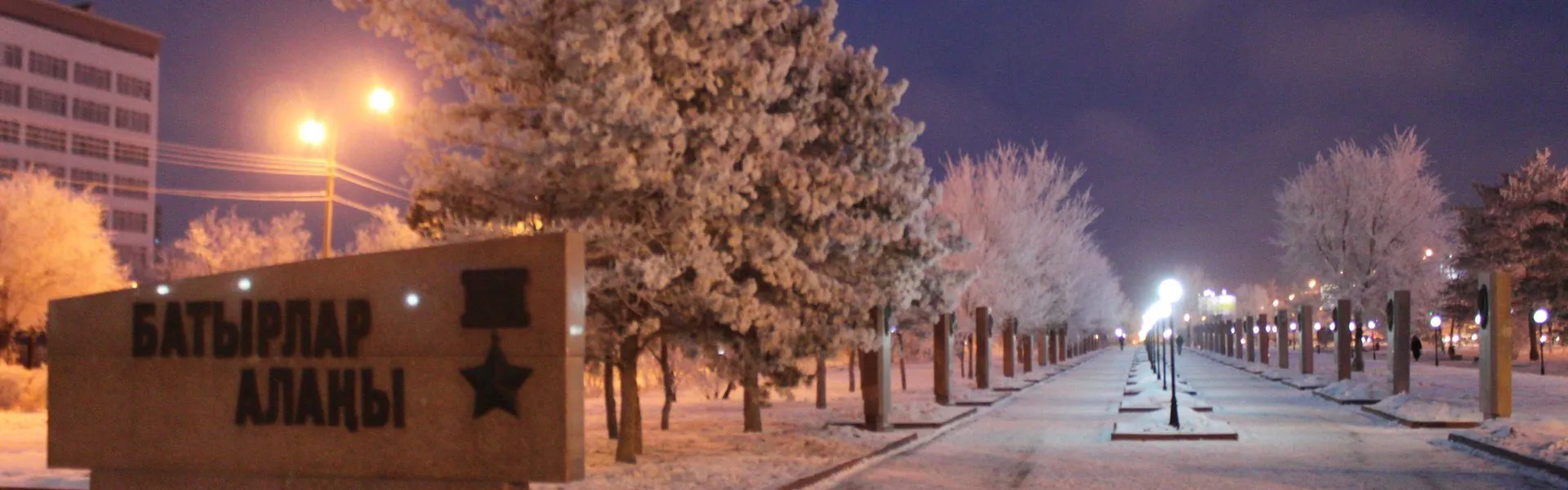
Aktobe is a city where the wind chooses the route
In Aktobe, the main question before a walk is not “how many steps should I do,” but where is it less windy today. The open Ilek Embankment is lovely on a warm, quiet evening, but with a strong side wind it quickly turns into a wind tunnel. Victory Park, Tasovsky Forest Park and alleys inside neighborhoods are calmer: trees and buildings work like a shield against dust.
- When the wind is above 7–9 m/s, choose a park, forest park or neighborhood alleys, not an open embankment.
- If AirKZ or another index shows “orange” air or worse, shorten the route and don’t speed up.
- In summer, plan your steps before 9:00 or after 19:00; in winter, go in daylight and in places where you can quickly get warm indoors.
- For an everyday habit, 2–3 short outings of 10–20 minutes are better than one heroic march through dust.
- The most versatile places: Victory Park, First President Park, Tasovsky Forest Park, a short stretch of the Ilek and the water-green boulevard.
In Aktobe, a good walk isn’t about endurance. It’s about choosing smartly: if it’s windy, go under trees; if it’s calm, take the Ilek; if it’s dusty, do a short loop and come back without guilt.
Before you go: 90 seconds for the forecast
Make a small ritual: first wind, then air, then temperature. For air, use AirKZ and Kazhydromet data: Aktobe has stationary monitoring, and the app shows pollutants and exceedances. If you want to understand more deeply how AQI affects walks, see our guide to walking in poor air.
- Wind: up to 5–6 m/s you can usually go anywhere; 7–9 m/s — parks and streets between buildings are better; 10 m/s and above — avoid open water, vacant lots and long straight avenues.
- Dust: if visibility is worse than usual, sand crunches on your teeth, or the wind is coming from vacant lots, don’t argue with the weather — move your long route to another time.
- Air: green level — a normal walk; yellow — a calm pace; orange — shorter and without climbs; red — better indoors, or only a very short necessary outing.
- Heat: in June–August, put your main step plan in the morning and evening, not at lunchtime.
- Frost: consider not only the temperature, but also the wind: when it’s below zero, the open embankment feels noticeably colder than a courtyard or park.
Aktobe’s simple rule When in doubt, choose a route with three shelters: trees, buildings and a place to go inside — a shop, café, mall or bus stop. This is especially important in winter, dusty March and hot July.
Where to go: routes for wind, dust and heat
Below are everyday scenarios, not sports tracks. Step counts are approximate: for you they’ll depend on height, pace and how many times you turn toward a bench or water. You’ll find more options in our separate Aktobe routes guide.
| Condition | Route | Distance and steps | How to get there |
|---|---|---|---|
| Quiet evening, air normal | Ilek Embankment, short stretch | ~5 km there and back, about 7 500 steps | Buses No. 3, 11, 16 to the bridge over the Ilek |
| Want 10 000 steps | Ilek Embankment, big loop | ~7 km loop, about 10 000 steps | Start at the “Aliya Moldagulova Bridge”, No. 3 or 11 |
| Heat or dust | Victory Park (Zhenis) | ~2 km big loop, about 4 500 steps | Buses No. 3, 16, 28 to Victory Park |
| Strong wind | Tasovsky Forest Park | ~5 km along the alleys, up to 12 000 steps | Bus No. 27 to Tasovsky, then 10 minutes on foot |
| Short walk after errands | First President Park and Triathlon Park | 2–2,4 km loop, about 3 500 steps | To the “President Park” stop or the 11th microdistrict |
| Pretty center without a long route | Unity and Accord Boulevard | 1–2 calm loops, 15–30 minutes | Landmark: Nur Gasyr and St. Nicholas Cathedral |
When open water helps, and when it doesn’t
The Ilek and Aktobe Reservoir are pleasant on summer evenings: the water softens the heat a little, views help you walk longer, and the route doesn’t feel monotonous. But in March, November and on a frosty day, water makes the cold feel stronger. Then it’s better not to prove your toughness to yourself, but to move to Victory Park, First President Park or Tasovsky Forest.
- If you’re going to the Ilek, start with a short 20–30 minute stretch, not the full route right away.
- At the reservoir, take water in advance: along the shore it isn’t always easy to buy a drink quickly.
- Unity and Accord Boulevard is good for an evening “social” loop: lights, people, a fountain, and landmarks that are clear even to a city guest.
- In Tasovsky Forest Park, don’t go far at dusk if you don’t know the trails: this place is better for daytime heat and wind.
Pace: why it’s better not to speed up in poor air
When the air is dusty, the biggest mistake is trying to “quickly finish your steps.” The faster you go, the more often and deeply you breathe, which means more dust and fine particles pass through your airways. On days like this, steps are not automatically canceled, but the format changes: shorter, calmer, closer to home.
The authors modeled the balance between the benefits of active travel and the harms of PM2.5. The conclusion is useful for Aktobe: in most urban conditions, the benefits of walking outweigh the pollution risk, but when PM2.5 is extremely high and you spend a long time outside, it’s wiser to cut duration and lower intensity. DOI: 10.1016/j.ypmed.2016.02.002.
Tainio et al., Preventive Medicine, 2016If you have asthma, COPD or heart disease Don’t rely only on “I seem to feel fine.” If you get coughing, wheezing, chest pressure, severe shortness of breath or dizziness, stop the walk and go indoors. If your doctor gave you an action plan or an inhaler, keep it with you.
In a randomized crossover trial, N95 respirators reduced PM2.5 exposure well, but the effect depended on pollution level and tolerability. Practical takeaway: on a dusty day, an N95/FFP2 mask is more useful than a neck gaiter, but it shouldn’t turn the walk into labored breathing. DOI: 10.1016/j.scitotenv.2023.164528.
Meng et al., Science of the Total Environment, 2023How long to walk: don’t chase the perfect 10 000
For Aktobe it’s easier to think not “I must hit 10 000 at any cost,” but “I’ll collect steps in pieces.” In the morning — 1 500 to the shop or stop, during the day — 10 minutes along the boulevard, in the evening — a loop in the park. If you want to convert steps to kilometers without guessing, use our guide to how many kilometers are in 10 000 steps.
A meta-analysis of 15 cohorts showed: more steps per day were associated with a lower risk of all-cause mortality, and the benefit plateau occurred at about 6 000–8 000 steps for people 60+ and 8 000–10 000 for younger adults. For a city guide, this means: consistency matters more than a perfect round number. DOI: 10.1016/S2468-2667(21)00302-9.
Paluch et al., The Lancet Public Health, 2022- On a green day: a normal conversational pace, you can walk for 30–60 minutes.
- On a yellow day: keep a conversational pace, but remove bursts of speed and long stretches along roads.
- On an orange day: 10–20 minutes near home, preferably a park or a car-free courtyard.
- On a red day: indoor steps — a shopping mall, corridor, stairs without rushing, housework.
- After illness, during pregnancy, with anemia or severe fatigue, cut the plan in half and watch how you feel, not the app.
A seasonal scenario for Aktobe
Aktobe has sharp seasons: in summer you’re limited by heat and sun, in winter by wind and ice, and in spring and autumn by dust. So one “favorite route” for the whole year doesn’t work. It’s better to keep four scenarios in mind and switch quickly.
| Season | Best time | Where to go | What to avoid |
|---|---|---|---|
| Spring | after rain or on a calm morning | Victory Park, Tasovsky Forest, neighborhood alleys | vacant lots, open roads, the long Ilek in wind |
| Summer | before 9:00 and after 19:00 | Ilek in the evening, Tasovsky Forest, Victory Park | midday sun, asphalt without shade, long routes without water |
| Autumn | September and the first half of October | Ilek, Unity Boulevard, First President Park | late November wind by the water |
| Winter | daylight hours, preferably after lunch | parks, courtyards, short loops near home | the embankment in wind, ice without grippy shoes |
What to take with you
The fewer things you take, the higher the chance you’ll actually go out. But in Aktobe there is a small minimum that often decides whether the walk will be pleasant or you’ll turn home after seven minutes.
- Water: in summer at least 0,5 l for an hour’s walk; at the reservoir — more, because shade and shops may not be nearby.
- Glasses: help not only with the sun, but also with dust, especially on the Ilek and near open roads.
- Cap or panama hat: in the steppe sun, this is not an accessory, but protection from overheating.
- Neck gaiter or respirator: a neck gaiter saves you from sand and wind; N95/FFP2 is better against fine particles if the air is truly bad.
- Windbreaker: you need it even on a summer evening by the water; in Aktobe, temperature and wind chill can diverge quickly.
- Shoes with grippy soles: in winter and the off-season, don’t chase lightweight sneakers, especially on tiles and near water.
A route for a bad day Save one backup loop near home on your phone: 8–12 minutes, no intersections, with a bench and a shop on the way. On a dusty, frosty or exhausted day, it will support the habit better than a beautiful but faraway route.
How to make walking a habit, not a feat
A walking habit is usually held together not by motivation, but by a low barrier to starting. In Aktobe this matters especially: if you wait for perfect weather every time, your steps will be rare. Make yourself a menu of three options: “5 minutes”, “20 minutes”, “an hour”. Then poor air doesn’t cancel the day — it simply moves you to the short scenario.
In a study of 19 806 adults, contact with nature for at least 120 minutes a week was associated with a higher likelihood of reporting good health and wellbeing. Important: you can collect 120 minutes through several short outings. For Aktobe, that’s Victory Park, Tasovsky Forest, the Ilek, the boulevard and green courtyards. DOI: 10.1038/s41598-019-44097-3.
White et al., Scientific Reports, 2019- Choose a 10-minute “home” route and walk it without preparation.
- Once a week, do a beautiful route: the Ilek, Unity Boulevard or a park with water.
- In poor air, don’t scold yourself: swap the walk for a short loop or indoor steps.
- Keep your shoes and windbreaker by the door so you don’t spend willpower getting ready.
- Track not only steps, but also the fact that you went out: in a windy city, that is already a win.
FAQ: short answers
Can you walk in Aktobe if the air is “yellow”?
Yes, if you feel fine: choose a calm pace, a park or courtyard, don’t walk along a busy road, and shorten the walk if coughing or chest heaviness appears.
What’s better in a dusty wind: the Ilek or a park?
A park. The open embankment is more exposed to wind, while trees in Victory Park, First President Park and Tasovsky Forest Park partially soften wind and dust.
Do you need a mask for a walk?
On a normal day — no. In a dust storm or with high PM2.5, an N95/FFP2 is better if you can breathe comfortably in it. A neck gaiter protects from sand, but is worse against fine particles.
When is the best time to go out in summer?
Before 9:00 or after 19:00. If you need to walk during the day, choose a short shaded route: Victory Park, Tasovsky Forest or a few blocks with a place to go inside.
Which route should a first-time visitor to Aktobe choose?
In calm weather — a short stretch of the Ilek Embankment. In heat or wind — Victory Park. For a beautiful central photo without a long walk — Unity and Accord Boulevard between Nur Gasyr and St. Nicholas Cathedral.
Sources
- Tainio M. et al. Can air pollution negate the health benefits of cycling and walking? Preventive Medicine, 2016. DOI: 10.1016/j.ypmed.2016.02.002. DOI
- Paluch A. E. et al. Daily steps and all-cause mortality: a meta-analysis of 15 international cohorts. The Lancet Public Health, 2022. DOI: 10.1016/S2468-2667(21)00302-9. PMC
- White M. P. et al. Spending at least 120 minutes a week in nature is associated with good health and wellbeing. Scientific Reports, 2019. DOI: 10.1038/s41598-019-44097-3. DOI
- Meng X. et al. Cardiovascular effects of wearing respirators against particulate matter: A randomized crossover trial. Science of the Total Environment, 2023. DOI: 10.1016/j.scitotenv.2023.164528. DOI
- WHO. Global air quality guidelines: PM2.5, PM10, ozone, nitrogen dioxide, sulfur dioxide and carbon monoxide, 2021. WHO
- WHO Guidelines on physical activity and sedentary behaviour: recommendations for adults — 150–300 minutes of moderate activity per week and the principle that “a little is better than nothing.” NCBI Bookshelf
- U.S. EPA. Should You Exercise Outside in Air Pollution? A practical explanation of how to account for AQI, intensity and sensitive groups. EPA
- Kazhydromet: atmospheric air monitoring in Aktobe is carried out at 6 stations, including automatic and manual sampling stations. Kazhydromet
- Kazhydromet: the AirKZ app shows air quality, pollutants and MPC exceedances for settlements in Kazakhstan. AirKZ
- Akimat of Aktobe Region: Triathlon Park in the southern part of First President Park, a 2,4 km perimeter path, free access. Gov.kz
- QazTravel: the water-green Unity and Accord Boulevard in central Aktobe between St. Nicholas Cathedral and the Nur Gasyr Mosque. QazTravel
- Qozgal: a city guide to Aktobe routes — the Ilek Embankment, Victory Park, Tasovsky Forest Park, the reservoir and step estimates. Qozgal
