The short version, if you're in a hurry
Bukhara is the most compact walking city in Central Asia. The Old City isn't a "historic quarter" — it really is the whole centre: from Lyabi-Hauz to the Ark is 1.2 km, from the Ark to the Samanids is another 700 metres. Walking it is easy even if you're out of shape — everything is flat, paved, with no climbs. The real enemies of a walk here are summer heat (+40°C and dust) and midday sun. Winters are mild, +5–10°C, occasionally damp
The basic rule: once you're up, walk — you don't need a car at all. Inside the core a taxi can't even get through; the lanes are two hands wide. If you want 10,000 steps, pick one loop. For 15,000 add Char Minar and the Jubar mahalla. The only places that need a car are Chor-Bakr and Sitorai Mokhi-Khosa, both 5–7 km from the centre
Pick a route that fits you
Pick a route by steps and effort
Check the heat and the dust first
Bukhara has two honest enemies: in summer — heat (+38–42°C in the day) and dust storms blown in by the garmsil; in winter — short days and damp fogs. High smog is rare here: the city is small, has no heavy industry, and the desert wind usually clears the air overnight
- Weather forecasts — Yandex.Pogoda or Windy. Bukhara forecasts are accurate to the hour: if it says +41 tomorrow, it'll be +41
- uzhydromet.uz — the official Uzbek meteo agency. Updates PM2.5 across the country; Bukhara's numbers are usually below Tashkent's
- Garmsil — the dry desert wind from the south. When it isn't blowing, the air is genuinely clean. When it is — wait it out in a teahouse
What the PM2.5 numbers mean (µg/m³): 0–12 — clean (Bukhara's typical state in summer without storms), 13–35 — fine, 36–55 — dusty day, prefer the trading domes, 56+ — very rare, mostly during storms
The temperature rule is simple: feels-like above +38°C makes hard exertion risky, especially for visitors not used to dry climates. Plan 50 ml of water for every 1°C above +30 per hour of walking
Old City routes — on foot, no car
1. Lyabi-Hauz — the very heart
Length: ~0.8 km loop · Steps: ~2,500 · Profile: flat
An ensemble around a 17th-century pond: a teahouse under old plane trees, the Nodir Devon-Begi madrasa with its phoenix birds on the portal, and the Kukeldash madrasa across the square. This is the most alive spot in Bukhara — in the evening tourists and locals share tables, play backgammon, eat plov. The perfect short walk: sit with green tea, lap the pond, take a few photos
Getting there: 5–10 minutes on foot from any Old City hotel. Everything in Bukhara is measured "from Lyabi-Hauz"
2. The trading domes — three 16th-century bazaars
Length: ~1.2 km loop · Steps: ~3,500 · Profile: flat
Bukhara was a key Silk Road trading hub, and three covered bazaars have stood on the main commercial axis since the 16th century: Toki Sarrofon (the money-changers' dome), Toki Telpak Furushon (the cap-makers') and Toki Zargaron (the jewellers'). It's shaded even at noon, with shops selling miniatures, knives, silk and rugs. A route where you can walk and souvenir-shop simultaneously
Getting there: 5 minutes on foot from Lyabi-Hauz toward the Kalyan Minaret
3. Po-i-Kalyan — the headline ensemble
Length: ~1.5 km loop from Lyabi-Hauz · Steps: ~4,500 · Profile: flat
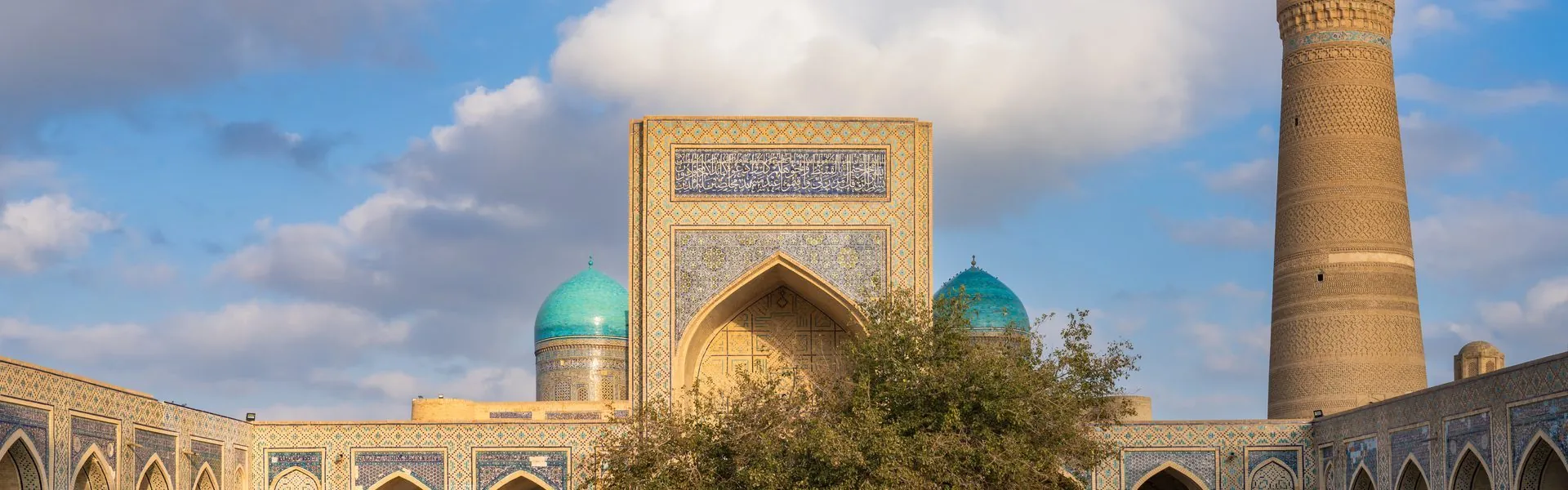
The heart of Islamic Bukhara: the Kalyan Minaret (47 m, 1127 — still standing 900 years later), the Kalyan Friday Mosque opposite (capacity 12,000), and the still-functioning 16th-century Mir-i-Arab Madrasa. Legend says Genghis Khan took off his helmet at the sight of the minaret — that impressed. You can wander the square slowly: every angle gives a new view, especially at sunset, when the brick glows copper
Getting there: 10 minutes on foot from Lyabi-Hauz through the trading domes
4. The Ark — emir's citadel
Length: ~2 km loop · Steps: ~5,500 · Profile: flat (a few steps inside)
The ancient fortress, the fortified node of Bukhara for almost two thousand years. Inside is now a museum: the throne room, ancient books, the emir's offices. Outside — massive sand-coloured walls and the Registan square looking onto Bolo-Hauz. Come here at sunrise: the first light turns the walls orange, the square is empty, and the medieval city feels real
Getting there: 15 minutes on foot from Lyabi-Hauz via Po-i-Kalyan
5. Bolo-Hauz and Chashma-Ayub
Length: ~2.5 km loop · Steps: ~7,500 · Profile: flat
Across the Registan square from the Ark stands the early-18th-century Bolo-Hauz mosque, with its famous gallery of 20 wooden columns (the reflection in the pond doubles them to "forty" — hence the local name). A bit further west — the Chashma-Ayub complex ("Job's Spring"), a 14th-century mausoleum with a conical roof and a small water museum next door. This is the western edge of the Old City, calmer and less crowded than Lyabi-Hauz
Getting there: 5 minutes on foot from the Ark
6. The main axis: Lyabi-Hauz to the Samanids
Length: ~3.5 km one way or ~7 km loop · Steps: ~10,000 loop · Profile: flat
Bukhara's most coherent one-day walk. Start at Lyabi-Hauz, pass through all three domes, the Kalyan Minaret, the Registan square and the Ark, on to Bolo-Hauz and Chashma-Ayub, and finish at the Samanid Mausoleum — the oldest monument in Central Asia (892–943 AD). A small fired-brick building inside a park, and behind that little building stands the entire history of the region. Return the same way or via the northern mahallas
Getting there: start at Lyabi-Hauz, finish at the Samanid Mausoleum in Samanids Park
7. Char Minar and Jubar mahalla
Length: ~2.8 km loop from Lyabi-Hauz · Steps: ~6,500 · Profile: flat
One of Bukhara's most unusual buildings: a small 1807 madrasa with four identical blue minarets at its corners, hidden in the eastern lanes of the Old City. To reach it you walk through the real residential Jubar mahalla — clay walls, wooden doors, kids playing nard. There are no souvenirs and no restaurants here, just real life. The best part of Bukhara if you've had enough of tourists
Getting there: 15 minutes on foot east of Lyabi-Hauz
8. Full circuit of the UNESCO core
Length: ~10 km loop · Steps: ~15,000 · Profile: flat
If you want to close the whole UNESCO site in a day, stitch it all together: the main axis plus Char Minar, the Zangiata and Faizabad caravanserais, the northern mahallas, the Sayfiddin Bokharzi mausoleum and the Faizabad khanaka. Don't follow a strict order — let yourself get lost in the lanes, come back to the same square twice. Allow 6–8 hours with tea breaks and plov stops
Getting there: any starting point in the Old City
Day trips by taxi — Bukhara's outskirts
9. Chor-Bakr — necropolis at Sumitan
Length: ~6 km on site · Steps: ~8,500 · Profile: almost flat
A 16th-century memorial-mosque complex 7 km west of Bukhara, near the village of Sumitan. Hundreds of mausoleums of the Juybari family, a mosque, a khanaka, a madrasa — all in sand colour, as if the desert is taking it back. There are ten times fewer tourists than in the centre, and you can walk for hours along the alleys between the tombs. A silence you rarely find anywhere else
Getting there: Yandex or InDrive taxi (15 min, ~25,000 sum). Local marshrutkas run, but rarely
10. Sitorai Mokhi-Khosa — the emir's residence
Length: ~2 km in the park and pavilions · Steps: ~5,500 round trip · Profile: flat
The summer palace of the last Bukharan emir, Alimkhan, built in the early 20th century, 5 km north of the centre. Architecturally unusual: Eastern tilework and carving inside, European columns and façades outside. A large park with peacocks and fountains, an ethnographic museum in the side pavilions. A good half-day option, especially with kids
Getting there: taxi (10 min, ~15,000 sum) or marshrutka №70
Seasons — what's when
Winter (December — February)
Bukhara's most underrated season. Daytime +5–10°C, soft sun, golden light on the sandy walls, almost no tourists, photos without crowds. What to do: plan whole days for walking. Damp fogs happen but burn off by midday. The big comfort is no heat at all — you can walk the entire day without a break
Spring (March — May)
The best time for Bukhara. Blooming gardens, soft +20–28°C, clean air after winter. What to do: aim for April–May — peak season for everything. By late May the heat already creeps toward +33; do Chor-Bakr and Sitorai Mokhi-Khosa in the morning
Summer (June — August)
The toughest season. +38–42°C, sometimes +45 in August. What to do: walk strictly before 9 a.m. and after 7 p.m. The trading domes (cool inside thanks to ancient architecture), the Lyabi-Hauz teahouses and bowls of green tea will save you. Between 11 and 18 — lunch, siesta, museum. In the evening the Old City wakes up: minaret lighting, fountains, crowds at Lyabi-Hauz
Autumn (September — November)
The second peak after spring. From mid-September the heat eases, and October brings a golden Bukhara with clean skies and cool evenings. What to do: hit October–November hard, walk a lot. By December days shrink to 9–10 hours, but that doesn't matter — the Old City is compact
What to bring — short checklist
- Water — at least a litre. 0.5 l per hour of walking in summer. Cafés along the way sell water but it's cheaper to take a bottle from your hotel
- A cap or hat. The Bukhara sun is brutal nine months of the year
- Sunscreen. SPF 50+ in summer is not optional — sand reflection is strong
- Comfortable trainers. Old City pavement is uneven in places; sandals will tire your feet fast
- Light scarf or shawl. Useful against the sun and for entering active mosques — Mir-i-Arab won't admit anyone with an uncovered head
- Cash in sum. Small teahouses and craft shops in the trading domes don't always take cards
- Charged phone with offline maps. Maps.me or Google Offline — the Old City is a labyrinth and GPS doesn't reach everywhere
The bottom line
- Bukhara is the most compact walking city in Central Asia: the entire UNESCO core fits inside a 1.5 km radius
- The main axis — Lyabi-Hauz → Po-i-Kalyan → Ark → Samanids: a 7 km loop, 10,000 steps, 1,100 years of history in a day
- The most "real" route — Char Minar and Jubar mahalla: residential Old City without tourists
- The longest — full UNESCO circuit: 15,000 steps, 6–8 hours with stops
- You can't walk anywhere out of Bukhara: Chor-Bakr and Sitorai Mokhi-Khosa need a taxi, but both are worth the trip
- The real enemies are summer heat and midday sun; everything else (terrain, smog, transport) isn't an issue here
- Seasonality matters: best months are March–May and October–November; in summer only mornings and evenings; winter is underrated
The rule is simple: in Bukhara you don't need to look for "where to go" — wherever you go, you walk into history. Know five or six tested loops and one weather app, and you can walk 10,000 steps through two and a half thousand years almost year-round. Qozgal will count every step — no subscriptions, no ads, no pointless numbers

Count steps for free
Download Qozgal — an accurate step counter through Apple Health and Health Connect, with no subscriptions and no ads