Quick version, if you're in a hurry
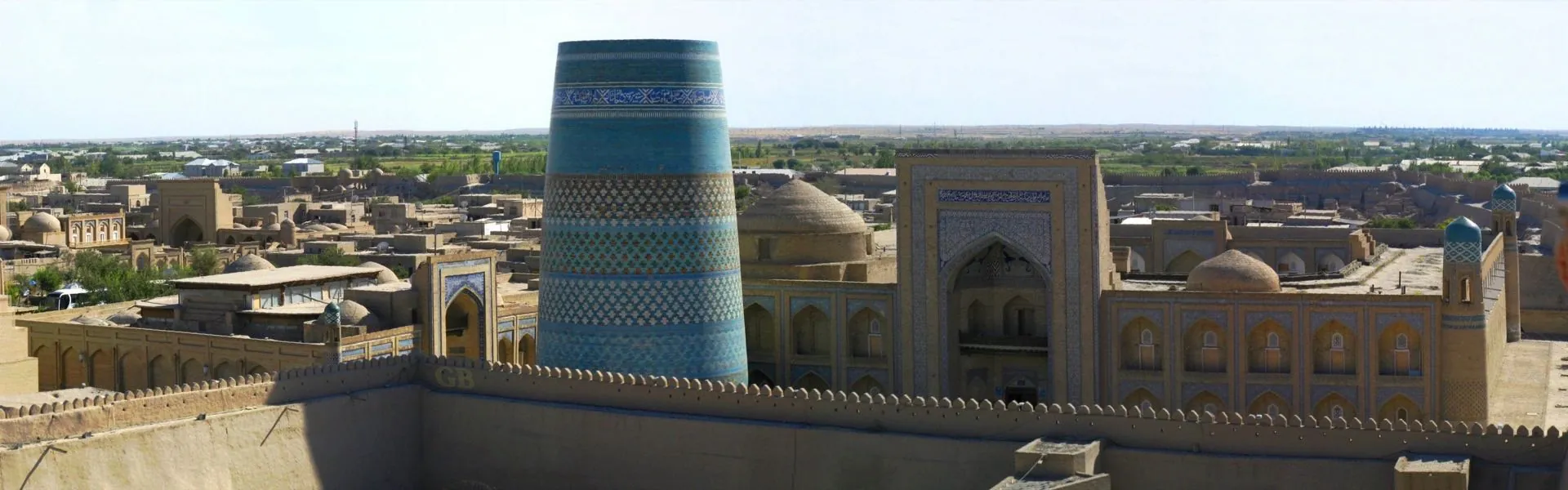
Khiva is the strangest city in Uzbekistan: it's essentially an open-air museum that happens to be inhabited. The main object is Itchan Kala, the inner walled fortress, 650×400 metres in size. Inside the walls: 60 monuments, four main gates, a handful of madrasas and minarets. Outside: Dishan Kala, an ordinary modern town with a bazaar and apartment blocks. Tourist logic is simple: one day in Itchan Kala, half a day in Dishan Kala
Basic rule: the sun is your main enemy. Khorezm is the hottest region of Uzbekistan: summer days hit +40 to +45°C, there is almost no shade, and clay walls turn into radiators by noon. Walk before 9:00 AM and after 7:00 PM. In shoulder seasons (April–May, October) midday is also fine
Pick a route for yourself
Route picker — by steps and effort
First, check the heat and the sun
Khiva has two seasonal extremes: summer brings +40 to +45°C and dust (the "garmsil" wind from the Kyzylkum), winter is mild frost around −5°C with occasional dry winds. Before any walk, know:
- Weather forecast — windy.com or AccuWeather. Especially the "feels-like" temperature and UV index. In summer Khorezm regularly hits UV 9–11 — the "extreme" category
- Sunrise and sunset times — your main reference. In summer the sun clears the fortress walls around 6 AM; until 9 there's still plenty of shade in Itchan Kala
- Museum hours — most monuments inside Itchan Kala are open 9:00–18:00, but the streets are open 24/7. The city is beautifully lit at night
What UV numbers mean: 0–2 safe, 3–5 sunscreen needed, 6–7 sunscreen + cap, 8–10 stay in shade if possible, 11+ — that's Khiva at noon in summer: long sleeves, broad-brim hat, sunglasses, SPF 50
Itchan Kala — inside the walls
1. Kunya-Ark
Length: ~0.8 km loop inside · Steps: ~2,000 with stops · Starting elevation: 100 m above sea level (Khiva is essentially flat)
The main citadel of the Khans of Khiva, in the western part of Itchan Kala by the Ata-Darvaza gate. It's a "fortress within a fortress" dating to the 12th century. Inside: a throne hall with turquoise tiles, mint, harem, mosque, zindan-prison. For an extra ticket you can climb a narrow staircase to the rooftop — best view of Kalta-Minor and the entire old city
How to get there: any Itchan Kala entry, but easiest via Ata-Darvaza, then immediately to the left
2. Kalta-Minor + Muhammad Amin-Khan madrasa
Length: ~0.5 km · Steps: ~2,500 with photo stops · Profile: flat
The most recognisable minaret in Central Asia — blue, fat, cut off at the top. 29 m tall, base diameter 14 m. It was supposed to become the tallest minaret in the Islamic world (planned at 80 m), but construction stopped when the Khan died in 1855. Right next to it is Khiva's largest madrasa with 125 cells — now home to a hotel and restaurant
How to get there: right inside the Ata-Darvaza gate, you can't miss it
3. Juma Mosque
Length: ~0.2 km inside · Steps: ~3,000 from gate and back
10th century, rebuilt in the 18th. The most unusual mosque in Central Asia: instead of a dome, a flat ceiling resting on 218 carved elm columns. Each column is unique, some are nearly a thousand years old (brought from older ruined mosques). Inside: dim light, cool air, distinctive acoustics. Small entry fee
How to get there: central part of Itchan Kala, between Kunya-Ark and Tash-Hauli
4. Tash-Hauli (Stone Yard)
Length: ~0.6 km loop inside · Steps: ~3,500 from gate
The 1830s palace of Allah-Kuli-Khan in the eastern part of Itchan Kala. Three courtyards: summer (reception), winter (throne) and harem. The most beautiful ceilings and carved wooden columns in Khiva. Every chamber covered in turquoise and white majolica — without exaggeration, the best place in town for slow walking and photos
How to get there: eastern part of Itchan Kala, near Palvan-Darvaza
5. Islam-Khoja Minaret
Length: ~0.3 km · Steps: ~4,000 with climb up and down · Minaret height: 57 m (118 steps inside)
The tallest minaret in Khiva (1908) and one of the tallest 20th-century structures in Central Asia. You can climb the narrow spiral staircase for an extra ticket. The staircase is dark, the steps uneven — phone torch is mandatory. The reward is the best panorama of Itchan Kala and the Kyzylkum Desert on the horizon. Not for claustrophobics
How to get there: southern part of Itchan Kala, next to the Islam-Khoja madrasa
6. The main axis: Ata-Darvaza to Palvan-Darvaza
Length: ~3 km loop with detours · Steps: ~8,000 · Profile: nearly flat
Khiva's classic tourist route. Start at the western Ata-Darvaza, pass Kalta-Minor → Kunya-Ark → Muhammad Amin-Khan madrasa → Juma Mosque → Islam-Khoja → Tash-Hauli → exit through the eastern Palvan-Darvaza. All major Itchan Kala monuments in one walk. With museums it takes 4–5 hours
How to get there: entry via Ata-Darvaza, single combined day ticket
Walls and gates
7. Inside perimeter of Itchan Kala walls
Length: ~2.2 km full loop · Steps: ~4,000 · Profile: flat
The route most tourists skip. You walk along the inside of the fortress walls through narrow streets, past mahallas (residential blocks inside Itchan Kala — yes, people still live there). Quieter, no crowds, you see the back side of the city: clay houses, courtyards, goats, locals' teahouses. Especially atmospheric at sunrise or sunset
Downside: some streets are dead ends, you'll need basic navigation
8. All four gates along the outside of the walls
Length: ~3.8 km loop · Steps: ~6,000 · Profile: flat
Walk around Itchan Kala from outside. There are four main gates: Ata-Darvaza (west, main entry), Palvan-Darvaza (east, towards the trade rows), Tosh-Darvaza (south) and Bagcha-Darvaza (north). Each gate is a separate architectural complex. From outside you see the full height of the fortifications — 8 to 10 metres of clay, 14 centuries old. The best way to feel the scale of the fortress
How to get there: start from any gate, easiest from Ata-Darvaza
Dishan Kala — the outer city
9. Nurullabay Palace and bazaar
Length: ~3 km loop · Steps: ~7,000 with bazaar · Profile: flat
Outside Itchan Kala, ordinary modern Khiva begins. The main spots: Nurullabay Palace (a country residence of Muhammad Rahim-Khan II from the early 20th century) with European interiors and a carpet collection; and the local artisan bazaar where they carve wood, felt hats and sell Khivan suzanis. The contrast with the museum inside the walls is sharp — and useful
How to get there: 15-minute walk west from Ata-Darvaza
10. Big loop: Itchan Kala + Dishan Kala
Length: ~9 km loop with detours · Steps: ~14,000 · Profile: flat
Full Khiva coverage in one go. Start at Ata-Darvaza, walk the main axis of Itchan Kala, exit through Palvan-Darvaza, circle the walls outside, enter Dishan Kala, hit the bazaar and Nurullabay, then return. This is essentially a full trekking day — plan 6–7 hours including lunch and museums. Only do this in the morning or in spring — a marathon like this in summer afternoon is dangerous
How to get there: start from any gate; finish the same place
Seasons — when to come
Winter (December–February)
Khorezm is desert, winters are cold and dry, nights down to −10°C, days around 0…+5. Snow is rare but the wind is sharp. What to do: winter is when Khiva empties of tourists — best time for slow walking and photos without crowds. Museums are open, hotels 2–3× cheaper. Layer up, the wind from the Kyzylkum cuts through
Spring (March–May)
Best season for Khiva. Desert blooms with tulips in March, April brings +20–28°C and clear skies, by May it's already pushing +30. What to do: chase April — peak season. You can walk all day without overheating, light is plentiful, photos turn out vivid. By late May the heat gets serious
Summer (June–August)
The main challenge. +40 to +45°C, nights not below +25, occasional dust storms. What to do: walk only before 9 AM or after 7 PM. At noon — in a museum, a teahouse, or an air-conditioned hotel. At sunset Itchan Kala turns honey-coloured — those are the best 30 minutes of the day. Carry a litre of water per hour of walking
Autumn (September–November)
Second peak after spring. September is still hot (+30 to +35), October is ideal (+15 to +25), November already cool. What to do: October is the best compromise between weather and clear skies. Fewer tourists than April, lower prices. By November the wind from the desert kicks in
What to bring — short checklist
- Water — lots. 1 litre per hour of walking in summer; at least a bottle even in winter — the air is bone-dry
- Broad-brim hat. A baseball cap doesn't cover the neck — in Khiva that matters
- SPF 50 sunscreen. UV in summer regularly hits 11+ — the "extreme" category
- Sunglasses. Against sand and sun, especially in wind
- A warm layer in winter and spring. Day/night swing in the desert can be 20°C
- Comfortable trainers. Itchan Kala stones have been polished for 14 centuries — they're slippery
- Phone torch. For climbing the Islam-Khoja minaret — staircase is dark
- Wet wipes. Dust, sand, +45°C — they help any time
The takeaway
- Honest hierarchy of routes in Khiva: Itchan Kala > walls and gates > Dishan Kala. The main thing is inside the walls
- Main enemy — summer sun: walk before 9 AM and after 7 PM, or come in spring/autumn
- Most recognisable monuments — Kalta-Minor and Kunya-Ark: just inside Ata-Darvaza
- Tallest — Islam-Khoja minaret: ~57 m, climbable via 118 steps
- Most unusual — Juma Mosque: 218 carved wooden columns, 10th century
- Most beautiful interior — Tash-Hauli: turquoise majolica and carved ceilings
- Seasons matter: best time — April and October; in summer, only mornings and evenings
Simple rule: in Khiva you can't just "walk however" — too hot and too many monuments. But once you know the Ata-Darvaza → Palvan-Darvaza axis, the museum hours, and the time of day, walking 10,000 steps inside an open-air UNESCO museum is one of the best things that can happen to a tourist in Uzbekistan. Qozgal counts every step — no subscriptions, no ads, no extra numbers

Count steps for free
Download Qozgal — accurate step counter via Apple Health and Health Connect, no subscriptions, no ads