Short version, if you're in a hurry
Nukus is a compact, flat city in the far northwest of Uzbekistan, capital of autonomous Karakalpakstan. The walking logic comes down to two limits: sun and dust. From May through September, asphalt hits +50°C in the daytime, and salt-laden dust storms from the dried Aral seabed (Aralkum) can roll in without warning. On the other side: the city is small. You can cover the entire centre in a couple of hours
The basic rule: plan short routes inside the city through parks and culture; for anything bigger, head to the surroundings. Inside Nukus, 8,000–10,000 steps come together easily as a loop of parks plus the museum. Mizdakhan, Chilpik and especially Muynak with its ship cemetery are separate half-day or full-day trips
Pick a route
Match a route by steps and effort
Check the air and the temperature first
The seasonal hazard in Nukus isn't smog — it's salt-laden dust storms. When the wind picks up dust from the dried Aral seabed, it carries old fertiliser and pesticide residues from former cotton fields. Studies show these salt storms can spike fine particles tenfold and are the main driver of respiratory disease in the region. Before heading out, check:
- IQAir / AirVisual — app and website that aggregate global sensors. Coverage in Nukus is thin, but you'll get a baseline PM2.5 reading
- uzhydromet.uz — official Uzhydromet, weather and dust-storm forecasts
- Windy.com — for wind and dust forecasts. You can see when a storm is rolling in from the northwest
What the PM2.5 numbers mean (μg/m³): 0–12 clean, 13–35 acceptable, 36–55 short walk OK, 56+ stay indoors — especially kids and the elderly. In a real dust storm the value can blow past 200
Temperature: summer days hit +40–45°C — serious effort is risky. Winter can drop to −15°C with desert wind that strips your face. Plan: 0.5 L of water per walking hour in summer, and a real warm jacket in winter
City routes — compact, flat Nukus
1. Berdakh Park
Length: ~1.5 km big loop · Steps: ~2,500 · Profile: almost flat
The main city park, named after Berdakh — a 19th-century Karakalpak poet considered the founder of national literature. Shaded acacia and plane-tree paths, central fountain, benches and small monuments. Pensioners play chess on weekdays; families take over on weekends. Perfect for a short morning or evening walk
Getting there: dead centre, walkable from any downtown point
2. Pakhlavan Mahmud Park
Length: ~1.5 km full loop · Steps: ~3,000 · Profile: flat
Smaller and quieter than Berdakh Park, in the blocks west of the centre. Named after the 14th-century Khwarezmian mystic-poet. Old mulberry and acacia trees throw heavy shade even at midday — a lifesaver in +40°C. Locals come here to read, play backgammon and drink tea at the chaikhana by the entrance
Getting there: Doslyk Street area, taxi 5 minutes from downtown, marshrutkas along Doslyk
3. Savitsky Museum and the square
Length: ~1.8 km walking loop · Steps: ~4,000 · Profile: flat
Nukus's main global draw. The State Museum of Arts of Karakalpakstan named after I. V. Savitsky holds a unique collection of Russian and Central Asian avant-garde from the 1920s–1930s, assembled by artist and archaeologist Igor Savitsky, who in the 1960s–80s rescued thousands of banned canvases from destruction. The square in front is flat and open, ringed by administrative buildings and fountains
Heads-up: the museum itself takes at least 2 hours inside — budget a half-day for the full route
Getting there: central Nukus, walking distance from Berdakh Square
4. First President Park
Length: ~2 km big loop · Steps: ~4,500 · Profile: almost flat
Modern formal park, opened in the 2010s. Straight avenues, smooth lawn, fountains and conifer plantings. A flat, smooth path that's good for stroller walks or after-work strolls. Downside: the trees are still young, shade is thin, and summer noon will burn you. Best before 8 a.m. or after 6 p.m.
Getting there: northeast of the centre, walk from Berdakh Square or 3-minute taxi
5. Nukus Park (Central City Park)
Length: ~3 km big loop · Steps: ~5,500 · Profile: flat
Classic Soviet-era park of culture and rest — the home format for Nukus residents. Rides, a Ferris wheel, paths under mature plane trees and poplars. Air is measurably cleaner than on neighbouring streets thanks to the canopy. In the evening, kiosks, cotton candy and local kids on BMX bikes. Easy with families
Getting there: A. Navoi Street, downtown marshrutkas, 15 minutes on foot from the Savitsky Museum
6. Karakalpak Theatre and the Soviet centre
Length: ~2.5 km loop · Steps: ~6,000 · Profile: flat
An architecture walk. The Berdakh Karakalpak State Music Theatre is a 1970s modernist building. From there it's the Friendship of Peoples Square, the central department store, the former House of Political Education. This is Nukus as a Soviet administrative city, planned from scratch on flat steppe. Along the way, the memorial to victims of the Aral tragedy
Getting there: start at Berdakh Square, all of it walkable
7. Centre → Savitsky → Berdakh Park loop
Length: ~5.5 km loop · Steps: ~8,000 · Profile: flat
The best one-loop daytime route. Start at Berdakh Park, cross the square to the Savitsky Museum (give it 2 hours), walk through the Soviet centre past the Karakalpak Theatre, swing through First President Park, return. Almost every key spot in the city, plus cafés and a chaikhana. 8,000 steps without noticing
Getting there: walk from any downtown hotel
8. Amu Darya embankment
Length: ~6 km one way · Steps: ~9,000 · Profile: almost flat
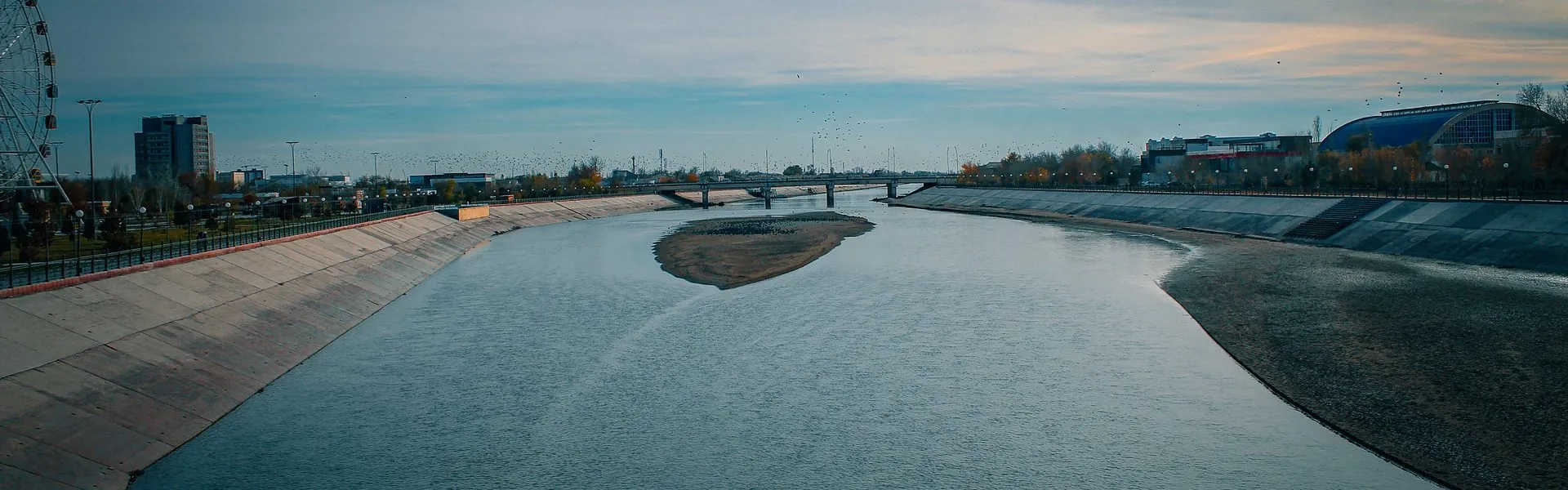
To get out of town, head west to the bridge over the Amu Darya. The great Central Asian river is wide and muddy-gold here, with reed beds, sandbars and the occasional fisherman. Open wind, low sky, real field feeling. The bank isn't fully developed in places — wear trainers, not sandals. Mosquitoes in summer at sunset
Getting there: taxi to the Amu Darya bridge (10–15 min from centre), or marshrutkas towards Khodjeyli — get off at the bridge
Out of town — necropolises, desert, the memory of the Aral
9. Mizdakhan — three-hill necropolis
Length: ~5–7 km across the site · Steps: ~11,000 · Profile: 60 m relief
25 km west of Nukus, near Khodjeyli — a sacred 12th–14th-century complex, one of Central Asia's most important archaeological sites. Three hills: one holds the Mazlumkhan-Sulu mausoleum with an underground burial chamber; another, Gyaur-kala fortress from the 1st century; the third, the symbolic «doomsday clock» (legend says one brick falls every year, and when the last one falls the world ends). The route runs between hills, with climbs and views over the plain
Getting there: round-trip taxi from Nukus with waiting — 150,000–200,000 sum, ~30 min drive. Or marshrutkas to Khodjeyli from the bus station, then local taxi
10. Chilpik-kala (Chilpik dakhma)
Length: ~3 km climb + summit loop · Steps: ~7,000 · Profile: 35 m relief
43 km south of Nukus, on the road to Bukhara — a lone hill crowned with a ring of ancient walls. Chilpik-kala is a Zoroastrian tower of silence from the 1st–4th centuries AD, where bodies of the dead were exposed for vultures, with cleaned bones later buried in ossuaries. The climb takes 15–20 minutes; the summit gives you wind, the wall ring and a sweeping view over the Amu Darya valley. Short walk, but a place that hits hard
Getting there: car or taxi only — 50 minutes from Nukus. Often combined with Ayaz-kala and Toprak-kala on tours
11. Muynak — ship cemetery and Aralkum
Length: ~8–12 km across former seabed · Steps: ~22,000 · Profile: almost flat
The most emotional route in the region. A former Aral fishing port — once a Soviet town with a cannery and beaches. Now the water is 100+ km away and the sand holds rusting ship hulls as monuments to the ecological catastrophe. Aral museum, memorial to victims, edge of the Aralkum desert. A full-day trip from Nukus (or overnight in a yurt camp)
Getting there: 200 km north, organised tour or taxi — 4 hours one way. Day tours from Nukus from 30 USD per person; with overnight, from 80
Seasons — what to do when
Winter (December — February)
Cold and dry: −5 to −15°C, often strong desert wind. Snow is rare; usually it's bare frozen ground. What to do: bundle up and walk in short bursts. Parks and the centre are open; the Savitsky Museum is the perfect long «indoor route». Mizdakhan and Chilpik are especially atmospheric in winter — empty, windy, no tourists
Spring (March — May)
The best time of year in Nukus. Tulip blooms in the steppe, +15–28°C, relatively little dust. What to do: April is peak for everything around the city. Mizdakhan, Chilpik, Ayaz-kala and Toprak-kala. By late May the heat already pushes +40 and dust-storm season starts
Summer (June — August)
The big seasonal challenge. +40–45°C in the day, never below +25 at night. Aralkum dust storms with no warning. What to do: walk strictly before 8 a.m. or after 7 p.m. The shaded parks (Berdakh, Pakhlavan Mahmud) and the air-conditioned Savitsky Museum become the best «escape from heat while seeing the world». For surroundings — mornings only, plenty of water
Autumn (September — November)
The second peak after spring. Heat backs off from mid-September; October brings a soft autumn with golden mulberries in the parks. What to do: grab October–November, take long trips (Muynak, Ayaz-kala). By late November the first cold and sharp winds arrive
What to bring — short checklist
- Water — a lot. 0.5–1 L per walking hour in summer; at least 0.5 L in winter
- Cap or scarf. The Nukus sun is brutal 9 months a year, plus dusty wind
- Sunscreen. SPF 30+ on face and hands in summer — non-negotiable
- Warm layer. Mornings around the city and winter evenings drop fast
- Trainers or hiking shoes. Sandals don't work at Mizdakhan or Chilpik — sharp rocks, dust
- Mask or buff in case of a dust storm — a must in spring and summer
- Charged phone and offline maps. Coverage thins out near Muynak
Bottom line
- Nukus is compact and flat: you can cross the centre in a couple of hours, no climbs, distances are minimal
- The real enemies are sun and Aralkum dust storms, not elevation. Plan for weather and season
- The main city anchor is the Savitsky Museum — one visit shapes your day and saves you from the heat
- Best parks: Berdakh and Pakhlavan Mahmud — shade, benches, water
- Longest urban route: centre → Savitsky → parks loop, 8,000 steps in one go
- Strongest day trips: Mizdakhan, Chilpik and Muynak — history, desert, the memory of the Aral
- Seasons matter: best months are April and October; in summer, only mornings and the museum; in winter, short bursts
The rule is simple: in Nukus you can't just «walk however» — the weather and dust don't forgive, and the city ends fast. But know five or six trusted spots and a couple of apps, and you can walk 8,000–10,000 steps comfortably year-round. Qozgal counts every step — no subscriptions, no ads, no clutter
Count steps for free
Download Qozgal — accurate step counter via Apple Health and Health Connect, no subscriptions, no ads