Short version, if you're in a hurry
Samarkand is an unusual city to walk in. On one hand, the historic centre is a pedestrian's dream: compact (3–4 km in radius), dense in content, mostly car-free. On the other, it has two seasonal quirks that change everything: in summer +35–40°C and almost no shade on the main squares, in winter +5–10°C and a dusty wind off the Zarafshan valley. And above all — every walk here isn't just steps, it's a route through seven centuries
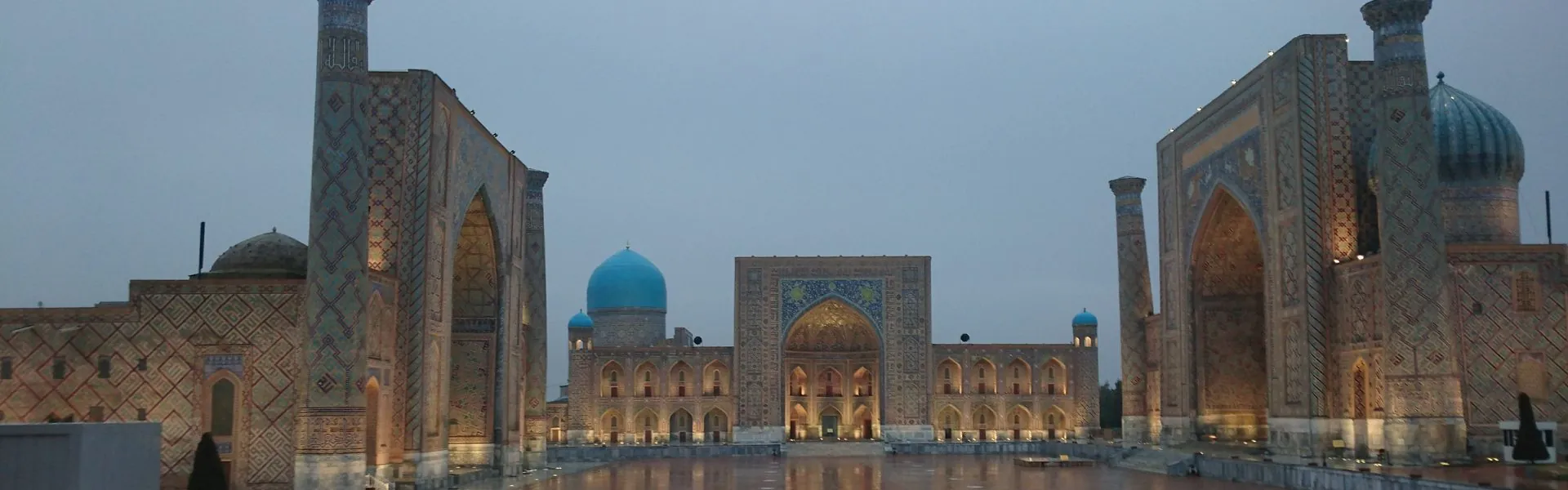
The basic rule: walk the historic core in the morning or evening; save the new complexes (Eternal City, Siab embankment) for sunset for the lighting. At noon in July there's no point standing in front of the Registan — the blue tiles reflect light like a mirror and shadow under the madrasahs is short. By evening though, the place is magic: lighting from 7 p.m., laser show, real coolness
Pick a route
Match a route by steps and effort
First — about timing and temperature
In Samarkand the main factor isn't air, it's sun and shade. There are no high mountains nearby, no inversion, not much industry — PM2.5 sits in the green band most of the time. But in summer the blue madrasah tile under direct sun is genuinely blinding, and there's almost no shade by the monuments themselves
- Summer (June–August): +35–40°C, clear skies, brutal UV. Walk before 9 a.m. and after 6 p.m. Noon is for cafés, chaikhanas, museums
- Winter (December–February): +0…+8°C, occasional snow and dusty wind. Days are short — dark by 5 p.m. Best window is 11 a.m. to 3 p.m.
- Spring (March–May): the perfect season. Apricot and magnolia in bloom, +18–25°C, everything open. 15,000-step routes are realistic in a single day
- Autumn (September–November): the second peak. Grapes ripen, markets are full, +15–25°C. Through late October — the golden window
Useful apps: Yandex.Maps and 2GIS both work well in Samarkand and have offline modes. For air and weather use Windy.com. Most museum tickets are sold on the spot, and weekday queues are basically nonexistent
The heart of the city — the big four
1. Registan
Length: ~750 m big loop around the square · Steps: ~2,500 on site · Profile: flat
Samarkand's main square and one of the world's most famous architectural ensembles: three madrasahs around an open plaza — Ulugh Beg (1420), Sher-Dor (1636), Tilla-Kari (1660). Blue domes, the gold interior of Tilla-Kari mosque, the symmetry of the portals. The loop itself is short, but go inside all three — interior courtyards house artisan stalls and one minaret can be climbed (extra fee). Best time is early morning (shadows and emptiness) or evening with the lighting and laser show
Getting there: dead centre. From any neighbourhood, Yandex.Go takes 10–15 minutes; or 10 minutes on foot from Gur-Emir
2. Bibi-Khanym
Length: ~1 km big loop including the bazaar · Steps: ~3,500 · Profile: flat
Tamerlane's congregational mosque — the largest in 15th-century Central Asia (40-metre dome). Long ruined after earthquakes, restored in late Soviet times. Right next door is Siab Bazaar, the city's main living market: spices, lavash, dried fruit, copperware, skullcaps. Don't skip it — this is real Samarkand, not a tourist set
Getting there: 1 km from Registan along Tashkent Street, 15 minutes on foot
3. Shah-i-Zinda
Length: ~600 m corridor on site · Steps: ~2,000 on site, ~6,000 return from Registan · Profile: slight climb
The avenue of mausoleums — a staircase up a hill flanked by 14th–15th century tombs. Every portal is its own work: majolica, lacework carving, colour deepest at sunrise. Legend says the person who counts the same number of steps going up and down receives celestial forgiveness. The staircase itself is short — the walk is long because of the climb from the centre
Getting there: 700 m on foot from Bibi-Khanym, or Yandex.Go from Registan in 5 minutes
4. Gur-Emir
Length: ~500 m around the complex · Steps: ~1,500 on site, ~3,500 with mahalla loop · Profile: flat
The mausoleum of Tamerlane and his descendants — compact but the most refined ensemble in town. Gold ceiling inside, jade tombstone over Timur himself. Worth a visit right after Registan — it's only 10 minutes away on foot, and worth comparing the tile. Just behind it, residential mahallas begin: low mud-brick houses, narrow lanes, silence. You can lose an hour here easily
Getting there: 700 m from Registan along Registan Street, 10 minutes on foot
Routes further from the centre
5. Ulugh Beg Observatory + Afrosiab
Length: ~7 km loop · Steps: ~11,000 return from the centre · Profile: small hill
On the northern edge — Kuhak hill with the 15th-century observatory where Ulugh Beg compiled his star catalogue. The underground sextant fragment (40 m long) and a small museum survive. Right next to it lies the Afrosiab citadel, ancient Samarkand from the 7th century BCE, destroyed by Genghis Khan. You can walk the hills; the museum holds original 7th-century Sogdian frescoes. Long route, partly shaded — there are trees on the boulevard from the centre
Getting there: bus 66 or 99 from the centre to "Afrosiab" stop (15 min), or taxi for 6,000–8,000 sum
6. Hazrat Khizr + Bibi-Khanym (quiet morning loop)
Length: ~2.5 km · Steps: ~6,000 from Registan · Profile: flat
Hazrat Khizr is Samarkand's oldest functioning mosque, perched on the hill above Siab Bazaar. Open mornings only (5–11 and after 2 p.m.); modest dress required. The terrace gives you views of the Bibi-Khanym and Shah-i-Zinda domes. Right beside it stands the mausoleum of Islam Karimov, Uzbekistan's first president. Perfect early-morning loop — empty, cool, photographs come out otherworldly
Getting there: 1.2 km on foot from Registan, or taxi in 5 min
7. Eternal City (Silk Road Samarkand)
Length: ~3 km inside complex + access · Steps: ~7,500 loop · Profile: flat
A new tourist complex on the western edge of the city, by the Congress Hall and the international-chain hotels. It's a themed park-street built in the style of the ancient Silk Road: artisan workshops (ceramics, paper, copper engraving), Uzbek and Central Asian restaurants, fountains, an amphitheatre with shows. Especially atmospheric in the evening when the lighting comes on. Locals are mixed on it (it's manufactured); tourists love it — your call, but if you're in Samarkand, go once
Getting there: Yandex.Go from Registan in 15 min, ~25,000–30,000 sum; or buses 26 and 73
8. University Boulevard
Length: ~6 km return · Steps: ~12,000 loop · Profile: flat
Samarkand's main modern boulevard — a wide green avenue from Alisher Navoi Square to Samarkand State University. This isn't tourist Samarkand, it's the living city: students, cafés, second-hand bookshops, a fountain in the park, trolleybuses (yes, Samarkand still runs trolleybuses — the only city in Uzbekistan that does). Perfect for an evening walk and for understanding how the city actually breathes
Getting there: bus 3 or 22 from the centre to Alisher Navoi Square, 10 min
9. The Russian Quarter
Length: ~4 km loop · Steps: ~9,000 from the centre · Profile: flat
The 19th-century blocks between Mahmud Kashgari and Tashkent streets — a legacy of the Turkestan Governorate-General era. Low buildings with balconies, the former real school, a church, Soviet constructivist buildings. A completely different Samarkand — quieter, with European facades and old plane trees. Easy to combine with Ulugh Beg Observatory
Getting there: 2 km north on foot from Registan, or bus 3 to "Bulvar" stop
A proper day trip
10. Konigil — the paper mill village
Length: ~12 km one way + walking in the village · Steps: ~18,000 over the day · Profile: small ascent
12 km north-east of Samarkand, on the bank of the Siab river — Konigil, where traditional silk-paper-making from mulberry bark survives. You can watch the whole process from soaking to drying, and even try making a sheet yourself. There's a working watermill, a garden, a chaikhana. Perfect for a day out of the city: silence, water, vineyards. On the way you pass the wheat fields of the Zarafshan valley
Getting there: Yandex.Go one-way ~50,000–70,000 sum — best to negotiate with the driver to wait. Or a "Damas" minivan from Siab Bazaar to Konigil; ask locals
Seasonality — what works when
Winter (December–February)
Samarkand in winter is half-empty — fewer tourists, no museum queues. Snow falls occasionally, and Registan tile capped with white is genuinely poetic. The downside is short days and dusty wind off the valley. What to do: walk between 11 and 3, warm up in chaikhanas, mandatory warm jacket and scarf
Spring (March–May)
The best time of year. Everything blooms: apricot in March, magnolia and tulips in April, roses in May. +18–25°C, little rain. Crowds at Registan are still light, and you can have Shah-i-Zinda's domes practically to yourself. What to do: aim for April — the sweet spot between March's chill and May's incoming heat
Summer (June–August)
Heat. +35–40°C in direct sun, with tile and stone holding the heat even longer. The main squares offer no shade — Registan, Bibi-Khanym, Shah-i-Zinda were not built with sunburn in mind. What to do: serious walks 6–9 a.m. and after 6 p.m. only. Daytime is for museums, lunch in shade, rest. Travel in summer only if you can handle a strict schedule, or if you're heading to the Aman-Kutan mountains
Autumn (September–November)
The second peak. October especially — grapes ripe at the bazaar, leaves yellow, +15–25°C. November gets dark early but daytimes are still warm. What to do: chase October — it's the freshest weather for long routes like Konigil or the grand historic loop
What to bring — short checklist
- Water. 0.5 L per walking hour in summer. Always for the historic centre
- Hat or cap. Samarkand's noon sun bounces off tile and into your eyes
- Sunscreen. SPF 30+ on face and hands, especially April–October
- Comfortable, modest clothes. You can only enter mosques and madrasahs in clothes covering shoulders and knees. Headscarf for women
- Cash in sum. Cards aren't accepted everywhere at the bazaar or in chaikhanas
- Trainers or closed shoes. Sandals and flip-flops over 10,000 steps of tile become torture
- Charged phone with offline map. Yandex.Maps works, but GPS occasionally drops inside museums
Bottom line
- Samarkand's historic centre is compact — 3–4 km radius. You can walk all the major sites in a single day
- The classic route — Registan → Bibi-Khanym → Shah-i-Zinda → Gur-Emir, about 8,500 steps
- The longest urban route — the grand loop including Afrosiab, 16,000 steps
- The longest day-trip — Konigil, 18,000 steps and a day by the water
- The most "modern" — Eternal City (Silk Road Samarkand): a new themed complex on the western edge
- Best season — April–May and October; in summer, walk only morning and evening
- Inside monuments: modest dress; women bring a headscarf
The rule is simple: you can't really walk Samarkand at random — there's too much you can't walk past. But if you know five or six tested routes and split them by time of day and season, walking 10,000 steps in a seven-century-old city is realistic year-round. And Qozgal will count every step — no subscriptions, no ads, no extra numbers

Count steps for free
Download Qozgal — an accurate step counter via Apple Health and Health Connect, no subscriptions and no ads