Short version, if you're in a hurry
Termez is a border city on the Amu Darya, the southernmost point of Uzbekistan. The Afghan shore is visible from any rise in the ground. The enemy of walking here is the sun: summer brings a steady +42–48°C, asphalt heats up to the point your shoe soles start to soften. The plan revolves not around a map but around the time of day: April through October, walks happen only before 8 a.m. or after 7 p.m. — at noon the city is literally empty
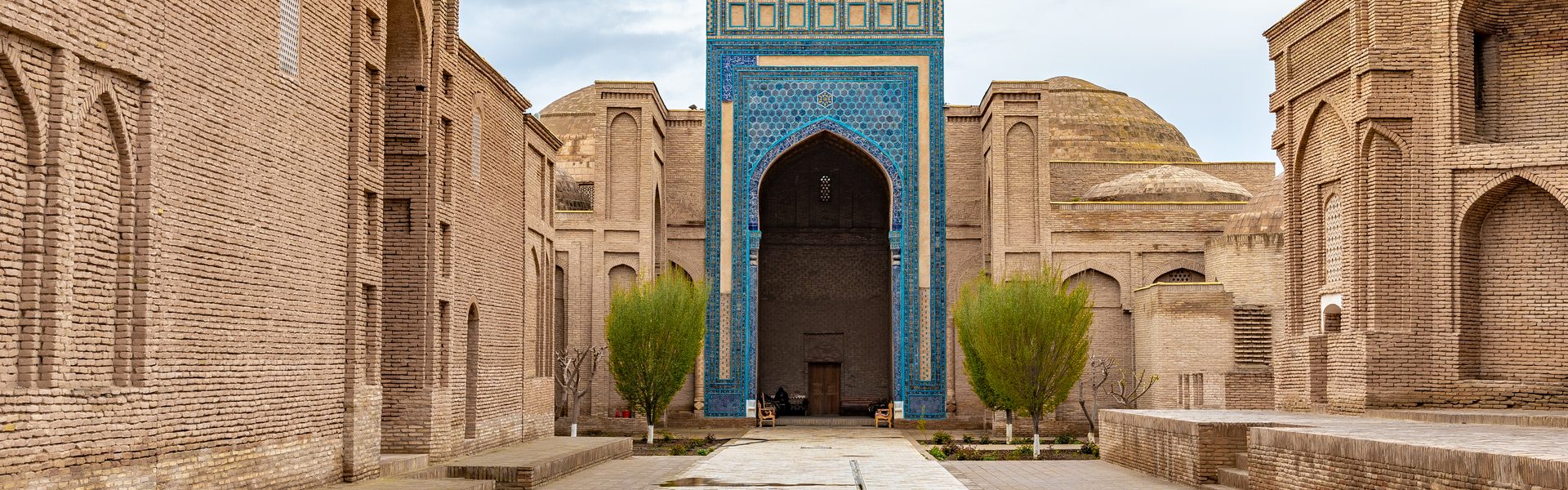
In return, Termez is the only place in the country where Buddhist and Muslim heritage sit side by side. You can spend the morning walking through the 2,000-year-old monasteries of Fayaz Tepa and Kara Tepa (UNESCO-grade material, just without the marketing) and the evening among the medieval mausoleums of Sultan Saodat and Hakim al-Termizi. In between: city walks along the new embankment and the First President Park
Pick a route
Match a route by steps and effort
Check the heat and the wind first
Termez has no smog — there's no real industry, no household heating in winter, no million-car traffic. There are two real problems instead: summer heat and desert dust storms (the so-called «afghanets» — a hot, dusty stream blowing in from across the Amu Darya). Before heading out, check:
- IQAir / AirVisual — PM2.5 is normally low here, but the «afghanets» wind spikes it sharply because of dust. The colour indicator is honest
- uzhydromet.uz — the official Uzhydromet. Temperature and wind forecast, updated twice daily
- Windy.com — for the wind forecast. A southwest wind brings dust from the Karakum; a northeast wind brings relatively clean mountain air
What the heat numbers mean: up to +30°C — walk almost all day; +30–35°C — mornings and evenings only; +35–40°C — strictly before 8 a.m. or after 8 p.m.; +40°C and above — long walks are dangerous without preparation, plan dawn outings and one litre of water per hour
Winter (December — February) is Uzbekistan's gentlest weather: +5–15°C in the day, almost no rain. You can walk all day; the only catch is the cutting river wind — bring a windbreaker, especially for the embankment
City routes — where Termez actually walks
1. First President Park
Length: ~1.2 km big loop · Steps: ~2,500 · Profile: flat
Termez's main city park, dead centre. Shaded avenues, fountains, a Ferris wheel and a small lake. The densest concentration of mature trees in the city — noticeably cooler than the streets around it in summer. Perfect for short walks at dawn or after sunset, when the lighting comes on
Getting there: any bus running through the centre — buses 1 and 7, marshrutkas from the Termez bazaar
2. Archaeology Museum + surrounding garden
Length: ~1.6 km loop on site · Steps: ~3,500 · Profile: flat
Termez Archaeology Museum is one of the best in Uzbekistan after Samarkand: a collection running from Greco-Bactrian coins to Buddhist sculptures recovered from Fayaz Tepa to medieval ceramics. The museum itself is small but the surrounding garden is well-kept, with shade, benches and photo spots. A good plan for the worst summer afternoons: an hour in the air-conditioned halls plus half an hour outside
Getting there: central Termez, al-Hakim al-Termizi street, marshrutkas from any central stop
3. Mustaqillik Park (Independence Park)
Length: ~2 km big loop · Steps: ~4,500 · Profile: flat
A big Soviet-planned park slightly west of the centre. Dense canopies of acacia and mulberry deliver real shade even at noon, with fountains, sports courts and outdoor gym kit. Families fill it in the evenings, runners take it in the mornings. One of the best long routes inside city limits, especially in the heat
Getting there: Mustaqillik street, buses 3 and 11; 10 minutes' walk from the centre
4. Loop: Mustaqillik Park → Amu Darya embankment
Length: ~7 km loop · Steps: ~10,000 · Profile: flat
The best long single-loop route in the city, no car needed. Start in Mustaqillik Park, cut through the central avenues past the Drama Theatre, drop down to the Amu Darya embankment, return via the First President Park. The whole thing is paved sidewalks with lighting and enough shade to survive the heat. You'll close out 10,000 steps without watching the counter
Getting there: start at any bus stop on Mustaqillik street, finish at al-Beruni Square
5. Amu Darya embankment with a view of Afghanistan
Length: ~4.5 km one way · Steps: ~6,500 · Profile: flat
Uzbekistan's southernmost embankment. On the far side: Afghanistan. On a clear day you can see the buildings of the Afghan town of Hairaton and the silhouette of the Friendship Bridge. The wind off the river noticeably cools things down — 3–5°C cooler than the city centre at the same hour. Part of the embankment is fully developed (paved, benches, lighting); part is open dam, ideal if you want silence
Downside: you can't approach the Friendship Bridge — border zone, photography forbidden
Getting there: bus 5 from the centre to Dustlik street, then walk
The ruins — the reason people come to Termez
6. Sultan Saodat ensemble
Length: ~2.5 km on site and back · Steps: ~6,000 · Profile: flat
The mausoleum complex of the Termez sayyids — descendants of the Prophet — from the 10th to the 17th centuries. Several dozen domed mausoleums and iwans are arranged on a long axis, an architecturally rare layout. It's far quieter than the tourist-heavy Samarkand sites, and that's the whole charm: typically you'll meet two or three other people on the entire site. Walk slowly, the brickwork rewards patience
Getting there: taxi 6–7 km from the centre, 15 minutes; or bus 2 to its terminus
7. Hakim al-Termizi mausoleum + Old Termez fortress wall
Length: ~3 km on site · Steps: ~7,500 · Profile: flat
The 9th-century mausoleum of Abu Abdullah Muhammad Hakim al-Termizi — founder of the at-Termiziya Sufi order and a locally venerated saint. You can enter, but photography on mosque grounds is not done. Next door: fragments of the fortress walls and towers of Old Termez, the city Genghis Khan razed in 1220. This is a walk through the deepest historical layer of Termez
Getting there: taxi 8 km from the centre, 20 minutes; no public transport runs out here
8. Fayaz Tepa and Kara Tepa — Buddhist monasteries
Length: ~4 km on the sites · Steps: ~9,000 · Profile: flat, sand and gravel
The reason to come to Termez. Fayaz Tepa is a surface-level Buddhist monastery from the 1st–3rd centuries, with monastic cells, a sanctuary and a stupa. Kara Tepa is a cave complex of dozens of cells cut into the hillside, with wall paintings (some now in museums, some still in situ). Both are roughly 1,900–2,000 years old — the same league as India's Ajanta and Ellora. A genuinely unique Buddhist layer in Uzbekistan, with no equivalent anywhere else in the country
Getting there: taxi only, 10 km from the centre, 25 minutes; arrange for the driver to wait 1.5–2 hours
Tip: bring water, a hat, real shoes and start at sunrise — after 10 a.m. the open steppe becomes unbearable
9. Old Termez + Zurmala stupa
Length: ~6 km across the site · Steps: ~12,000 · Profile: flat
The Zurmala stupa is a 2nd-century Buddhist stupa, originally about 16 metres tall. It stands in open desert a few kilometres from the modern city, considered one of the earliest Buddhist sites in Central Asia. Next to it: the ruins of Old Termez, ~50 hectares of fortress walls, towers and mosque foundations. Not much remains of the old Kushan capital, but the scale still makes an impression
Downside: zero shade on the entire site. Mornings or evenings only, and bring water
Getting there: taxi 10–12 km from the centre; usually combined with Fayaz Tepa and Kara Tepa as a single circuit
10. Kokildor-Ota — 12th-century mausoleum
Length: ~2.5 km on site and through the mahalla · Steps: ~5,500 · Profile: flat
The old mausoleum of the Sufi sheikh Kokildor in the eponymous neighbourhood on Termez's northern edge. Stone and brick, the simple, strong architecture of the 12th century. Tourists almost never come — only locals stopping to pray. Walk the ensemble plus the surrounding historic mahalla with its mud-brick houses and old gates
Getting there: taxi or bus 14 to the Kokildor-Ota district
Outside the city — Surkhandarya exotica
11. Jarkurgan minaret
Length: ~7 km walking the minaret and the village · Steps: ~16,000 round trip with the field walk · Profile: flat
One of Central Asia's most unusual minarets, built in 1108 by the architect Ali of Sarakhs. The carved brickwork features a corrugated «gofre» pattern unique to the region. The minaret leans slightly, like the tower at Pisa. It stands in the village of Minor in Jarkurgan district, surrounded by cotton fields and orchards. A full day trip
Getting there: 30 km from Termez. A marshrutka from the bus station to Jarkurgan plus a local taxi, ~1 hour each way. A taxi with waiting time, or a guided trip, is much easier
Seasonality — what works when
Winter (December — February)
The mildest season in Termez and one of the gentlest in all of Uzbekistan. Daytime +5–15°C, sometimes up to +20°C, almost no rain. What to do: visit the ruins without the heat — Fayaz Tepa, Kara Tepa, Zurmala, Sultan Saodat. Few tourists, lower prices. Bring a windbreaker, and a hat for the embankment
Spring (March — May)
The best season. Late February through April: blossom everywhere, +18–28°C, ideal conditions for long walks across the ruins. What to do: get everything done by the end of April. From May 1 the summer regime takes over, and by late May you're already pushing +35
Summer (June — August)
The hard season. A steady +42–48°C, the thermometer occasionally hits +50. Asphalt heats to the point you can — and locals jokingly do — fry an egg on it. What to do: walks strictly before 7:30 a.m. or after 8 p.m. Daytime is for air-conditioning. Long routes across open steppe (Old Termez, Zurmala) are off the table without serious preparation
Autumn (September — November)
The second peak after spring. Mid-September brings the heat down; October delivers a golden autumn of mulberry and quince leaves. What to do: grab October — it's the best month for everything: embankment, ruins and Jarkurgan. By November it gets dark early but daytime is still +18–22°C, ideal for walking
What to bring — short checklist
- Plenty of water. 0.5 L per 30 minutes in the sun in summer, at least 1 L for any outing
- A wide-brimmed hat. A baseball cap doesn't cover ears or neck — at 47°C this matters
- SPF 50+ sunscreen. UV in Termez is roughly 30% harsher than in Tashkent
- A light jacket. Even in summer the river wind on the embankment cools things down at dusk
- Closed shoes with thick soles. Sand on the ruins hits +60°C — sandals turn into torture
- Camera. Don't take photos near the Friendship Bridge, military installations or the border strip (forbidden), but everywhere else Termez is a photographer's gift
- Charged phone + power bank. Coverage to the ruins is fine but the wait for the ride back can be long
- Documents. In the border zone any visitor can be asked to show a passport
Bottom line
- Termez is the only city in Uzbekistan where 1st–2nd century Buddhist sites sit beside medieval Muslim mausoleums. World-heritage material, untouched by tourism marketing
- The enemy is summer heat (+42–48°C), not smog. The city is flat — every route works if you know your hours
- The most convenient city walks are the First President Park, Mustaqillik Park, the Amu Darya embankment
- The longest in-city route is the Mustaqillik → Amu Darya loop: 10,000 steps in one go
- The most valuable sites are Fayaz Tepa, Kara Tepa and the Zurmala stupa: 1,900–2,000 years old, mornings only
- The most beautiful mausoleums are Sultan Saodat and Hakim al-Termizi
- Outside the city: the 11th-century Jarkurgan minaret, 30 km — a day trip with a walk through the fields
- Seasonality is critical: best windows are October — April; in summer, only dawn and dusk, always with water
The rule is simple: in Termez you can't follow the Tashkent tourist's plan — the sun is harsher, the wind drier, the distances longer. But with five or six trusted spots, a litre of water and one taxi for the out-of-town ruins, you can hit 10,000 steps and see two thousand years of history in a single day. And Qozgal will count every step — no subscriptions, no ads, no junk numbers

Count your steps for free
Get Qozgal — accurate step counter via Apple Health and Health Connect, no subscriptions and no ads