Short answer if you're in a hurry
Turkestan is a small town of about 150,000 in southern Kazakhstan, and the spiritual capital of the Turkic world. Since 2018 it has been the seat of Turkestan Region, which is why so much of what you see was built in the last five years. Walking logic comes down to two things: summer heat and a flat landscape. No mountains, almost no shade, asphalt that can hit +50°C — but everything is compact
Basic rule: start your day with the mausoleum before it gets hot, retreat to museums or Karavan-Saray at midday, do a final loop in the park in the evening. Inside town everything sits within a 5 km radius, and most of the sights cluster around the Yasawi complex. To go further you need a car: 30 minutes to Sayram, 1.5 hours to Otrar
Pick a route for your steps and energy
Route picker by steps and effort
Check the sun and the time first
In Turkestan — like Shymkent or Kyzylorda — the main variable isn't air or wind, it's the sun. The town sits on the southern plain with hardly any shade and a summer UV index of 9–10. Before stepping out:
- Windy.com — UV index, temperature, wind. If UV is over 8, don't leave without a hat and SPF
- 2GIS or Yandex Maps — for distances and bus routes; Turkestan's grid is irregular
- kazhydromet.kz — official stations, hourly temperature and humidity
The temperature rule is simple: when the heat index goes above +35°C, a long route is risky. Plan 0.5 L of water per hour in summer; a hat and SPF 30+ are non-negotiable. Best walking windows: 6:30–9:00 a.m. and 7:00 p.m. until sunset
Around the heart — the Yasawi complex
1. Khoja Ahmed Yasawi mausoleum — the main building
Length: ~1.2 km loop · Steps: ~2,500 · Profile: flat
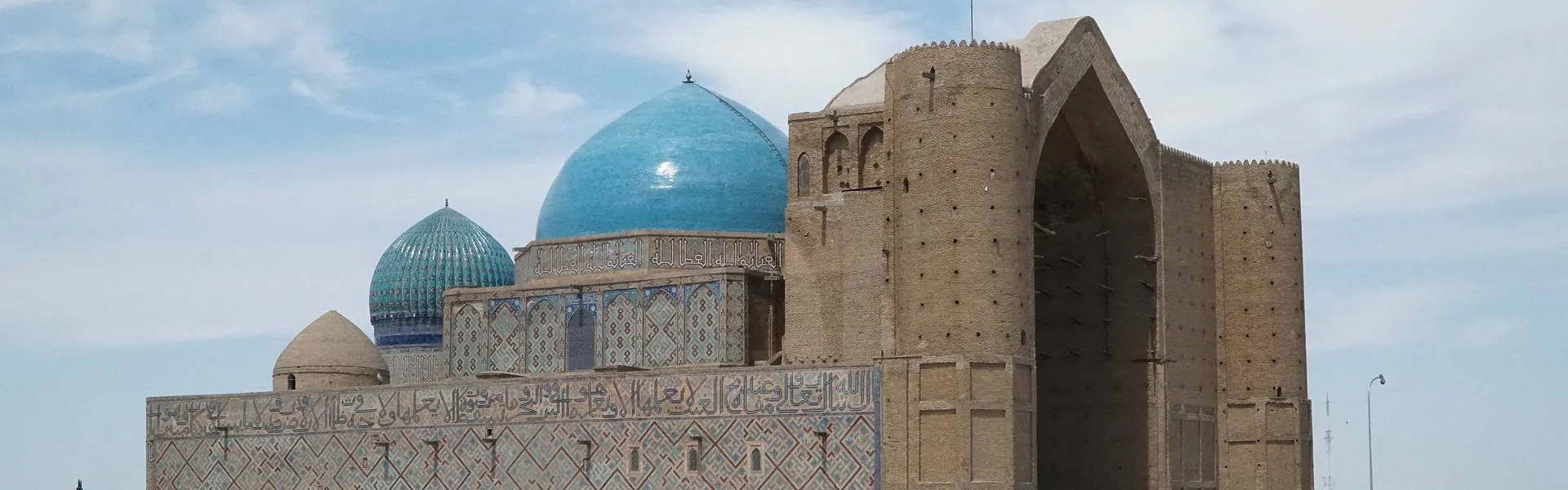
The headline place in town. The mausoleum of the Sufi sheikh Yasawi was commissioned by Tamerlane in 1389 — Kazakhstan's largest medieval building and a UNESCO World Heritage site. The turquoise dome is visible from anywhere in the centre. Inside: the giant Taikazan ritual cauldron, a domed prayer hall, cells. The old saying holds that three pilgrimages to Yasawi equal one to Mecca
How to get there: buses #1 or 7 from downtown, "Mausoleum" stop; or 15–20 minutes on foot from any central point
2. Hilvet underground mosque
Length: ~0.5 km to the entrance · Steps: part of the loop · Profile: 4–5 m below ground
A secret 12th-century underground mosque where, according to tradition, Khoja Ahmed Yasawi himself meditated. The entrance is right beside the main mausoleum — a staircase down into stone cells. Dark, cool, very quiet — people come here in summer specifically to escape the heat. It's the oldest surviving structure in the complex
3. Citadel and fortress walls
Length: ~1.8 km perimeter · Steps: ~2,800 · Profile: flat
A reconstructed medieval citadel next to the mausoleum — walls, towers and gates. Not the original 15th-century structure (that was destroyed) but rebuilt from surviving plans. You can climb the walls — the panorama over the turquoise dome of Yasawi from up there is the best in town
4. Side mausoleums: Ulugbek, Gaukhar-Ana, Rabia Sultan Begim
Length: part of the loop · Steps: +1,500 to the main route
Three small standalone mausoleums inside the complex. The Rabia Sultan Begim mausoleum holds Ulugbek's wife — early 15th century. Gaukhar-Ana is a Sufi female saint. All modest but atmospheric, especially at sunset when warm light catches the old brick. A full circuit including these is the classic "5,000 steps around the complex"
City routes — parks and streets
5. Yasawi Park — the main city park
Length: ~2.5 km big loop · Steps: ~3,500 · Profile: flat
The main park sits right beside the mausoleum. Shaded alleys (mature willows and plane trees), fountains, benches. One of the few genuinely shaded routes in Turkestan — you can walk here even at midday. Pensioners with outdoor gym equipment in the morning, families and pilgrims in the evening. Perfect for a half-hour stroll or a quick post-heat evening loop
6. Otrar Park (Tauelsizdik / Independence Park)
Length: ~3 km big loop · Steps: ~4,500 · Profile: flat
Independence Park on the eastern side of town, refurbished in 2018 for Turkestan's new status. Wide alleys, fountains, sports areas. Trees are still young so there's less shade than in Yasawi Park — but more space and fewer people. A solid evening route
7. Karavan-Saray — modern tourist complex
Length: ~3 km big loop · Steps: ~6,000 · Profile: flat
Turkestan's flagship modern attraction, opened in 2021. A square stylised as a medieval citadel: arcaded streets, craft shops, restaurants, a 3,000-seat amphitheatre, dancing fountains. Separate quarters mimic Khiva, Bukhara and Samarkand. Lighting and music shows in the evening. The covered arcades stay walkable even at noon — there's shade and a draught. A full visit is two to three hours
How to get there: 10 minutes by taxi from downtown, or buses #4, 9
8. Mausoleum → park → Karavan-Saray loop
Length: ~7 km loop · Steps: ~10,000
The best long single loop for anyone trying to "do Turkestan in a day". Start at the mausoleum first thing (before the heat) and circuit the complex. Cut through Yasawi Park toward Otrar Park. By midday you're under the Karavan-Saray arcades for lunch and shade. Catch sunset there by the fountains. 10,000 steps come naturally
Out of town — Sayram, Otrar and nature
9. Aksumbe — hills on the edge of town
Length: 5–8 km depending on the trail · Steps: up to 12,000 · Gain: 50–100 m
A nature area on the western edge of Turkestan. Low loess hills, dirt trails, steppe. The only place nearby with any vertical relief at all. Almost no one around, just shepherds and the occasional walker. Best at dawn or dusk for the light and temperature
10. Sayram — ancient town 10 km from Turkestan
Length: 5–10 km loop through the village · Steps: up to 14,000 · Profile: flat
One of Central Asia's oldest settlements (mentioned for 3,000+ years). Today a large village, but with surviving mausoleums (Karashash-Ana, Ibrahim-Ata, Mirali-Bab), remains of ancient walls, a traditional bazaar and narrow lanes. A great half-day on foot — history, real life and a southern bazaar in one
11. Otrar — archaeological reserve
Length: ~6–12 km across the site · Steps: up to 18,000 · Profile: flat
The famous Otrar — an ancient Silk Road trading city destroyed by Genghis Khan's armies in 1220 after a six-month siege. Today it's a vast site of mud-brick walls, the citadel and ongoing excavations. Nearby: the Arystan-Bab mausoleum, the spiritual teacher of Yasawi. A full day trip — three hours on the road, three to four on the ground. Best in March–May or September–October; in summer midday on open ruins is brutal
How to get there: car only, ~1.5 hours each way along the Kyzylorda highway
Seasons — what works when
Winter (December — February)
Mild compared to northern Kazakhstan: 0…+5°C in the day, occasional minus. Snow rare and short-lived. What to do: winter is excellent for walking the Yasawi complex — no heat, no pilgrim crowds. The downside is short daylight and steady wind off the plain. Wind layer essential
Spring (March — May)
The best season in Turkestan. +15–28°C, the steppe greens, tulips, poppies. What to do: March–April is peak for every route plus the day trips to Sayram and Otrar. By late May the heat is climbing toward +35 and dust season starts
Summer (June — August)
The hard season. +35–42°C in the day, UV 9–10, almost no shade. What to do: walks strictly before 9 a.m. or after 7 p.m. At midday: Hilvet (cool underground), the museums with AC, or the Karavan-Saray arcades. Otrar and Sayram trips are risky in summer — bring at least 2 L per person
Autumn (September — November)
The second peak after spring. From mid-September the heat eases; October is ideal at +20–25°C, and the southern steppe turns gold. What to do: catch October–November for as much walking and travel as you can. By late November cold winds end the walking season until March
What to bring — a short checklist
- Water — lots. 0.5 L per hour in summer. For Otrar or Sayram, at least 1.5–2 L per person
- A hat or cap. The mausoleum precinct has barely any shade
- A scarf (for women). You'll need to cover your head to enter the mausoleum and Hilvet — bringing your own is easier than borrowing one
- Modest clothing. Long sleeves and long trousers/skirt at the shrine. Shorts at the Yasawi complex are out of place
- Sunscreen. SPF 30+ on face, shoulders, arms
- Easy-to-remove shoes. Inside the mausoleum and Hilvet you'll need to take them off — pick something convenient
- Sunglasses — the open square at the mausoleum is blinding
- A charged phone. Coverage at Otrar can be patchy — download the offline map first
Bottom line
- Turkestan has a clear hierarchy: Yasawi complex > Karavan-Saray > parks > everything else. The mausoleum is non-negotiable, even if you're not a pilgrim
- The real enemies are summer sun and absent shade, not distances. The town is compact
- The most accessible routes are the Yasawi complex, Yasawi Park and Karavan-Saray. All reachable without a car
- The longest city loop is the mausoleum → park → Karavan-Saray circuit at 10,000 steps
- The "coolest" summer route is Hilvet: a naturally cold underground mosque
- The most epic is the Otrar trip: 1.5 hours each way to the ruins of a city Genghis Khan needed six months to take
- Seasons matter: best — March–May and September–November; in summer, only morning and evening
The simple rule: in Turkestan you can't just "walk wherever" — the sun, the distance to Otrar and the sanctity of the Yasawi complex don't reward poor preparation. But knowing five or six trusted spots and a couple of apps lets you walk 10,000 steps between the ancient and the very new year-round. And Qozgal will count every one — no subscriptions, no ads, no extra numbers

Count your steps for free
Download Qozgal — an accurate step counter using Apple Health and Health Connect. No subscriptions, no ads