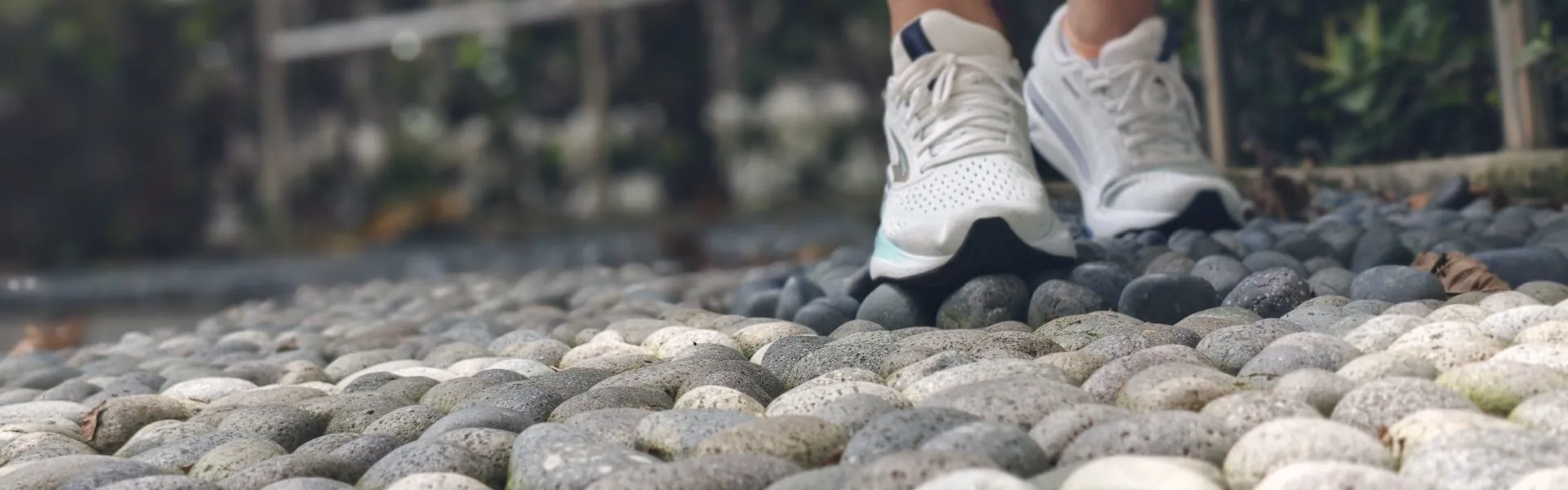
How to walk with ankle osteoarthritis
Ankle osteoarthritis often develops after a fracture, ligament sprain, or another injury. That is why the same route may feel very different from one day to another: a level path may be fine, while a descent, cobblestones, or a fast pace may already be too much. Current recommendations emphasize combining education, therapeutic exercises, and a gradual return to activity for mild and moderate symptomatic osteoarthritis, although there is still less evidence specifically for the ankle than for the knee and hip. The 2026 AAOS guideline rates the quality of this evidence as low or based on expert consensus.
These figures do not mean that you need to reach a specific step target or put up with pain. They show something else: people with osteoarthritis often start moving noticeably less, while a safe program is built around gradual progression and monitoring how the joint responds over the following day.
The main principle: keep the load manageable
A good walk with osteoarthritis is not a walk with no sensation in the joint at all. It is a walk after which you do not start limping, swelling does not increase, and you return to your usual symptom level the next day.
- Start at a conversational pace on a level route, rather than aiming for a target number of steps.
- First increase the duration of your walk, then add speed, hills, and uneven surfaces.
- Your shoes should secure your heel, avoid squeezing your foot, and not force your ankle to work through pain.
- If symptoms clearly worsen and last longer than usual, reduce the load and review your plan.
- A hot, red joint, marked swelling, deformity, or inability to put weight on the leg requires medical assessment.
How to choose your walking pace
Start at a pace that allows you to speak comfortably in short sentences without changing your usual walking pattern. This is not athletic training: the goal is to move evenly, without sudden jolts or constant braking. If you can speed up only by pushing off harder with your toes, and your ankle starts hurting at the front or back, the pace is already too fast.
- Walk more slowly than you want to during the first few minutes: the joint needs time to get moving.
- Choose a level surface without long descents, stairs, or sections with large uneven areas.
- Try taking slightly shorter steps if a long stride increases pain at the front of the ankle.
- Do not force yourself to walk through a limp: limping changes the load on your knee, hip, and lower back.
- If your joint usually feels stiff after a walk, keep the same pace but shorten the route.
It helps to distinguish muscle fatigue from a joint reaction. Calf muscle fatigue usually eases with rest and does not change the way you walk. An overloaded ankle is more likely to cause increasing local pain, a feeling of pressure or fullness, more swelling, or a tendency to protect the leg.
Check your pace without a watch During your walk, assess not your speed but the quality of each step: can you place your foot confidently, are you catching your toe on the ground, and are you shifting your weight abruptly onto the healthy leg? If your technique breaks down, slow down or stop.
How to increase distance safely
There is no universally safe distance for the ankle. It depends on the degree of osteoarthritis, deformity, ligament stability, previous operations, body weight, muscle strength, and how the joint responds to loading. So rather than using a fixed target, it is better to increase gradually: change only one parameter at a time.
- First choose a short route after which your symptoms return to their usual level by the next day.
- Repeat this amount of loading several times without worsening.
- Then add a small amount of time or distance, while keeping the same pace and surface.
- If your response remains stable, only then try a faster pace or a slight incline.
- After a noticeable increase in loading, give the joint time to adapt and do not add stairs, descents, and uneven surfaces at the same time.
In practice, it might look like this: you walk on a level path until you feel familiar but manageable fatigue. The following week, you do not necessarily need to walk faster—simply extending the walk a little may be enough. If this causes prolonged worsening, return to the previous tolerable amount. This approach reflects the idea of graded activity: in studies of knee and hip osteoarthritis, a gradual program helped people adhere to exercises and maintain physical activity better than usual advice. But these results cannot be applied directly to the ankle.
A cluster randomized study of 200 participants with knee and/or hip osteoarthritis found that graded activity improved adherence to the exercise program and supported a higher level of physical activity. This supports gradually increasing loading according to a pre-planned schedule, but it is not a ready-made plan specifically for the ankle.
Pisters MF et al. DOI: 10.1016/S1836-9553(10)70053-9Footwear: what really matters
Shoes do not treat osteoarthritis, but they can make each step more predictable and reduce irritating factors such as instability, pressure on painful areas, and unnecessary twisting of the foot. Some footwear recommendations for ankle osteoarthritis are based on biomechanics and clinical experience rather than a large number of direct randomized studies.
| Feature | What to look for | What to avoid |
|---|---|---|
| Support | Laces or an adjustable fastening and a firm heel counter | A loose heel and shoes that you have to grip with your toes |
| Sole | Moderately firm, stable, with good traction | A very soft and unstable sole |
| Shape | Enough room in the toe box so your toes are not squeezed | A narrow toe box and pressure on bony areas |
| Heel height | Low and stable | A high heel or a sharp change in height |
| Rocker sole | Can be tried after assessment by a specialist | Buying one blindly if you have instability or balance problems |
Start with ordinary, stable walking shoes: they should fit well in the store, not require a long break-in period, and let you walk without increasing your pain. A detailed checklist is available in the Qozgal article about walking shoes. If you have a marked restriction in ankle flexion, a specialist may suggest a stiff sole, rocker profile, brace, or another unloading option. These solutions are best selected after an examination: the wrong correction can shift the load to the knee, foot, or opposite leg.
In a small laboratory study of healthy participants, a rocker sole and SACH heel changed foot and ankle kinematics during walking. This supports the biomechanical mechanism of these designs, but it does not prove that a particular rocker shoe will reduce pain in someone with osteoarthritis. It is therefore best viewed as an individual trial option, not a purchase everyone needs to make.
Wu WL et al. DOI: 10.1016/j.medengphy.2004.05.003This review of conservative treatment emphasizes that the evidence base for ankle osteoarthritis is weaker than for knee and hip osteoarthritis. Education, aerobic activity, muscle strengthening, gait correction, braces, and unloading options are considered components of comprehensive management, but the choice should depend on the cause of the osteoarthritis and the mechanics of the individual foot.
Tejero S, Prada-Chamorro E. DOI: 10.3390/jcm10194561How to tell when a walk has become too much
Assess not only how you feel while walking, but also your response that evening and the next day. An osteoarthritis flare-up is generally understood as a sudden and sustained increase in pain, stiffness, or swelling lasting at least 24 hours. For you, this is a practical signal: if the joint remains more painful or swollen than usual for longer after a new distance, reduce the load.
- Pain gradually increases as the walk continues instead of remaining stable.
- You start limping, turning your foot outward, or noticeably shortening your step.
- Swelling after the walk is greater than usual and does not decrease with rest.
- The next day, familiar everyday activities are difficult.
- You develop a new feeling of instability, giving way, or sharp pain when placing your foot down.
Do not test the joint by pushing through If symptoms have clearly worsened, remove long walks, descents, and uneven routes for a day or two, but do not switch to complete immobility unless your doctor tells you to. You can keep up gentle movements within a comfortable range and return to your previous tolerable load once symptoms improve.
This practical review describes a flare-up as a sustained increase in pain, swelling, and stiffness lasting at least 24 hours. For self-management, the authors highlight physical activity and exercise in the long term, while sudden worsening may call for a short period of relative rest, adjustment of the provoking load, and a review of treatment with a doctor.
Parry E et al. DOI: 10.1136/bmj-2023-076455When you need to consult a doctor
If you already have a diagnosis, discuss a planned consultation when pain limits everyday activity, your walks are becoming shorter and shorter, you need pain medication more often, or episodes of worsening keep returning. Persistent symptoms may require assessment by an orthopedist, a physical and rehabilitation medicine doctor, or a physical therapist. BMJ recommends orthopedic assessment if conservative treatment is not helping, the condition is substantially affecting quality of life, or it has reached a late stage.
- Seek urgent help after an injury if you have severe pain, marked swelling, a deformity, or cannot put weight on the leg.
- Do not delay seeking care if the joint becomes hot, red, and sharply painful, especially together with a fever.
- Arrange an examination if pain is steadily worsening, swelling does not go away, or mobility is noticeably deteriorating.
- Seek help sooner if you develop numbness, unusual paleness or bluish discoloration of the foot, or new marked instability.
Before your visit, write down how long you walked, where it hurt, whether there was swelling, and how you felt the next day. This helps the doctor distinguish an unsuitable amount of loading from disease progression or another cause of pain.
A simple daily walking plan
Before you go out
- Choose a level route where you can shorten the walk quickly if needed.
- Wear shoes you have already tested, not a new pair for a long distance.
- Spend a few minutes making gentle foot and ankle movements; ideas for a safe warm-up and cool-down are collected separately.
During the walk
- Walk at a conversational pace and make sure your step does not become a limp.
- Assess pain together with swelling, stability, and movement quality.
- Stop earlier than usual if symptoms are increasing rather than stabilizing.
After the walk
- Compare how your ankle feels with its usual level in the evening and the morning.
- If there is no worsening, repeat the same amount before increasing the distance.
- If you feel worse, return to your previous tolerable load and review your shoes, surface, and pace.
Frequently asked questions
Can I walk every day with ankle osteoarthritis?
You can if your daily amount does not cause prolonged worsening, limping, or a noticeable increase in swelling. Frequency itself matters less than how the joint responds to a particular walk.
Which pace is better: slow or fast?
Start with a slow or moderate conversational pace. Increase the speed only when you can maintain a confident step, stable foot placement, and your usual condition the next day.
Will orthopedic footwear help?
Sometimes—especially if you have restricted movement, a deformity, or instability. But there is no universal model: shoes, insoles, or a brace are best selected after assessing your gait and foot position.
Do I need complete rest during a flare-up?
Relative rest is usually more reasonable: temporarily remove long walks, inclines, and uneven surfaces, but maintain comfortable movement unless your doctor has advised otherwise.
What should I do if pain appears only after a walk?
Compare it with your usual level and assess the next day. If the pain goes away quickly and does not change your gait, keep the amount the same. If it comes with swelling, limping, or prolonged worsening, reduce the load and discuss the situation with a specialist.
Sources
- Smith M. et al. A combined program of education plus exercise versus general advice for ankle osteoarthritis: A feasibility randomised controlled trial. Musculoskeletal Science and Practice, 2024. DOI 10.1016/j.msksp.2024.103169
- Tejero S., Prada-Chamorro E. Conservative Treatment of Ankle Osteoarthritis. Journal of Clinical Medicine, 2021. DOI 10.3390/jcm10194561
- Decreased physical activity in patients with ankle osteoarthritis. A case-control study comparing daily step counts. Foot and Ankle Surgery, 2022. DOI 10.1016/j.fas.2021.01.011
- Pisters M. et al. Behavioural graded activity results in better exercise adherence and more physical activity than usual care in people with osteoarthritis. Journal of Physiotherapy, 2010. DOI 10.1016/S1836-9553(10)70053-9
- Wu W. et al. The effects of rocker sole and SACH heel on kinematics in gait. Medical Engineering & Physics, 2004. DOI 10.1016/j.medengphy.2004.05.003
- Parry E. et al. Recognising and managing osteoarthritis flares in primary care. BMJ, 2023. DOI 10.1136/bmj-2023-076455
- McCarron L. et al. Assessment and management of ankle osteoarthritis in primary care. BMJ, 2023. DOI 10.1136/bmj-2022-070573
- American Academy of Orthopaedic Surgeons. Management of Ankle Osteoarthritis: Evidence-Based Clinical Practice Guideline, adopted June 4, 2026. AAOS guideline, 2026
