An evening route: why walk around the walls
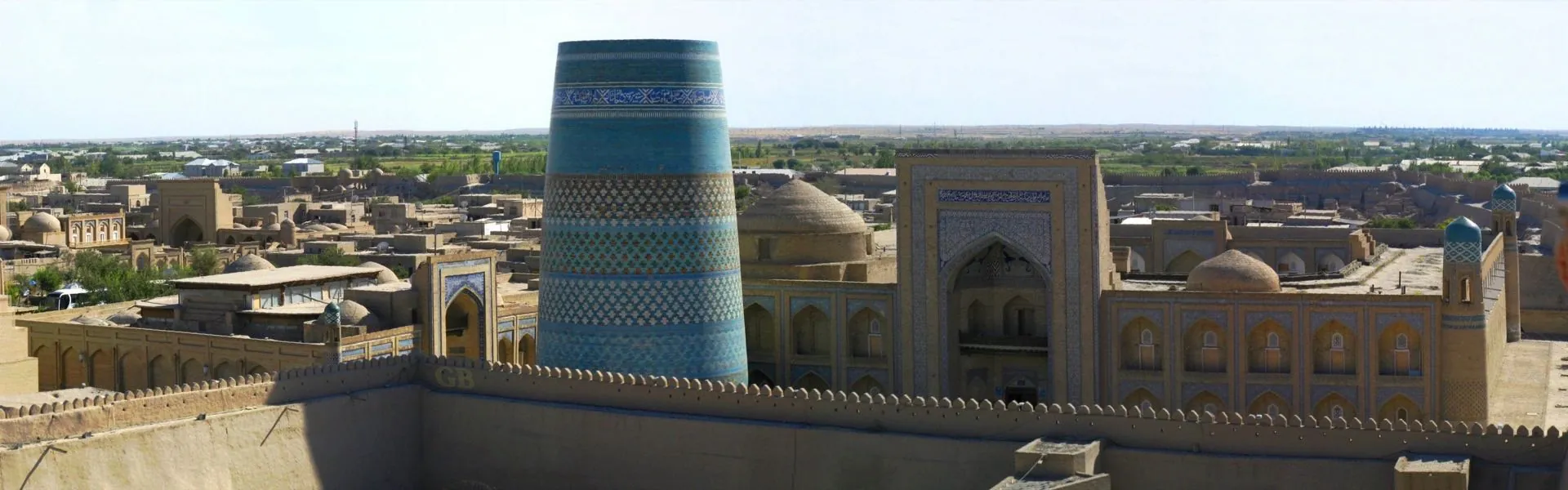
Itchan Kala is a rare city where the route almost holds your hand. Khiva’s inner city is shaped like an elongated rectangle of about 650 by 400 meters, and its brick walls rise up to 10 meters. That makes the outside loop around the walls short, clear, and spectacular: you don’t have to hunt for sights, because they’re always right beside you.
The main idea of this guide is not to “finish Khiva in one evening,” but to walk it in a way that leaves your feet feeling fine the next day. The basic outer loop gives you about 3–3.6 thousand steps. Add an easy walk along the inner axis or a loop toward the green area in the northwest, and you’ll reach 4–7 thousand steps — a good range for an evening stroll after travel, heat, or museums.
In Khiva, it’s better not to speed up. Look at the wall in the side light, take shorter steps than usual, and save some energy for tomorrow morning.
Which gate should you start from?
Itchan Kala has four clear starting points: Ota-Darvoza in the west, Polvon-Darvoza in the east, Bogcha-Darvoza in the north, and Tosh-Darvoza in the south. For a first evening, the western gate is usually the easiest: Kalta Minor is nearby, there are many hotels, and it’s simple to reorient yourself if you get tired.
| Start | Why it’s convenient | Best for |
|---|---|---|
| Ota-Darvoza, west | The most recognizable point, near Kalta Minor and many hotels | If it’s your first time in Khiva and you want a beautiful start |
| Polvon-Darvoza, east | Convenient from the station, bazaar, and eastern part of the city | If you arrived by train or are staying closer to the station |
| Bogcha-Darvoza, north | Closer to transport stops from Urgench and calmer streets | If you want fewer crowds at the start of the walk |
| Tosh-Darvoza, south | A good entrance if your hotel is south of the walls | If you don’t want to cross the tourist center first |
How to get to the start Local transport runs from Urgench to Khiva, including a trolleybus connection; taxis are also a common option. From Khiva railway station to Itchan Kala, you can ride in a few minutes or walk if it isn’t hot and your luggage is light. Check train and transport schedules on the day of travel: in Uzbekistan they can change.
A 4–7 thousand step loop: three versions
The basic plan is simple: start at your chosen gate, walk outside along the walls clockwise or counterclockwise, and return to the same point. I’d start at Ota-Darvoza and go like this: western wall → north side to Bogcha-Darvoza → east side to Polvon-Darvoza → south side to Tosh-Darvoza → back to Ota-Darvoza.
- Short loop: just the outer circuit of the walls, about 2.2–2.4 km and 3–3.6 thousand steps. Good after a long journey or dinner.
- Gentle 4–5 thousand steps: do the outer loop and add an inside walk from Ota-Darvoza to Juma Mosque or Polvon-Darvoza, returning along a parallel street.
- Extended 6–7 thousand steps: after the loop, add a detour to the northwestern part of Dishan Kala: the Park Khiva area and Nurullabay Palace, then return to Ota-Darvoza or Bogcha-Darvoza.
- If you’re coming from the station: start at Polvon-Darvoza, walk the eastern and southern sides, then decide at Tosh-Darvoza whether you have enough energy for the full loop.
- If you’re staying inside Itchan Kala: go out through the nearest gate, do the outer loop, and collect your last thousand steps on quiet inner streets rather than the main tourist axis.
Want to estimate kilometers from your steps in advance? Open the guide how many kilometers are in 10,000 steps. For Khiva, count conservatively: on cobblestones, your stride usually gets shorter.
When to head out so you don’t overheat
In summer, Khiva is very hot: in July the average monthly temperature is about 30 °C, while daytime highs often reach 37 °C. So it’s better to plan your evening loop not “after lunch,” but after the sun has clearly eased off: in the warm season, aim for 18:30–20:30; in June–August, closer to sunset.
The simplest marker is the shade from the wall. If the ground by the wall still feels scorching, don’t start a fast loop: drink water, sit for 10 minutes, begin with a short inner loop, and only then go outside. Khiva’s dry air can be deceptive: you feel sweat less, but you still lose fluid.
The ACSM consensus emphasizes that the risk of heat-related problems rises with heat, dehydration, recent illness, and lack of climate adaptation. For city walking, the takeaway is simple: in the evening, slow down, take breaks, don’t compete with your step counter, and move into the cool if you feel dizzy, nauseous, or unusually weak.
Roberts W.O. et al. Journal of Sport Rehabilitation. 2023. DOI: 10.1249/JSR.0000000000001058Heat stop signals If you feel faint, get chills in the heat, become confused, feel very weak or nauseous, or your pulse “won’t let go” after you stop — end the walk. Go into shade or indoors, cool down, drink in small sips, and seek medical help if things get worse.
Cobblestones and sandy dust: how to protect your feet
Itchan Kala is beautiful precisely because of its textures: stone and uneven streets, dust, drops near the gates, curbs, and sections with different surfaces. But for your feet, that isn’t the same as a smooth promenade. On uneven ground, the body changes step length and foot placement width more often, while the ankle works harder to stabilize you.
In a laboratory study of walking on uneven terrain, participants reduced step length by about 4%, while variability in step length and width increased noticeably. The practical point for Khiva: on cobblestones, it’s better to take shorter steps, look 2–3 steps ahead, and not try to keep your “asphalt” pace.
Voloshina A.S., Kuo A.D., Daley M.A., Ferris D.P. Journal of Experimental Biology. 2013. DOI: 10.1242/jeb.081711- Choose sneakers or sandals with a secure heel, not soft flip-flops.
- Wear thin socks without rough seams: after a hot day, skin chafes more easily.
- On slopes by the gates, shorten your stride and don’t look at your phone.
- If you already have a blister, don’t try to be a hero: shorten the loop through the nearest gate.
- After the walk, rinse your feet, dry the skin between your toes, and let your shoes air out.
If the balls of your feet often burn after old cities, read the separate guide how to walk on cobblestones without overload: the rules for Bukhara work well in Khiva too.
Pace: stroll, don’t train
For evening Khiva, the best pace is conversational. You should be able to say a sentence of 8–10 words without getting breathless. If you want to speed up for the sake of steps, it’s better to add a short flat loop by a gate than to rush along an uneven street. That way you’ll build volume without extra strain on your Achilles, knees, and lower back.
A meta-analysis of 15 cohorts found that more daily steps were linked to a lower risk of mortality, but the benefits did not require a magical 10,000 steps. For many adults, a range of about 6–8 thousand steps already looks practically meaningful. So an evening goal of 4–7 thousand steps in Khiva is not “too little,” but a sensible amount for travel.
Paluch A.E. et al. The Lancet Public Health. 2022. DOI: 10.1016/S2468-2667(21)00302-9A review on cadence suggests about 100 steps per minute as a simple marker of moderate intensity in adults. In Khiva, that isn’t a required target: on cobblestones and in the heat, it’s safer to keep the pace lower if that makes it easier to talk and control where your feet land.
Tudor-Locke C. et al. British Journal of Sports Medicine. 2018. DOI: 10.1136/bjsports-2017-097628- Walk so you can talk without pausing to breathe.
- A shorter step on uneven surfaces is normal, not a technique mistake.
- If it’s hot, count feeling steady after the loop as success, not speed.
- 4–7 thousand steps in the evening is better than 10 thousand through fatigue and blisters.
- For a more accurate self-check, use the talk test while walking.
Where to turn off if you’re tired or it gets noisy
The strong point of the route along the walls is that every few hundred meters you have a logical decision point. Tired? Go in through the nearest gate, sit in the shade, buy water, or return to your hotel along the inner streets. You don’t need to “push through the loop” if your feet are already sending signals.
- At Ota-Darvoza there are usually more people and photos, but it’s easy to find a café, hotel, or taxi.
- At Bogcha-Darvoza it’s usually calmer; this is a good area for a pause and a turnaround.
- At Polvon-Darvoza it’s convenient to finish the route if you’re heading on to the station or eastern streets.
- At Tosh-Darvoza you can shorten the southern part and go back inside if it’s getting dark or you’re walking alone.
Khiva doesn’t have a classic long promenade for an evening walk like cities on a big river. If you want greenery and water, don’t add a “promenade”; add the northwestern loop to Park Khiva, with ponds and trees, or a calm walk to Nurullabay Palace.
A 70-minute mini-plan
Here’s a plan for your first evening if you start from Ota-Darvoza and want about 5 thousand steps without overload. Before you start, drink water, check that your shoes aren’t rubbing, and put your phone away: on cobblestones, holding it makes it harder to watch your step.
- 0–10 minutes: Ota-Darvoza, slow start, photos of the walls in side light, no speeding up.
- 10–25 minutes: western and northern sides to Bogcha-Darvoza, short pause in the shade.
- 25–45 minutes: eastern side to Polvon-Darvoza, shorter steps on uneven patches.
- 45–60 minutes: southern side to Tosh-Darvoza and return to the western wall.
- 60–70 minutes: if you have energy, add an inner loop to Kalta Minor or Juma Mosque; if not, cool down and drink water.
If the day was hard, stop at the basic loop. If, on the other hand, it feels pleasant after sunset and your legs are fresh, add the northwestern green loop. You can find more city options in the routes guide where to walk in Khiva on foot.
Frequently asked questions
Can I walk the loop along the walls after dark?
Yes, if you stay on lit and populated sections, but for the first time it’s better to start before sunset. That way you’ll see the surface, the gates, and the places where it’s easiest to shorten the route.
How much water should I take for the evening loop?
For a gentle walk, take a small bottle and drink in small sips before you feel very thirsty. In June–August, it’s better to start already hydrated rather than trying to “hold out” until a café.
Is the route suitable for children or older adults?
Yes, if you choose the short loop, walk slowly, and take breaks by the gates. The main risk isn’t the distance, but the heat, uneven surfaces, and fatigue after daytime excursions.
Can I collect 7 thousand steps only inside Itchan Kala?
Yes, but inside there are more cobblestones, people, and stops. For your feet, it’s gentler to combine the outer loop by the walls with short inner loops rather than walking back and forth along the most touristy streets.
What shoes are best for Khiva in the evening?
Light sneakers or sandals with heel support and a non-slip sole. Leave flip-flops for the hotel: on stone, dust, and the steps by the gates, they tire your feet faster.
In short: your evening loop
- Start from Ota-Darvoza if it’s your first time in Khiva; from Polvon-Darvoza if you’re coming from the station side.
- The basic outer loop along the walls is about 2.2–2.4 km; inner or northwestern loops bring it up to 4–7 thousand steps.
- In summer, head out closer to sunset: in Khiva, the heat lingers long after an active tourist day.
- On cobblestones, shorten your step, look several steps ahead, and don’t keep your phone in your hand.
- Shorten the route through the nearest gate if there is heat, blisters, dizziness, or sudden fatigue.
- The goal of the evening is to return with pleasant tiredness, not to prove to your step counter that you’re a hero.
Sources
- UNESCO World Heritage Centre. Itchan Kala: dimensions of the inner city, walls, and World Heritage status. UNESCO: Itchan Kala
- Khiva Interactive Guidebook. City Walls: description of Itchan Kala’s walls and the evening view of the fortifications. Khiva.info: City Walls
- Uzbekistan Travel. Ichan-Kala: tourist description of Itchan Kala, its walls, streets, and monuments. Uzbekistan Travel: Ichan-Kala
- Uzbekistan Travel. Nurullabay Palace: location and description of the palace complex in the northwestern part of Khiva. Uzbekistan Travel: Nurullabay Palace
- Khiva.info. Getting Around: practical information about transport between Urgench and Khiva. Khiva.info: Getting Around
- Climate-Data.org. Khiva climate: average monthly temperatures and seasonal heat in Khiva. Climate-Data.org: Khiva
- Paluch A.E. et al. Daily steps and all-cause mortality: a meta-analysis of 15 international cohorts. The Lancet Public Health, 2022. DOI: 10.1016/S2468-2667(21)00302-9
- Lee I-M. et al. Association of Step Volume and Intensity With All-Cause Mortality in Older Women. JAMA Internal Medicine, 2019. DOI: 10.1001/jamainternmed.2019.0899
- Voloshina A.S. et al. Biomechanics and energetics of walking on uneven terrain. Journal of Experimental Biology, 2013. DOI: 10.1242/jeb.081711
- Tudor-Locke C. et al. How fast is fast enough? Walking cadence as a practical estimate of intensity in adults. British Journal of Sports Medicine, 2018. DOI: 10.1136/bjsports-2017-097628
- Roberts W.O. et al. ACSM Expert Consensus Statement on Exertional Heat Illness. Journal of Sport Rehabilitation, 2023. DOI: 10.1249/JSR.0000000000001058
- Tripadvisor. Park Khiva: description of the city park with trees, ponds, and its location northwest of Itchan Kala. Tripadvisor: Park Khiva

