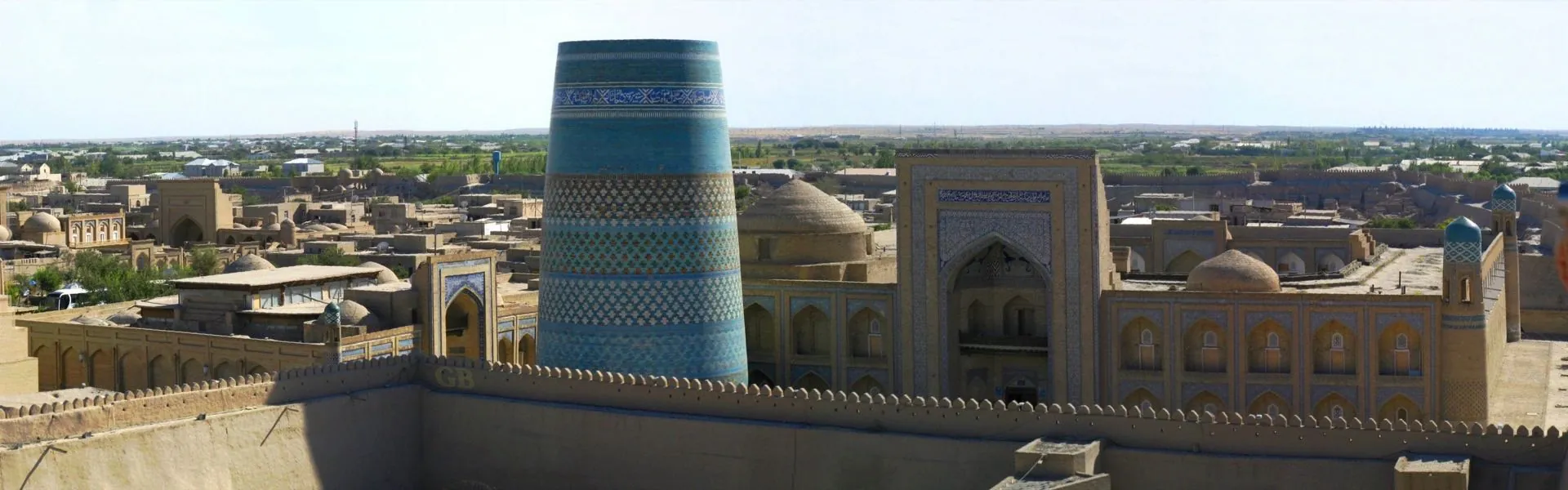
The idea of the route: Khiva without rushing
Itchan Kala is not a long city promenade, but a dense museum-city inside the walls. According to UNESCO, the inner city stretches roughly 650×400 m and includes dozens of monuments, residential quarters, mosques, madrasahs, and gates. So the main mistake here is thinking: “since everything is nearby, I’ll do it quickly.” Quickly is exactly how you get tired.
Your task for the morning is not to “cover” every site, but to walk a gentle loop: the western Ota-Darvoza gate, Kalta Minor, the square by Kunya-Ark, the Juma Mosque, the area around the Pahlavan Mahmud Mausoleum, and the Islam Khodja Minaret. If you have the energy, add the southern and eastern gates. If not, calmly return to the start.
For this guide, I use a practical benchmark: 1 km of easy city walking is about 1300–1500 steps. On stone, near shopfronts, and in narrow lanes, your stride is usually shorter, so the counter may show more than on a flat embankment.
When to head out in the morning
The best window is early morning, while the old city is just waking up. In the warm season, aim for 06:30–08:00. In cooler months, you can go later, but still keep the first half of the morning for walking rather than museums: it is easier to walk when there are fewer groups, service vehicles, and bright reflections from pale clay and stone.
- If you’re staying inside Itchan Kala, start right after water and a light breakfast: loop first, then coffee or a museum.
- If you arrive by train in the morning, don’t start the walk with a hard push from the station with a backpack. It’s better to take a taxi to the walls or leave your luggage.
- If the day is hot, don’t plan to “make up 10 000 steps” inside the fortress. There’s a separate logic for that, and it shouldn’t break the walk. Read the basics about the 10 000 steps goal.
- If you want pretty photos without crowds, spend the first 20 minutes by Kalta Minor and Kunya-Ark, not in the middle of the main street.
60-minute route: a gentle loop from Ota-Darvoza
Start at the western Ota-Darvoza gate. It is the clearest entrance: Kunya-Ark, the Muhammad Amin Khan Madrasah, and Kalta Minor are nearby. For the first 10 minutes, don’t speed up. Let your eyes adjust to the details: blue tiles, shadows along the walls, uneven ground underfoot. That way you don’t start the walk with the pulse of “the tour has already run off.”
- Ota-Darvoza → Kalta Minor: 200–300 m, 5–8 minutes with photos.
- Kalta Minor → the square by Kunya-Ark: another 200–300 m; keep a conversational pace.
- Kunya-Ark → Juma Mosque along the central axis: about 400–500 m; this is the best even stretch.
- Juma Mosque → Pahlavan Mahmud Mausoleum → Islam Khodja Minaret: 300–400 m; here you’ll want to stop more often.
- Return to Ota-Darvoza through the western part: 400–600 m, without trying to “push” the pace.
| Option | Length | Steps | Best for |
|---|---|---|---|
| Very short | 1,2–1,5 km | 1700–2300 | After a train, with kids, in heat |
| Basic 60 min | 1,6–1,9 km | 2300–2900 | First look without museums |
| Full morning | 2,2–2,6 km | 3200–3900 | If you slept well and it’s not hot |
| Plus park outside the walls | 3,5+ km | 5000+ | Only if there is shade and water |
75–90-minute route: add the south and east
If you feel steady after the Islam Khodja Minaret, add the southern and eastern edge. From the Islam Khodja area, head toward Tash-Darvoza, then turn through quieter streets toward Polvon-Darvoza. The eastern gate is interesting because it is not just a passage, but a long covered gallery and trading hub. Then return west along the main axis.
- Head south with a short stride: the surface requires attention in places, and the sun reaches open sections faster.
- At Tash-Darvoza, pause for 2–3 minutes: check your water, shoulders, breathing, and feet.
- From Tash-Darvoza to Polvon-Darvoza, don’t chase the map. If a street is narrow and photogenic, slow down — it’s part of the route.
- From Polvon-Darvoza back to Ota-Darvoza, walk at the calmest pace of the day. This is the final stretch, not a finish-line sprint.
A good walk through Khiva is one where you remember not only the minarets, but also your own state: steady breathing, legs that aren’t “dead,” and enough energy left for the city at lunchtime.
How to alternate walking and pauses
A workable pattern for Itchan Kala is 8–12 minutes of walking + 2–3 minutes of pausing. A pause doesn’t have to mean sitting down: you can stand by a wall, take a photo, read a plaque, or drink water. The main thing is not to let fatigue build up until all you want is shade and silence.
- The first 10 minutes: ease in slowly, without overtaking groups.
- 10–25 minutes: the even stretch to the Juma Mosque; pace a little brisker, but you can still speak in phrases.
- 25–40 minutes: photos and stops by the mausoleum and minaret; stride shorter.
- 40–60 minutes: decide whether you’re returning or adding the south and east.
- After 60 minutes: every 10 minutes, check water, feet, and your desire to continue. If the desire is gone, the route is finished.
Say a short phrase out loud: “I’m walking calmly and I can keep going.” If speaking is easy, the pace is fine. If you have to catch your breath, slow down on the next block.
Where to deliberately slow down
In Itchan Kala, you slow down not only because of heat. There are many visual “hooks” here: arches, shops, carved doors, tourists with cameras, children, bicycles, and service vehicles. The more stimuli around you, the shorter your stride should be. This isn’t weakness; it’s normal city navigation.
- At Ota-Darvoza: people enter, stop, and turn around for photos.
- Around Kalta Minor: your gaze goes upward, while your feet are still on uneven ground.
- At the Juma Mosque: lots of sideways movement, entrances, and groups waiting.
- At the Pahlavan Mahmud Mausoleum and Islam Khodja Minaret: narrow spots, photos, patchy shade.
- On the way to Tash-Darvoza: fewer tourists, but more reason to watch your step.
- At Polvon-Darvoza: covered gallery, shops, and a sharp change of light.
Walking on the walls and stairs can be beautiful, but it is a separate load: steps, height, sun, and photo pauses. If your goal is a calm 60–90 minutes, don’t add climbs “while you’re there.” It is better to think about stairs and inclines separately: how to walk up steps without overdoing it.
If you want shade, greenery, or more steps
Inside Itchan Kala, there is no classic long embankment or large park like in cities with a river or a wide boulevard. It is important to accept this in advance: the route is built around gates, squares, and narrow streets, not water. Don’t look for the “perfect promenade” inside the walls — it isn’t here.
If you want greenery after the loop, a real option outside the walls is Park Khiva to the northwest of Itchan Kala, near Najmiddin Kubro Street. This is no longer part of the short morning walk, but an extra block: go there only when the temperature is reasonable, with water, and without luggage. On a hot day, it is better to replace the park with shade in a café or a return to your hotel.
| Place | Role in the walk | When to go |
|---|---|---|
| Kunya-Ark and western square | Pause at the start, orientation | First 15 minutes |
| Juma Mosque | Quiet central anchor | Middle of the route |
| Tash-Darvoza | Strength check before continuing | After 45–60 minutes |
| Polvon-Darvoza | Final point of the full loop | If it isn’t hot |
| Park Khiva outside the walls | Greenery and benches, but more steps | Only after resting |
How to get to the start
The easiest start is Ota-Darvoza, the western gate. If you’re staying inside the walls, just walk to it and begin the loop from there. If you’re staying in the newer part of Khiva, ask a taxi to take you to Ota Darvoza or Ichan Kala West Gate. That way you start from a clear point, not by searching for an entrance under the sun.
- From Khiva railway station to Itchan Kala, usually allow about 20 minutes on foot or a short taxi ride. With a backpack, choose a taxi.
- From Urgench, it is easier to come by taxi or transfer straight to the western gate or your hotel: don’t start the walk with logistics stress.
- If you come with a group, agree to meet at Ota-Darvoza after the loop. In narrow streets, it is easy to drift apart for 5 minutes and lose the calm rhythm.
- If you use the Qozgal step counter, start the walk at the gate, not at the station: that way the route will honestly be about Itchan Kala, not the road to it.
- Head out early: 06:30–08:00 is best in the warm season.
- The basic loop inside Itchan Kala is 1,6–1,9 km; the full calm loop is 2,2–2,6 km.
- Keep the pattern of 8–12 minutes walking and 2–3 minutes pausing.
- On stone and near gates, deliberately shorten your stride: uneven surfaces are more tiring than they seem.
- Don’t add walls, stairs, or the park outside the walls if it’s already hot or you arrived after a night train.
- The walk worked if you still have energy afterward for breakfast, a museum, and evening Khiva.
FAQ: common questions
Can you walk Itchan Kala in an hour?
Yes, if the goal is a gentle overview loop without going into every museum. For 60 minutes, choose Ota-Darvoza, Kalta Minor, Kunya-Ark, the Juma Mosque, the Pahlavan Mahmud area, and the return. If you start going inside every site, it’s no longer a one-hour walk.
How many steps will you get in a morning in Khiva?
On the basic route, it’s usually about 2300–2900 steps. On the full loop with the south and Polvon-Darvoza, about 3200–3900. If your counter shows more, that’s normal: on stone, in crowds, and during photo pauses, your stride is shorter.
Where is better to start: Ota-Darvoza or Polvon-Darvoza?
For a first morning, Ota-Darvoza is more convenient. The western entrance immediately gives you clear landmarks: Kalta Minor, Kunya-Ark, and the main axis of the old city. It is better to leave Polvon-Darvoza as the point of the full loop or as a separate entrance if you’re staying farther east.
Do you need sports shoes?
Not running shoes “for records,” but comfortable closed shoes with a grippy sole. The main risk isn’t the distance, but stone, dust, steps, and foot fatigue. If you get rubbing, look at the guide to walking blisters in advance.
Is there an embankment or park inside Itchan Kala for a cool pause?
There is no classic embankment inside the walls, and no large park either. For pauses, use shade by the walls, courtyards, cafés, and quieter lanes. If you need greenery, you can add Park Khiva outside the walls, but that is already a separate piece of the walk.
What if it gets hot after just 30 minutes?
Shorten the route without guilt: return to Ota-Darvoza, drink water, and move the eastern part to the evening. In Khiva, two short outings are better than one long overheating. For hot days, a separate guide will help: how to walk in Khiva in heat and on stone.
Sources
- UNESCO World Heritage Centre: description of Itchan Kala, inner city dimensions 650×400 m, walls up to 10 m, list of monuments, and date of inscription. UNESCO: Itchan Kala
- UNESCO World Heritage Centre: map and geodata for the Itchan Kala property, property area 37,5 ha. UNESCO: Itchan Kala maps
- Uzbekistan Travel: Ota-Darvoza as the western main gate of Itchan Kala, description of the gate and reconstruction. Uzbekistan Travel: Ata Darvaza
- Turkestan Travel: Polvon-Darvoza as the eastern gate of Itchan Kala, covered gallery, and historic trading area. Turkestan Travel: Polvon Darvaza
- National Geographic Travel: practical logistics for Khiva — the station is about 20 minutes on foot or 5 minutes by taxi from Itchan Kala. National Geographic: Khiva 2026
- Voloshina A.S., Kuo A.D., Daley M.A., Ferris D.P. Biomechanics and energetics of walking on uneven terrain. Journal of Experimental Biology, 2013. DOI: 10.1242/jeb.081711
- Tudor-Locke C. et al. Walking cadence and intensity in 41 to 60-year-old adults: the CADENCE-Adults study. International Journal of Behavioral Nutrition and Physical Activity, 2020. DOI: 10.1186/s12966-020-01045-z
- Persinger R., Foster C., Gibson M., Fater D.C.W., Porcari J.P. Consistency of the Talk Test for Exercise Prescription. Medicine & Science in Sports & Exercise, 2004. DOI: 10.1249/01.MSS.0000074670.03001.98
- Tudor-Locke C., Bassett D.R. How many steps/day are enough? Preliminary pedometer indices for public health. Sports Medicine, 2004. DOI: 10.2165/00007256-200434010-00001

Count your steps with Qozgal
A free app that counts your steps, keeps your streak and motivates you to walk every day.