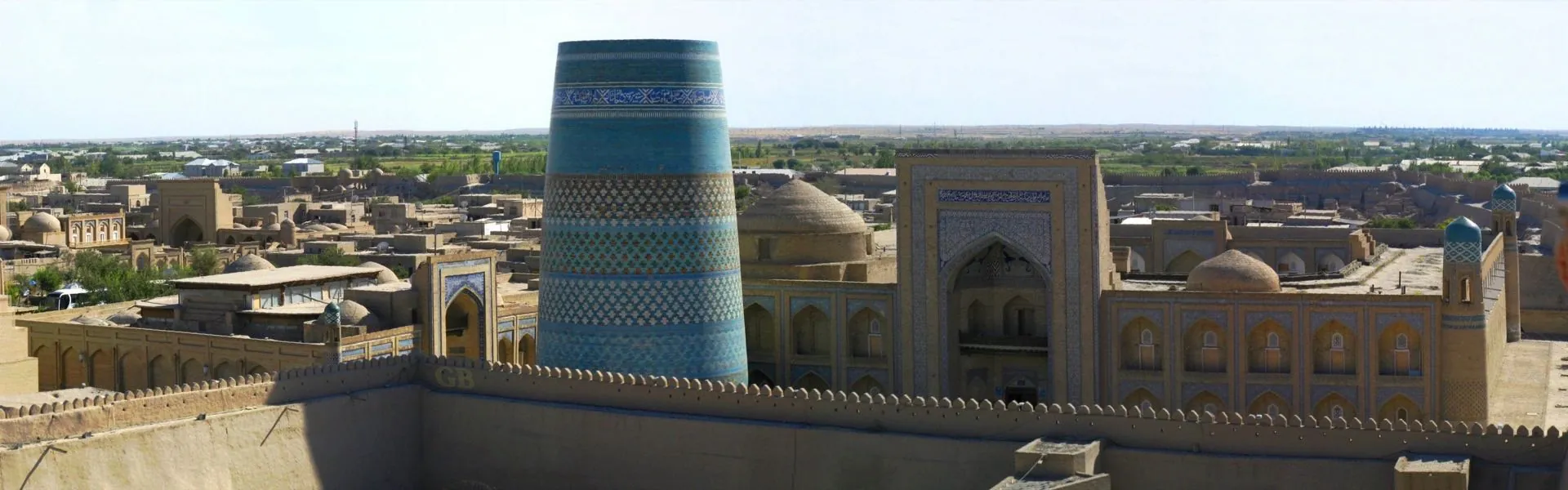
Khiva on foot: the city is small, the load is real
Itchan Kala seems perfect for walking: inside the walls everything is close, and the main gates, madrasahs, minarets, and courtyards are linked by short streets. But that compactness is exactly what can fool you. In an hour you may cover only a few kilometers, yet take on a lot of heat stress: stone and clay heat up, there is little shade at midday, and the uneven paving makes the muscles in your feet, calves, and thighs work harder.
The good news: Khiva is excellent for walks if you do not try to “tick off everything” during the hottest part of the day. Think not like a tourist with a checklist, but like someone who spreads out their steps: morning for Itchan Kala, daytime for rest and indoor spaces, evening for the walls, parks, and easy loops. If you want to compare with regular city walks, take a look at this selection of routes around Khiva.
- Go out early in the morning or after 17:30: at midday, keep walking to short transfers only.
- Plan your route in 20–40 minute loops so you can always step into shade, a café, a museum, or your hotel.
- Bring extra water: at least 0.5 l for every hour of easy walking, more if you are walking in summer and sweating a lot.
- For cobblestones, choose closed sneakers or sandals with a fixed heel, grippy sole, and no high heel.
- Count steps roughly: on uneven ground your stride is shorter, so 2 km in Khiva can feel like 3 km on a smooth sidewalk.
When to go out: two windows instead of one long trek
The best rhythm for Khiva is two walks a day. The first starts soon after sunrise and lasts until the sun begins to burn the walls and the square by Ota-Darvoza. The second is closer to evening, when building shadows grow longer and the stone gradually releases heat. If you love steps, do not aim to do 10,000 in one go: in a hot city, it is safer to collect them in parts. This steps-to-kilometers conversion will help with the math.
| Time | What to do | Pace | Why it works |
|---|---|---|---|
| 06:00–09:00 | Main walk through Itchan Kala | Easy, with pauses | Less heat, softer light, easier to watch your step |
| 09:00–11:00 | Short transfers, museums, breakfast | Very relaxed | Heat is building, but you can still move through shade |
| 11:00–16:30 | Break, nap, lunch, covered courtyards | Do not plan steps | Higher overheating risk, short shade |
| 17:30–20:30 | Walls, park, outer loop, photos | Conversational pace | Shadows are longer, rhythm is easier to maintain |
If you step out of the shade and after 3–5 minutes are already looking for somewhere to sit, that is not weakness. It is a signal to shorten the loop, not to “push through one more sight.”
Routes: realistic Khiva loops in km and steps
Below is not a sightseeing checklist, but a set of workable walking loops. Steps are estimated roughly at 0.70–0.75 m per step. On cobblestones, in crowds, and in heat, your stride often becomes shorter, so the actual number on your tracker may be higher. The point of these routes is not to “see everything,” but to walk the city without overheating.
| Route | Distance and steps | Start and how to get there | When to go |
|---|---|---|---|
| Ota-Darvoza — Palvan-Darvoza — return loop inside the walls | 1.5–2 km, 2000–2700 steps | Start at the western gate; from the station, take a taxi or walk only in the morning | Morning before 09:00 |
| Outer loop along the walls of Itchan Kala | 2.2–2.5 km, 3000–3400 steps | Start at Ota-Darvoza, keep the walls on your left, return to the gate | After 18:00 |
| Itchan Kala — Nurullabay Palace — back | 2.5–3 km, 3300–4000 steps | From the western gate, go northwest into Dishan-Kala; part of the route is exposed | Morning or a cool evening |
| Itchan Kala — Lokomotiv Park — station | 1.4–2 km, 1900–2700 steps | Good on arrival day: the park and Amir Temur Street are between the old city and station | Just not at midday |
| Arda Khiva canal | about 2 km, 2700 steps | This is a separate taxi ride from the old city, not a walking link with Itchan Kala | In the evening, if the complex is open for your visit |
Classic Itchan Kala does not have the kind of city waterfront you might expect for a long walk by the water. The water loop is the separate modern Arda Khiva complex with a canal; treat it as an evening outing, not a replacement for a walk through the old city.
Shade and pace: how to walk Itchan Kala without overheating
In the heat, you choose a route not by the shortest line, but by the shade. In Itchan Kala this matters especially: narrow streets can suddenly open into exposed squares where the sun hits your head directly. Before you go out, look at the map not as a tourist, but as a pedestrian: where are the gates, covered passages, courtyards, places to buy water, and your hotel or a café.
- Walk on the side of the street with longer shade, even if it adds 100–200 meters.
- Cross open squares without stopping, and take breaks by a wall, in a gate, or in a courtyard.
- Keep a pace at which you can speak in full sentences. If your speech breaks up, slow down.
- Every 20–30 minutes, take a short 3–5 minute pause: take off your backpack, drink, check how you feel.
- Do not chase stairs, viewpoints, and walls during the hot hour: climbing sharply increases the load.
In Khiva, a good route is not the shortest line on the map, but a chain of shade, water, and places where you can stop before fatigue becomes a problem.
Water: how much to carry and how to drink
For an easy walk through Itchan Kala, count at least 0.5 l of water for every hour. In June–August, if you are walking for more than an hour, it is better to have 0.75–1 l per person or know in advance where you will buy the next bottle. Do not drink it all at once: sip small amounts every 10–15 minutes. If your sweat is salty, your clothes quickly show white marks, or the walk lasts more than 1.5–2 hours, add an electrolyte drink or salty food at your next meal.
- Drink water before you go out, not only once you already feel thirsty.
- Do not start a walk after alcohol or a very heavy lunch: in the heat, it makes effort harder to tolerate.
- Keep one small bottle within reach and the extra supply in your backpack; that way you will not postpone drinking.
- If your urine becomes very dark, you have a headache, or you feel dizzy, end the route and get somewhere cool.
- Do not try to “flood” yourself with endless water: during long hot activity, both fluid and salts matter.
Stop, move into shade or an air-conditioned space, and ask for help if you develop severe weakness, dizziness, nausea, confusion, chills in the heat, fainting, or you can no longer speak normally. Confusion, fainting, or worsening condition requires urgent medical care.
Cobblestones: why your legs get tired faster
The stone streets of Itchan Kala are beautiful, but for your feet they mean constant small adjustments. On smooth asphalt, your step repeats almost automatically. On uneven cobblestones, your brain and muscles keep deciding every second where to place the foot, how to hold balance, and how much to bend the knee. So after 6000 steps in Khiva, you may feel more tired than after 9000 steps along a flat waterfront in another city.
- Best choice: lightweight walking sneakers with a grippy sole and fixed heel.
- Acceptable: trekking sandals with a heel strap, as long as the sole does not slip on smooth stone.
- Bad idea: flip-flops, thin ballet flats, platform shoes, high heels, or a new untested pair.
- Choose breathable socks without rough seams; if you are prone to blisters, tape risk zones before you go out.
- After the walk, check your feet: hot dry weather plus stone can quickly cause rubbing.
Do not test a new pair for the first time in Itchan Kala. Walk in them for 30–40 minutes on a flat street or near your hotel. If the heel slips or your toes hit the front on a downhill, cobblestones will make it worse. More details are in the guide to walking shoes.
How to get there without spending your energy before the start
Khiva railway station is not right by the gates of Itchan Kala: it is about 1.4 km to the old city along urban streets. On a cool morning, that can be a decent warm-up, but with a suitcase, after a night train, or on a summer day, it is better to take a taxi to Ota-Darvoza, drop your things, and start your steps already traveling light.
- If you arrive in the morning: water, toilet, luggage — and only then the walk. Do not start with an 8–10 kg backpack.
- If you are staying inside Itchan Kala: make short loops from your hotel, not one big circuit.
- If you are staying near the station or Lokomotiv Park: use the park as a gentle evening section, and go to Itchan Kala in the morning or take a ride.
- If you are going to Arda Khiva: plan it as a separate evening walk by the canal, not as a continuation of a hot day in the old city.
One-day plan: steps without overheating
The most comfortable day in Khiva looks like this: 4000–6000 steps inside Itchan Kala in the morning, rest during the day, then another 3000–5000 steps in the evening along the outer loop, through a park, or on a calm street. This way you get in a solid amount of movement without putting your body in a situation where heat, stone, and fatigue hit all at once.
| Scenario | Morning | Day | Evening |
|---|---|---|---|
| Gentle | 1.5 km inside the walls | Rest and a museum | 1.5 km by the walls or park |
| Active | 2–3 km Itchan Kala plus courtyard | Nap, water, lunch | 2–2.5 km outer loop |
| With children | Short 40 minute loop | Break somewhere cool | Park or gates without rushing |
| After a train | Taxi to hotel, 20 minute warm-up | Recovery | Easy loop by the walls |
Questions and answers
Can you walk around Itchan Kala in July?
Yes, but not in a “11 to 16 all on foot” mode. In July, plan an early morning, a long daytime break, and an evening. If you want more detail on physiology and tactics, read this piece on how to walk in the heat.
How much water should you take for a walk in Khiva?
For an easy hour, take at least 0.5 l. In strong heat or for a 2-hour loop, take 1–1.5 l per person, or choose a route where you are sure you can buy water along the way. Sip little by little instead of waiting for strong thirst.
Can you walk through Itchan Kala in sandals?
Yes, if they are sports sandals with a fixed heel, grippy sole, and decent cushioning. Flip-flops and thin soles are a bad choice: the foot gets tired, toes catch, and the risk of twisting an ankle is higher.
Where can you get steps if you have already covered the old city?
Do the outer loop along the walls, walk toward Nurullabay Palace, take the section to Lokomotiv Park, or plan an evening trip to the Arda Khiva canal. In the heat, choose not the longest option, but the shadiest one.
Do you need trekking poles?
For ordinary Itchan Kala, usually no. But if you have balance issues, knee problems, or are recovering after an injury, one light folding pole can add confidence on uneven stone. The main thing is not to get in other people’s way on narrow streets.
Sources
- UNESCO World Heritage Centre: description of Itchan Kala, area of 26 ha, inner city dimensions of 650×400 m, walls up to 10 m. UNESCO: Itchan Kala
- Golden Pages Uzbekistan: Khiva railway station address and approximate distance to Itchan Kala of about 1.42 km. Khiva Railway Station
- Weather Atlas: climate data for Khiva, including an average July high of about 37 °C. Khiva July weather
- CDC Travelers’ Health: recommendations for hot climates, rest in shade, drinking, and signs of heat illness. CDC: Heat Illnesses
- Sawka M. N. et al. Exercise and Fluid Replacement. Medicine & Science in Sports & Exercise, 2007. DOI: 10.1249/mss.0b013e31802ca597
- Périard J. D., Eijsvogels T. M. H., Daanen H. A. M. Exercise under heat stress. Physiological Reviews, 2021. DOI: 10.1152/physrev.00038.2020
- Voloshina A. S. et al. Biomechanics and energetics of walking on uneven terrain. Journal of Experimental Biology, 2013. DOI: 10.1242/jeb.081711
- Menant J. C. et al. Effects of Shoe Characteristics on Dynamic Stability When Walking on Even and Uneven Surfaces. Archives of Physical Medicine and Rehabilitation, 2008. DOI: 10.1016/j.apmr.2008.02.031
- Azar E. et al. An observational analysis of shade-related pedestrian activity. Buildings & Cities, 2025. DOI: 10.5334/bc.574
- AboutThePoint: Khiva Lokomotiv Amusement Park on Amir Temur Street, with park description and coordinates. Khiva Lokomotiv Park
- Kun.uz: opening of the Arda Khiva tourist complex and a canal about 2 km long. Arda Khiva complex
- Turkestan Travel: Nurullabay Palace in Dishan-Kala, its location on Mustaqillik Street, and the historic garden. Nurullabay Palace

Count your steps with Qozgal
A free app that counts your steps, keeps your streak and motivates you to walk every day.