What heat does to your body
Once the air goes above 30°C, the body starts working harder to stay cool. The main mechanism is sweating. Sweat evaporates and takes heat with it. When humidity is high, sweat evaporates more slowly — and cooling suffers
Walking at the same speed in heat raises your heart rate noticeably. It's called cardiac drift: at the same workload, heart rate creeps upward over minutes as the heart compensates for blood diverted to the skin for cooling. For healthy adults this is fine. For older adults, people with cardiovascular conditions, or anyone not acclimatised — it's already risk territory
Skipping walking entirely in summer is also a bad idea. The streak dies, fitness drops. The goal is to find a safe window
The dangerous combo: it's not just temperature
Air temperature alone doesn't tell the whole story. The body suffers from a combination of heat, humidity, sun, and wind. Sport medicine uses WBGT (wet bulb globe temperature) — it factors all of these together
Rough thresholds from ACSM (American College of Sports Medicine):
- Below 27°C WBGT — walk as usual
- 27-30°C — slow pace, drink more, find shade
- 30-32°C — short walks, breaks every 15-20 minutes
- Above 32°C WBGT — recreational walking is not recommended for most. Shift it to morning or evening
In practice in Shymkent in July, midday WBGT often tops 32. Tashkent too. Almaty is lower thanks to altitude and mountain air, but on windless smog days the limiting factor flips to air quality
The best walking windows in KZ and UZ
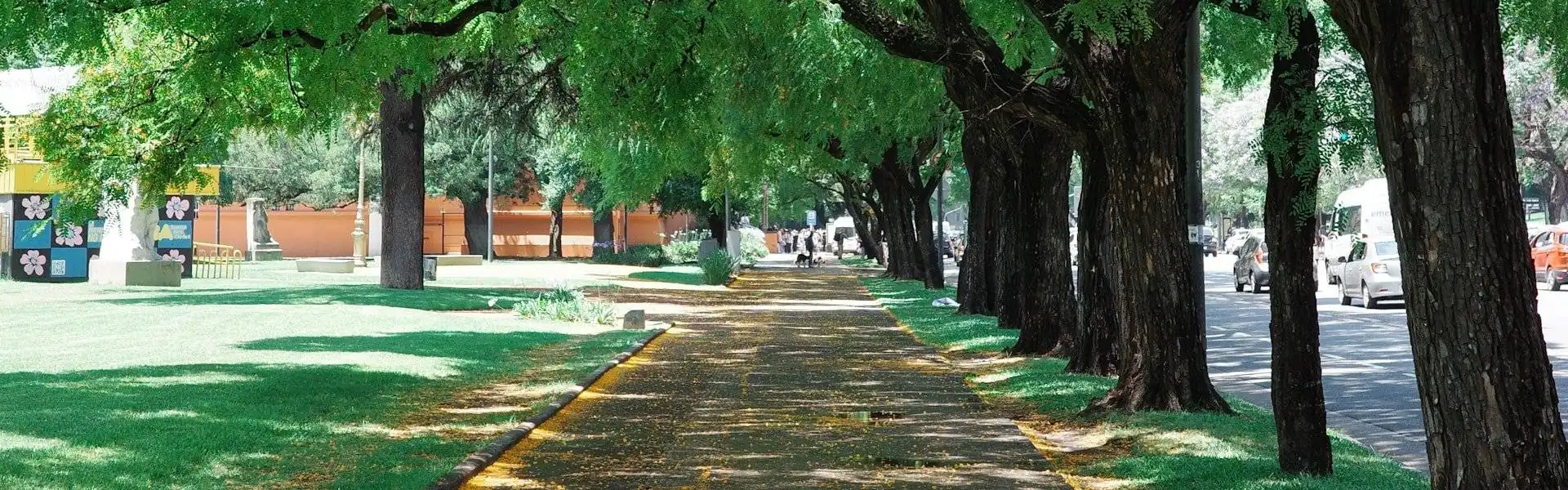
Universal rule for the region: 5:30-8:00 AM and after 8:30 PM. At those hours UV index is lower and heat is bearable
Morning beats evening for two reasons:
- Sidewalks and asphalt have not yet stored the day's heat. By evening they're still radiating until midnight
- Air is usually cleaner — dust and exhaust have settled overnight
In the southern cities (Shymkent, Taraz, Kyzylorda, Tashkent, Samarkand, Bukhara) — summer mornings become the only real walking window
Clothing, hydration, electrolytes
What works:
- Light, loose, breathable clothing. Cotton or technical fabrics with UPF 30+. Dark clothes heat 5-10°C more than light ones in direct sun
- A wide-brim hat, not a cap. A cap only covers the forehead. A brim covers the neck too
- Sunglasses (UV 400) — especially in Almaty, where summer UV index often runs 8-10
- SPF 30+ on all exposed skin 15 minutes before going out. Don't forget the back of hands and back of the neck
- Water: 500-700 ml per hour in heat. Not in one gulp — small sips every 10-15 minutes
- Electrolytes if you walk more than an hour. A pinch of salt in your bottle or a rehydration sachet from the pharmacy. Without them, long sweating can cause hyponatremia — nausea and weakness easy to confuse with heat stroke
Heat stroke symptoms — when to turn back
Heat stroke is not just "tired". It's when the body stops cooling itself and core temperature rises. Untreated, it's an emergency
Symptoms in escalating order:
- Heat exhaustion: heavy sweating, weakness, dizziness, nausea, headache, fast pulse. Skin cool and clammy. What to do — shade, drink, cool water on neck and wrists. The walk is over
- Heat stroke: dry hot skin (the body has stopped sweating!), confusion, core temp above 40°C, possibly vomiting. This is a medical emergency. Call 103 (KZ/UZ), and while waiting — cold water, ice packs to armpits and neck
Any of the early signs is a reason to head back. The streak isn't worth a hospital visit
Plan B: walking pad and the mall
If outdoor WBGT is 32+ or smog is bad, two strategies:
- A walking pad at home. A walking-only treadmill costs ₸70-150K, takes little space, folds under a bed. 4 km/h + a series — 1.5 hours give you 8,000 steps in air conditioning. Not for every flat (noisy), but solves three months of summer
- The mall. Mega in Almaty, Mega Silk Way in Astana, Compass Mall in Shymkent, Tashkent City Mall and Magic City in Tashkent — all have 1.5-2 km of corridors. AC, free toilets, cafés. Not the most inspiring scenery but the steps count
A third option — covered markets and shaded embankments. In Almaty — Terrenkur and shaded park alleys. In Tashkent — Anchor after 7 PM. In Shymkent — the covered streets of the old centre
City by city
Almaty. Altitude 700-900 m softens the heat — rarely above +33-35°C in the day. The summer enemy is smog on windless days. The site airkaz.org shows live PM2.5. Above 50 µg/m³ — wait it out. The trick: get above 1,100 m — Kok-Tobe, Medeu, the Presidential Park. Cleaner air, 3-5°C cooler
Shymkent. The hottest of Kazakhstan's major cities. July-August daytime +35-42°C, dry air. Sidewalks in sun hit +60. Real windows — before 8 AM and after 9 PM. Abai Park, Koshkar-Ata embankment, the shaded streets of the old centre. Above 35 — don't go out without a real reason
Tashkent. Heat +35-42°C plus elevated humidity from aryks and greenery. It "feels" hotter than Shymkent at the same numbers. Best window — early morning. Anchor, Yangi O'zbekiston, the Botanical Garden offer shade. The Alisher Navoi park with its fountains is a saviour on the hottest days
Bukhara, Samarkand, Khiva. Very dry heat. Old cities — stone walls, narrow shaded alleys, historically built for summer. Registan at dawn is a great walk. From 10 AM to 6 PM — inside, museums, stone caravanserais
Astana, Karaganda, Pavlodar. Continental climate: heat is short and sharp, plus steppe winds. Rarely above +35, but with dust wind, walks turn into sandpaper for the eyes. Better — waterside parks: the Esil embankment in Astana, Pushkin Park in Karaganda
How to keep the streak through summer
Practical rules that work for most people:
- Shift your schedule. Wake up an hour earlier — it pays off. A morning walk before 8 in Shymkent gives you a clean 5-7K steps without pain
- Split into two walks. 4,000 in the morning, 4,000 in the evening — same 10K, no peak heat
- Check the forecast ahead of time. WBGT, UV index, PM2.5. Apps: Windy, AccuWeather, AirVisual, airkaz
- Don't tough it out. First day of heat, cardiovascular issues, or just visiting and not acclimatised — pick walking pad or mall
- Use freezes if needed. Qozgal has streak freezes for days when going out isn't safe. That's part of a healthy habit, not a "loss"
And if you want concrete shaded routes in your city — we have city guides for 24 cities in Kazakhstan and Uzbekistan with season and shade notes
Sources
- Roberts WO, Armstrong LE, Sawka MN et al. "ACSM Expert Consensus Statement on Exertional Heat Illness." Current Sports Medicine Reports, 2021. → Wolters Kluwer
- Gronlund CJ, Berrocal VJ, White-Newsome JL et al. "Vulnerability to extreme heat by socio-demographic characteristics and area green space among the elderly." Epidemiology, 2014. → LWW
- Kjellstrom T, Briggs D, Freyberg C et al. "Heat, Human Performance, and Occupational Health." Annual Review of Public Health, 2016. → Annual Reviews
- WHO. "Heat and Health." World Health Organization, 2018 fact sheet. → WHO
- CDC. "Heat-Related Illnesses." Centers for Disease Control and Prevention. → CDC

Start counting your steps
Download Qozgal for free — automatic step counting and monthly raffles