Main rule for Nukus: short, early, with a backup plan
Nukus is not a city for heroic daytime walks in summer. A different strategy works better here: 2–3 short outings instead of one long one, more shade and fewer open spaces, plus checking wind and air quality before you leave. That way you can get your steps without overheating, drying out your throat, or taking in an unnecessary dose of dust.
- Go out before 8:00–9:00 or after 19:00; from 11:00 to 17:00 in summer, it’s better to move your steps indoors.
- When dust is visible, the wind is sharp, or PM2.5 is above 55 µg/m³, make only the necessary transfer and finish your steps at home, in a museum, or in an indoor shopping space.
- For shade, choose parks, narrow streets with buildings along the edges, and loops near the center; avoid bridges, empty lots, and the open embankment when it’s windy.
- Keep your pace conversational: if you can’t speak in phrases, your pace is too high for the heat and dust.
- Bring water, a cap or buff, sun protection, glasses, and an N95/FFP2 mask for dusty days.
Why dust here is more than a cosmetic problem
Nukus is in Karakalpakstan, near the area affected by the dried-up Aral Sea. In its place, the Aralkum Desert has formed — a source of salty and mineral dust. When the wind picks up, a walk becomes not just hot but aerosol-heavy: you inhale more particles, while dry air irritates your nose, throat, and eyes faster.
Satellite analysis showed that the dried bottom of the Aral Sea has become an active source of dust and salt storms, and the northeastern and eastern parts of the Aralkum stand out especially clearly as aerosol sources. For walking in Nukus, this means one simple thing: on a windy day, temperature is not the only thing that matters — wind direction, wind strength, and visibility matter too.
Xi X., Sokolik I.N. Aeolian Research. 2015. DOI: 10.1016/j.aeolia.2015.02.004In Nukus, the goal of a walk is not to prove your endurance, but to get your steps at the lowest cost to your breathing and heat balance. If the city is dusty today, the best step is the one you take indoors.
When to go out: a working schedule by season
| Period | Best window | What to do | What to avoid |
|---|---|---|---|
| May — September | Before 8:00–9:00 and after 19:00 | Short loops in parks, the center, a museum route | Midday, open squares, a fast pace |
| October — November | Morning and daytime hours | Longer routes, 6–10 thousand steps at a time | Sharp wind without a buff or glasses |
| December — February | Middle of the day | Short outings of 20–40 minutes | Open, wind-exposed places |
| Dusty day | Only the necessary transfer | Mask, glasses, slow pace, indoors | Embankment, bridge, speed workout |
Heat red flag If you feel dizzy, get chills in the heat, feel confused or nauseous, have severe weakness, or stop sweating — go somewhere cool immediately, drink small sips, and ask for help. This is no longer a question of willpower.
This position statement on heat illness emphasizes that risk increases with heat, dehydration, lack of acclimatization, and insufficient rest. For ordinary walking, the takeaway is practical: start with short outings, take breaks in the shade, don’t speed up in the heat, and don’t set out on a long route if you’re sick or slept badly.
Casa D.J. et al. Journal of Athletic Training. 2015. DOI: 10.4085/1062-6050-50.9.07The tricky thing about dry heat is that sweat evaporates quickly, so it can feel like there is hardly any strain. But you are still losing water. So in Nukus, don’t wait for strong thirst: take 2–3 sips every 10–15 minutes, especially if you’re walking for more than half an hour.
How to read wind, dust, and PM before going out
- First, check the temperature, wind gusts, and warnings from Uzhydromet. For Nukus, degrees are not the only thing that matters — so does any mention of blowing dust near the ground or a dust storm.
- Check PM2.5 and PM10 at a monitoring station or in an air-quality app. If the data is delayed, trust your eyes: a hazy horizon, grit on your teeth, or stinging eyes is enough reason to shorten your walk.
- Assess wind direction. If dust is coming from open northwestern or western directions, don’t plan the embankment or bridge.
- Don’t look at one indicator alone; look at the combination: heat above 35°C plus wind plus dust is a reason to replace a training walk with calm everyday walking.
- If you have asthma, COPD, cardiovascular disease, or a cold right now, your threshold for canceling an outdoor walk should be lower.
The model by Tainio and coauthors compared the benefits of active transport with the harms of PM2.5. In most urban conditions, the benefits of walking remained, but at very high pollution concentrations, risk increased. For Nukus, the takeaway is not to stop walking, but to catch clean windows and not turn a dust storm into a workout.
Tainio M. et al. Preventive Medicine. 2016. DOI: 10.1016/j.ypmed.2016.02.002Qozgal’s simple rule If visibility is good, the wind is weak, and the air doesn’t sting your eyes, do your usual loop. If the horizon is gray and you can feel dust in your mouth, make a short transfer to the nearest indoor space and finish your steps inside.
Routes around Nukus: where to get steps more safely
Below are city options that are easier to adapt to wind and sun. Distances are approximate: step length depends on height and pace. If you want a separate list of city walks, see our guide where to walk in Nukus, and if you’re converting steps into kilometers, this breakdown will help: how many kilometers are in 10 000 steps.
| Route | Distance and steps | How to get there | When to choose it |
|---|---|---|---|
| Berdakh Park → Savitsky Museum → square | 3–4 km, 4500–6000 steps | On foot from the center; start at Berdakh Square | Morning, evening, moderate wind |
| Center → Doslyk Avenue → Amir Timur City Park | 4–5 km, 6000–7500 steps | On foot from central hotels or a short taxi ride | When you need a flat urban route |
| Nukus Park / central park loops | 2–3 km, 3000–5000 steps | Taxi or a 15-minute walk from the Savitsky Museum | For shade, family, an easy pace |
| Savitsky Museum + Berdakh Museum | 2000–4000 steps inside and nearby | Center, convenient by taxi in the heat | Dust, heat above 38°C, recovery day |
| Amu Darya and the bridge toward Khodjeyli | 4–6 km, 6000–9000 steps | Taxi 10–15 minutes or minibuses toward Khodjeyli | Only when the wind is light and not at noon |
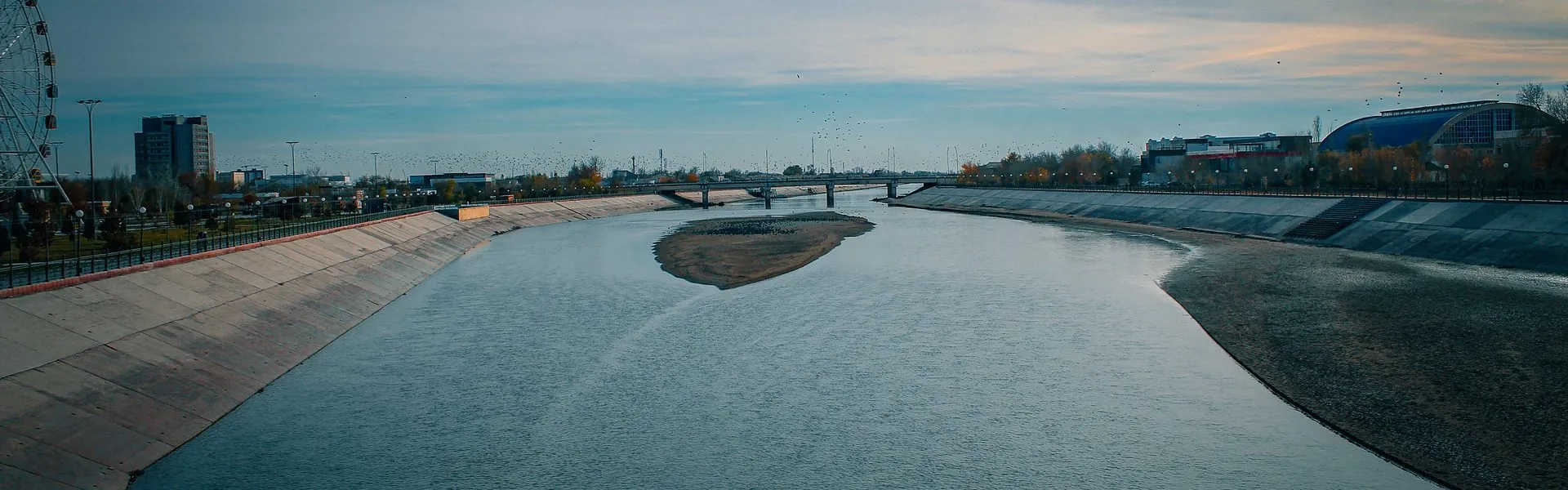
About the Amu Darya embankment It’s a beautiful but open route. It’s good at a quiet sunrise or on a mild autumn day. In the wind, there is little protection there: dust, sun, and side gusts quickly take away the comfort.
The most universal option for a daily goal is not one long loop, but a combination: 20–30 minutes in a park in the morning, everyday steps indoors during the day, and 20–40 minutes around the center in the evening. That way you’ll get 7000–10 000 steps without overheating and without extra dust.
How to choose a sheltered path
- Walk on the shady side of the street, even if it’s longer. In Nukus, an extra 300–500 meters in the shade is often easier than a short route under direct sun.
- Stay in blocks with trees and buildings on both sides: they partly cut the wind and reduce the flow of dust around your face.
- Don’t stand for long in open squares. Cross them — then move back toward shade, facades, or a park.
- In a side wind, use a buff, glasses, and a visor. Glasses don’t only protect you from the sun; they also protect you from sand and dry irritation.
- Don’t speed up against the wind. Your breathing gets deeper, and you inhale more dust. It’s better to shorten the route than to increase the pace.
In a randomized crossover study, people with coronary heart disease walked around Beijing with and without a high-efficiency mask. The mask reduced personal exposure to particles and improved several cardiovascular indicators. For Nukus, this is not a license to walk in a storm, but it is a good argument for keeping an N95/FFP2 in your backpack on dusty days.
Langrish J.P. et al. Environmental Health Perspectives. 2012. DOI: 10.1289/ehp.1103898A mask does not replace common sense If dust is hanging like a wall, a mask helps you inhale fewer particles, but it does not solve overheating, dry eyes, or poor visibility. On days like that, choose an indoor space.
What to bring on your walk
- Water: a small bottle for a short outing, 0.5–1 liter per hour of summer walking. If you walk for more than an hour and sweat a lot, add salty food or a drink with electrolytes.
- A cap, panama hat, or light scarf: it’s better to cover your head and neck than simply endure the sun.
- SPF 30+ sunscreen for your face, ears, neck, and hands. In a dry climate, you may notice a burn late.
- Sunglasses: on a windy day, they also work as dust protection.
- A buff or N95/FFP2 mask: not for every walk, but as an emergency filter for a dusty section.
- Closed-upper shoes: sandals collect sand quickly, and overdried skin is more likely to chafe.
Keep your pace by the talk test: you should be able to speak calmly in short phrases. If you have to gasp for air, slow down. For hot Nukus, this matters more than a pretty average pace in an app.
When it’s better to swap the street for indoors
- Temperature around 38°C or higher, especially if the route has no shade.
- Wind gusts with dust, a hazy horizon, or sand visibly blowing across the asphalt.
- PM2.5 above 55 µg/m³ or a sharp rise in PM10 according to monitoring data.
- After illness, with a cough, or during a flare-up of allergies, asthma, or heart problems.
- If you already feel dryness in your throat and stinging in your eyes before the walk starts.
The backup plan in Nukus is simple: the Savitsky Museum, the Berdakh Museum, covered shopping spaces, stairs in your building, corridor walking, a home treadmill, or steps around the apartment. This is not losing to the street. It’s a way to keep the habit when the urban environment is against you today. See a comparison of the pros of outdoors and indoors in the article walking at home or outside.
An 8000-step plan without overheating
- Morning: 2500–3500 steps in Berdakh Park or the central park. Walk before the asphalt heats up.
- Day: 1500–2500 everyday indoor steps — museum, shop, stairs, corridor, home loop.
- Evening: 3000–4000 steps around the center: Savitsky Museum, the square, Doslyk Avenue, a short loop to Amir Timur City Park.
- If the wind picks up: remove the evening outdoor walk and move the steps indoors. Your streak will stay alive, and your lungs will thank you.
The best route in Nukus is the one with a plan B: shade nearby, water with you, and an indoor place you can retreat to without guilt.
Questions and answers
Can you walk in Nukus during the day in summer?
Only very briefly and when necessary: getting to a taxi, shop, or museum. For a walk to collect steps, it’s better to choose early morning or evening. Daytime heat plus dry wind quickly increases the strain.
What’s better in dusty weather: a park or the embankment?
A park. Trees and city blocks provide at least some protection. The embankment and the bridge by the Amu Darya are open to the wind, so on a dusty day they are worse for your breathing and eyes.
How much water should you take for 10 000 steps?
In summer, use 0.5–1 liter per hour of walking as a guide, but adjust for sweat, duration, and how you feel. Drink in advance, in small sips, not only when strong thirst appears.
Do you need a mask for a normal walk?
On a clean, calm day — no. On a windy, dusty day, keep an N95/FFP2 or a tight respirator in your bag. If the dust is heavy, a mask does not make the walk safe: it’s better to go indoors.
Where can you get steps in Nukus if there’s a dust storm outside?
Choose the Savitsky Museum, the Berdakh Museum, covered shopping spaces, stairs, or walking at home. On days like that, the goal is to keep your regular routine, not necessarily to walk outside.
Sources
- Xi X., Sokolik I.N. Dust emission and environmental changes in the dried bottom of the Aral Sea. Aeolian Research, 2015. DOI: 10.1016/j.aeolia.2015.02.004
- Groll M. et al. Aeolian dust deposition in the southern Aral Sea region. Quaternary International, 2016. DOI: 10.1016/j.quaint.2015.12.103
- Banks J.R. et al. Impacts of the Desiccation of the Aral Sea on the Central Asian Dust Life-Cycle. Journal of Geophysical Research: Atmospheres, 2022. DOI: 10.1029/2022JD036618
- Tainio M. et al. Can air pollution negate the health benefits of cycling and walking? Preventive Medicine, 2016. DOI: 10.1016/j.ypmed.2016.02.002
- Casa D.J. et al. National Athletic Trainers' Association Position Statement: Exertional Heat Illnesses. Journal of Athletic Training, 2015. DOI: 10.4085/1062-6050-50.9.07
- Sawka M.N. et al. American College of Sports Medicine position stand: Exercise and Fluid Replacement. Medicine & Science in Sports & Exercise, 2007. DOI: 10.1249/mss.0b013e31802ca597
- Langrish J.P. et al. Reducing Personal Exposure to Particulate Air Pollution Improves Cardiovascular Health in Patients with Coronary Heart Disease. Environmental Health Perspectives, 2012. DOI: 10.1289/ehp.1103898
- World Health Organization. WHO global air quality guidelines: PM2.5, PM10, ozone, nitrogen dioxide, sulfur dioxide and carbon monoxide, 2021. WHO guidelines
- National Tourism Information Center of Uzbekistan. Nukus: top attractions, climate and city information. Uzbekistan Travel
- Agency of Hydrometeorological Service of Uzbekistan. Automatic atmospheric air pollution monitoring station, Nukus. Monitoring station