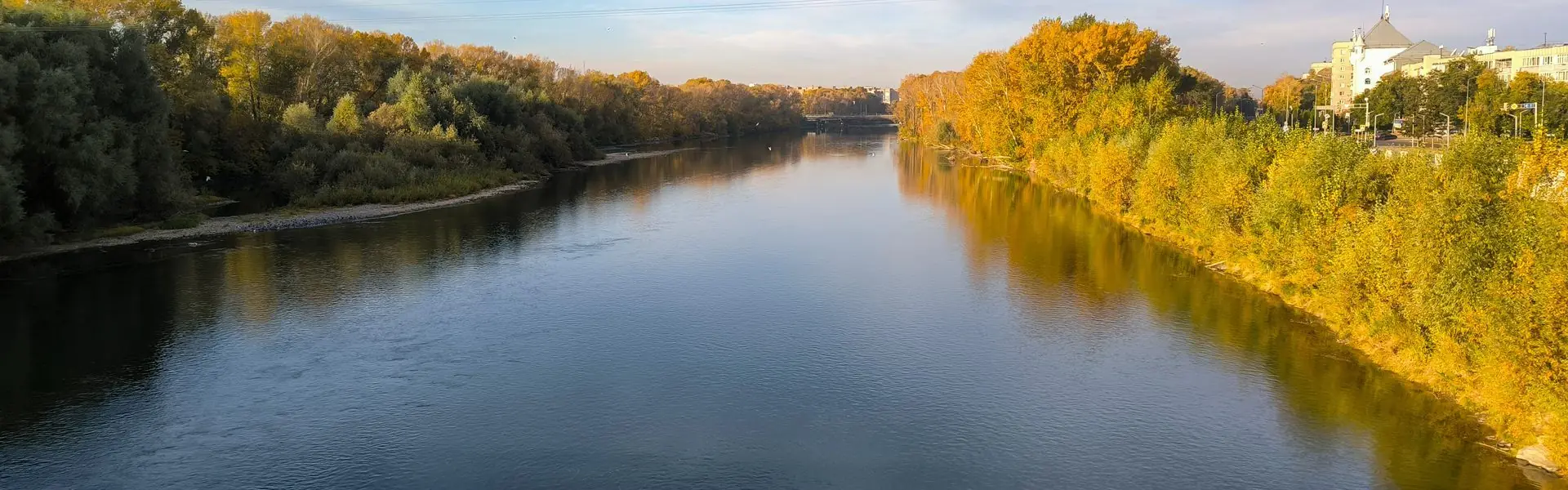
A route by the water: start with the turnaround, not kilometers
In Oskemen, it’s easy to overestimate your energy: the river pulls you farther, the bridges add interest, and you still have to get back. So the working plan is this: choose a starting point, set your turnaround for 15, 20, or 30 minutes, and don’t argue with the plan. That gives you a 30–60 minute walk without the feeling that you’ve “gone too far.”
- The flattest start is the E. P. Slavsky Embankment along the Irtysh: convenient for 30–45 minutes.
- Strelka is great for the view of the Irtysh and Ulba confluence, but the wind feels stronger in open areas.
- It’s better to use the Ulba as an add-on to your route, not as your first long outing after a break.
- For 30 minutes of walking, aim for 3000–4000 steps; for 60 minutes, 6000–8000 steps.
- If the forecast mentions NMU, dense smog, or strong gusts, shorten the route and choose a sheltered park.
How to build a 30–60 minute walk
For a river route, it’s better to think not “how many kilometers,” but “how much energy will I have left for the way back.” If you haven’t walked regularly in a while, start with 30 minutes: 15 minutes from the start and 15 minutes back. After a week, add another 5–10 minutes, but only if your feet, shins, and knees don’t ache the next day.
- Choose a flat start: Slavsky Embankment, the River Station, Sauletai Park, or the entrance to the Left-Bank Complex.
- Walk the first 5 minutes more calmly than usual: it’s a warm-up, not wasted time.
- Keep the main part at a pace where you can speak in full phrases.
- Turn around before you get tired: by the water, wind and the return trip can feel harder.
- Slow down for the last 3–5 minutes, especially if you went up onto a bridge or walked into the wind.
The review by Tudor-Locke and colleagues links steps with activity recommendations: 100 steps per minute can be used as a practical marker of moderate walking, and 30 minutes at that pace gives about 3000 steps on top of normal everyday movement. For a city route, that’s more useful than chasing the round number of 10,000.
DOI: 10.1186/1479-5868-8-79Ready-made sections along the Irtysh
| Route | Distance and steps | Who it suits | How to get there |
|---|---|---|---|
| Slavsky Embankment out and back | 2–3 km, 2600–4300 steps | first outing, evening walk | start by the River Station or Sauletai Park |
| Sauletai → River Station → Strelka → back | 3–4 km, 4000–5700 steps | 30–55 minutes with Irtysh views | landmark — Slavsky Embankment, 40a |
| Strelka + short detour to the Ulba | 3.5–5 km, 5000–7000 steps | when you want bridges and the confluence view | start at the Victory memorial complex |
| Left-Bank Complex along inner alleys | 2–5 km, 3000–7000 steps | wind, kids, relaxed pace | area near the central mosque and Arzan wholesale market |
| Left bank → Strelka → Ulba | up to 9 km one way | only if you already walk regularly | better planned as a long walk, not a beginner one |
Slavsky Embankment is the basic option: a wide line, clear landmarks, nearby stops, and places where you can turn off. If you need a walk without elevation gain, choose this one. Sauletai Park on the embankment works well as a family start: you can walk part of the route, return to the playgrounds, and avoid turning the walk into a chore.
How to count steps without obsessing If your tracker shows less than you expected, don’t force extra loops just to make up the steps. For a route by the water, regularity matters more: 30–40 minutes today is better than 90 minutes followed by a three-day break. If you want to convert your steps into kilometers, keep Qozgal’s guide handy: how many kilometers are in 10,000 steps.
Ulba and Strelka: beautiful, but dose it
Strelka is where the city explains itself best: the Irtysh and Ulba meet here, the Victory memorial complex is nearby, and you get open views and plenty of air. But that same openness makes this section changeable: on a calm evening it feels easy, while in gusty wind the very same path can feel noticeably harder.
- If you’re walking for 30 minutes, don’t go far from Strelka: make a scenic loop and come back.
- If you want 45–60 minutes, add a short section along the Ulba and choose your turnaround point in advance.
- If you’re walking with a child, a stroller, or after illness, leave the bridges for the end of the walk, not the start.
- If your goal is a calm load, don’t speed up on the climbs to the bridge: your pulse rises there on its own.
A meta-analysis of 15 cohorts with 47,471 adults showed that more steps per day are linked with a lower risk of death from all causes, while the benefit curve plateaus at around 6000–8000 steps for people 60+ and 8000–10,000 steps for younger adults. The takeaway for your walk is simple: longer doesn’t always mean better.
DOI: 10.1016/S2468-2667(21)00302-9Wind by the water: the main route factor
Wind feels stronger by the water because there are fewer barriers and more open space. In Oskemen, this is not a small detail: in Kazhydromet’s bulletin for the first quarter of 2025, the city’s average wind speed is listed as 3–13 m/s, with gusts of 15–21 m/s recorded on some days. For a walk, that’s the difference between “pleasantly brisk” and “I want to get home faster.”
The best rule for a river walk: walk into the wind in the first half, with the wind in the second. That way, you won’t find yourself tired and far from the start with the wind hitting your face.
When to shorten the route If flags are stretched out, branches are moving actively, and you have to lean forward on the bridge, don’t play the hero. Shorten the walk to 15–25 minutes or go into a park. In cold weather, wind speeds up heat loss from exposed skin, so gloves, a buff, and a hood matter more than one more kilometer.
How to get to convenient starting points
For Slavsky Embankment, use the stops near the River Station, the Cathedral, and the Central City Library as landmarks: according to city news, the new bus route №37 runs along E. P. Slavsky Embankment and includes these stops. But always check the schedule on the day of your walk — public transport changes faster than walking routes.
- From the center: start at the River Station and walk toward Strelka if you want a scenic route.
- With kids: start at Sauletai, walk 10–15 minutes one way, then return to the playgrounds.
- From the Left Bank: use the Left-Bank Complex as a sheltered warm-up, and go out to the Irtysh only when the wind is reasonable.
- If you live closer to Zhastar Park: walk through the park as a warm-up, then add a short section toward the Ulba, but don’t turn it into a long loop right away.
- If you came by car: choose parking near the start in advance so you don’t finish the walk by crossing noisy streets.
Pace: walk so you can talk
In the CADENCE-adults study of people aged 21–40, a threshold of about 100 steps per minute matched moderate intensity, while around 130 steps per minute was vigorous. For a city guide, that means you don’t need a sporty march. A rhythm is enough if your breathing gets deeper but conversation is still possible.
DOI: 10.1186/s12966-019-0769-6If you’re walking by the Irtysh for your health rather than a record, use the talk test: if you can say 1–2 sentences without pausing, the pace is fine; if you can only manage single words, slow down. This is especially important on open sections and in a headwind: effort rises quietly, while the pleasure of the walk drops quickly.
- Easy day: 70–90 steps per minute, 20–35 minutes, without the goal of “working up a sweat.”
- Regular day: 90–110 steps per minute, 30–45 minutes, deeper breathing, conversation possible.
- Brisk day: short sections at 110–120 steps per minute, but only if there is no pain or strong wind.
- After a break, illness, or a sleepless night: keep the pace easy and check how you feel in the evening.
Safety: surface, bridges, air
River routes are good because they’re flat, but they have their own details: wet paving, sand after wind, ice in winter, curbs near ramps, open bridges, and dense city air on NMU days. If there is fog outside, a smell of smoke, or an official warning about adverse meteorological conditions, don’t try to “push through” a long walk. For days like these, Qozgal has a separate guide to winter smog in Oskemen.
Let the surface set the pace On a flat embankment, you can walk more steadily. On a bridge, paving stones, a wet descent, or by the water after rain, shorten your stride. If your sole slips even once, that’s a sign not to speed up — not a reminder to “just be more careful.”
Kelly and colleagues analyzed prospective cohorts and estimated the benefits of regular walking: at a dose of 11.25 MET-hours per week, the risk of death from all causes was about 11% lower. The most important practical takeaway is that the increase is especially valuable for people who used to walk very little. So start with a route you can manage, not the maximum one.
DOI: 10.1186/s12966-014-0132-xWeekly plan: no overload
The WHO recommends that adults get 150–300 minutes of moderate aerobic activity per week. But that doesn’t mean you need to start by walking for an hour every day. For Oskemen, it’s easier to build the week from short river outings: two times on the embankment, one time at Strelka, one time in a park or on the Left Bank. That gives you volume without turning walking into an exam.
- Monday: 30 minutes along Slavsky Embankment, easy pace.
- Wednesday: 35–45 minutes Sauletai → River Station → back.
- Friday: 40–50 minutes Strelka + a short section toward the Ulba.
- Sunday: 45–60 minutes in the Left-Bank Complex or along sheltered alleys.
- If you want more city ideas, see the general guide where to walk in Oskemen.
Questions
Where is the flattest section for a first walk by the water?
Start on the E. P. Slavsky Embankment by the Irtysh. It’s easier to keep a steady pace there, simple to turn around, and you don’t need to add bridges or a long loop right away.
How many steps will I get in 30 minutes?
Usually 3000–4000 steps if you walk at an easy or moderate pace. If you walk more slowly, that’s fine: what matters more is that the walk is pain-free and you want to repeat it.
Can I walk from the Irtysh to the Ulba in one route?
Yes, but don’t make it your first outing after a break. First get comfortable with 30–45 minutes along the Irtysh, then add Strelka, and only after that add a short section along the Ulba.
What should I do if the wind is strong by the water?
Turn the route around so you walk back with the wind, or shorten the walk. In gusts, it’s better to choose the Left-Bank Complex, Zhastar Park, or another section with trees and buildings nearby.
Do I need exactly 10,000 steps on this walk?
No. A 30–60 minute river walk can already give you 3000–8000 steps. If you want to understand your daily goal, read the guide about 10,000 steps and choose a norm that suits you.
Sources
- World Health Organization. WHO Guidelines on Physical Activity and Sedentary Behaviour: recommendation of 150–300 minutes of moderate aerobic activity per week for adults. NCBI Bookshelf
- Paluch A. E. et al. Daily steps and all-cause mortality: a meta-analysis of 15 international cohorts. The Lancet Public Health, 2022. DOI: 10.1016/S2468-2667(21)00302-9. DOI
- Tudor-Locke C. et al. How many steps/day are enough? for adults. International Journal of Behavioral Nutrition and Physical Activity, 2011. DOI: 10.1186/1479-5868-8-79. DOI
- Tudor-Locke C. et al. Walking cadence and intensity in 21–40 year olds: CADENCE-adults. International Journal of Behavioral Nutrition and Physical Activity, 2019. DOI: 10.1186/s12966-019-0769-6. DOI
- Kelly P. et al. Systematic review and meta-analysis of reduction in all-cause mortality from walking and cycling. International Journal of Behavioral Nutrition and Physical Activity, 2014. DOI: 10.1186/s12966-014-0132-x. DOI
- National Weather Service. Understanding Wind Chill: how wind increases heat loss and why open areas require caution in cold weather. weather.gov
- RSE “Kazhydromet”. Bulletin for East Kazakhstan Region for Q1 2025: wind, NMU, and air observations in Ust-Kamenogorsk. Kazhydromet PDF
- East Kazakhstan Regional Architectural-Ethnographic and Natural-Landscape Museum-Reserve. Description of the Left-Bank Complex in Ust-Kamenogorsk. vkoem.kz
- Komandirovka.ru. Zhastar Park in Ust-Kamenogorsk: overview, address, and GPS coordinates. Komandirovka.ru
- Komandirovka.ru. Victory Memorial Complex at Strelka, near the confluence of the Irtysh and Ulba. Komandirovka.ru
- Noks.kz. News about route №37: the bus runs along E. P. Slavsky Embankment with stops “Cathedral,” “Central City Library,” and “River Station.” Noks.kz
- Votpusk.ru. Sauletai children’s playground on the Slavsky Embankment in Ust-Kamenogorsk. Votpusk.ru
