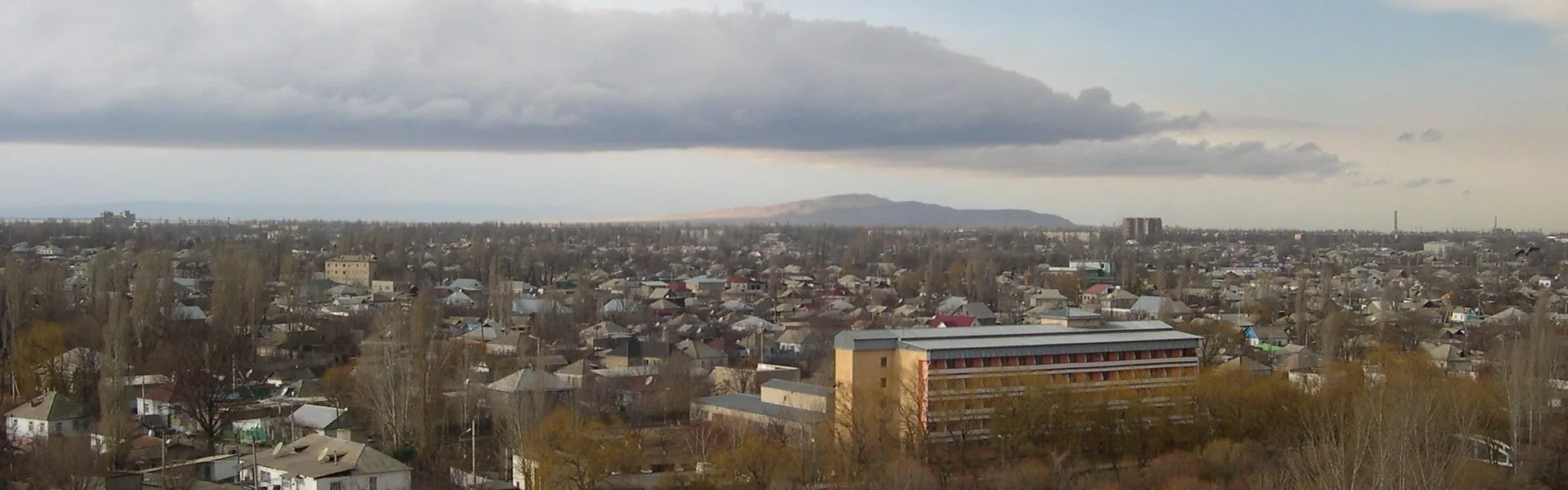
Why summer walking in Taraz needs a plan
Taraz is a city for short, frequent, smart walks, not a heroic march at noon. In July, climate references put the city’s average daytime high at about 35°C, so the main task is not to “push through,” but to lower heat stress: choose an early or evening window, stay in the shade, sip water, and know in advance where you can turn off.
The second feature is wind and dust. Wind can help if it is cool and light, but a head-on gust increases effort, dries your mucous membranes, and makes you speed up your breathing without noticing. That’s why in the hot season it’s better to think not only about kilometers, but also about surface, trees, stops, water, and a backup indoor option.
- The best summer windows are early morning before strong heating and evening after the sun drops.
- In heat, choose loops through parks and the center, not long straight routes on open asphalt.
- For 40–60 minutes, take 0,5–0,75 L of water; for 90 minutes, take about 1 L and something salty if you sweat a lot.
- In wind and dust, lower your pace by one level: the goal is conversational walking, not a record.
- Save Tekturmas for sunrise or sunset: it’s beautiful, but the hill and open sections intensify heat and wind.
When to go: morning, evening, and a midday pause
For Taraz in the hot season, the working rule is simple: start early or late. In the morning, it’s most comfortable to do the main share of your steps before the asphalt and walls have stored up heat. In the evening, it’s better to go out not right after work, but when the sun is lower and the shade from trees and buildings has grown longer. If your only window is lunchtime, turn it into 10–15 minutes of calm walking in the shade, not a full workout.
| Situation | What to do | Pace |
|---|---|---|
| Before 08:30 | Main walk, 40–70 minutes | Normal conversational |
| 09:00–11:00 | Shade only, parks, short loops | 10–20% slower |
| 11:00–17:00 | Indoors is better, or a very short outing | Easy, with no step goal |
| After 19:00 | Historic center, Zhenis, Zhastar | Comfortable, can be longer |
| Wind with dust | Shorten the route and move away from roads | Slowly, with pauses |
Five Taraz routes for the hot season
Below are not sports courses, but city scenarios. Distances are approximate: your step count depends on height, pace, and detours. If you want more options around the city, see Qozgal’s separate guide to Taraz walking routes.
| Route | How to get there | Length | Best time |
|---|---|---|---|
| Köne Taraz → Karakhan → Dautbek | Kh. Bekturganova, center; easy to reach the center | 2,0–2,8 km / 2600–4000 steps | Morning or evening |
| B. Momyshuly Zhenis Park | Victory Park stop, buses №10, 12, 46 | 1,6–2,2 km / 2200–3300 steps | Evening, family-friendly |
| Zhastar Alley → K. Ryskulbekov Park | Start from Zhastar Alley | 2,0–3,0 km / 2800–4300 steps | After 19:00 |
| First President’s Park → monuments | Reach the park by public transport or taxi | 2,5–3,5 km / 3500–5000 steps | Twilight |
| Tekturmas → view of the Talas | Bus №33 to “Tekturmas,” then 1 km on foot | 1,5–2,5 km / 2200–3600 steps | Sunrise or sunset |
If the day is hot and calm, choose a park or the center with short loops. If it’s hot and windy, avoid the open hill and long straight sections. If you’re visiting the city and want photos, it’s better to make Tekturmas the first stop in the morning, not the finale after you’re tired.
Shade matters more than the perfect distance
It’s easy to misjudge Taraz: 2 km looks short on a map, but in open sun it can feel like 5. So build your route not in a straight line, but from shade to shade: trees, the north side of the street, a small park, a courtyard, a museum, a café, a bus stop. If you’re choosing between “shorter in the sun” and “longer through the park,” the second option often wins in summer.
- Before you go out, open a map and mark 2–3 points where you can stop in the shade or step indoors.
- Walk on the side of the street where shade will be ahead of you, not behind you: in the morning and evening this changes the feel a lot.
- On wide squares, don’t speed up “to get through the sun faster” — instead, find a shaded diagonal in advance.
- In a park, make loops: that way you’re always near an exit, water, a bench, or a stop.
- If your soles feel heat from the surface, move to a dirt or tiled section instead of sticking to black asphalt.
Water and salt: how much to bring
For an ordinary walk around Taraz, you don’t need a sports hydration system. But you do need predictability. For 30 minutes in the shade, a few sips before and after are often enough. For 40–60 minutes in summer, take 0,5–0,75 L. For 75–90 minutes, especially if you’re going to Tekturmas or through open areas, take about 1 L and plan a point where you can buy more water.
- 20–30 minutes before going out, drink a few sips of water, especially if you had coffee earlier or spent a long time in an air-conditioned room.
- Drink small amounts every 10–15 minutes, not the whole bottle at the end.
- If the walk is longer than an hour and you sweat a lot, add a salty snack or an electrolyte drink.
- Don’t try to “preload” too much: stomach discomfort and frequent stops will ruin your rhythm.
- After the walk, check simple signs: thirst, urine color, headache, unusual weakness.
If you have heart or kidney disease, significant swelling, salt restrictions, or take diuretics, don’t copy sports advice word for word. It’s safer for you to discuss summer walks and drinking with a doctor.
Wind, dust, and air quality
Wind in Taraz changes a walk not only physically, but also in how you breathe. If dust is visible on the horizon, your eyes sting, or your throat feels scratchy, lower the goal: instead of 60 minutes, do 20–30 minutes in a park or move your steps indoors. For more on pollution-related decisions, see Qozgal’s piece on walking and air quality.
- In a headwind, shorten your stride and drop the speed goal: let your breathing stay steady.
- Wear glasses: they protect against dust better than trying to squint through the whole walk.
- A thin buff or mask can help on a dusty stretch, but if it gets stuffy, slow down or go indoors.
- Don’t walk along a busy road if you can go one block deeper through a courtyard or alley.
- After a dusty walk, rinse your face, drink water, and don’t do a second intense outing the same day.
A summer walk in Taraz should end with the feeling “I could go a little farther,” not “I barely made it.” That’s the best marker that you chose the right time, shade, and pace.
Pace: how not to overheat and still get steps
In heat, it’s better to regulate pace not by ambition, but by the talk test. If you can speak in short phrases without breathlessness, the pace fits. If your phrases break up, your breathing feels dry, and your pulse seems unusually high, slow down. Qozgal has a separate detailed guide on walking in heat.
| Condition | Adjustment | Example |
|---|---|---|
| Sun and 30°C+ | 10–20% below your usual speed | 5 km/h → 4–4,5 km/h |
| Headwind | Shorter stride, relaxed shoulders | Don’t fight the gust |
| Dust | Less time outdoors | 20–30 minutes instead of an hour |
| Climb to Tekturmas | Pause before breathlessness | 2–3 minutes in the shade |
| After eating | Easy walk | 10–20 minutes calmly |
Safety: when to turn back
Every walk needs a stop signal. Turn back or go into a cool place if you notice unusual weakness, dizziness, nausea, chills in the heat, confusion, a severe headache, cramps, or you stop sweating while feeling overheated. This is not a “bad workout” — it’s a reason to cool down and ask for help.
If there is confusion, fainting, very hot skin, severe weakness, or symptoms don’t pass after resting in a cool place, don’t continue the route. Call for help and cool down: shade, a cool indoor space, water on the skin, loose clothing.
- Tell someone close to you where you’re going if the route is long or in the evening.
- Take a charged phone and a little cash for water or a taxi.
- Don’t start a new long walk after a sleepless night, illness, or alcohol the day before.
- For your first summer outings, keep this rule: 2–3 short walks are better than one long one.
- If you want to get more steps, add them in the evening or at home, not during the hottest hour.
Ready-made plans for 30, 60, and 90 minutes
30 minutes: the safe minimum
Choose Zhenis, Zhastar Alley, or a short loop near Köne Taraz. Walk 10 minutes one way, 10 minutes back, and keep 10 minutes for pauses and water. This is a good format for a day when it’s already hot in the morning or a dry wind is blowing.
60 minutes: the main summer walk
Start in the center in the morning: Köne Taraz, Karakhan, Dautbek, then move into the shade of small parks and toward a water point. Or in the evening, do two loops through Zhenis and nearby streets. If you want more hydration details, open Qozgal’s material on water in summer.
90 minutes: only with backup
This is a format for a cool morning, not midday. Tekturmas at sunrise works well: take bus №33 to the “Tekturmas” stop, walk about 1 km to the complex, do a scenic loop, and return before strong heating. If it’s already hot or dusty, it’s better to take a taxi to the starting point and shorten the walking part.
Questions and answers
Can you walk around Tekturmas in summer during the day?
It’s better not to plan Tekturmas for noon. There are open sections, a climb, and wind. Choose sunrise or sunset, take water, and don’t do this route after a long walk through the center.
How much water should you bring for a walk in Taraz?
For 40–60 minutes in summer, usually take 0,5–0,75 L. For 75–90 minutes, take about 1 L, especially if the route is open. Drink in small sips and don’t force yourself to drink more than feels comfortable.
What should you do if dust rises?
Shorten the route, move away from the road, slow down, and protect your eyes. If your throat feels scratchy, you feel dizzy, or it’s hard to breathe, go indoors and reschedule the walk.
How do you know the pace is too high?
If you can’t speak in short phrases, your breathing becomes dry and frequent, and your pulse is unusually high, slow down. In heat, a normal pace is almost always lower than in spring.
Where is it best to walk with city guests in the hot season?
In the morning — Köne Taraz, Karakhan, and Dautbek. In the evening — Zhenis, Zhastar Alley, or First President’s Park. Save Tekturmas for a separate early outing so you don’t mix the hill, heat, and fatigue.
Sources
- Périard J.D., Eijsvogels T.M.H., Daanen H.A.M. Exercise under heat stress: thermoregulation, hydration, performance implications, and mitigation strategies. Physiological Reviews, 2021. DOI
- Sawka M.N. et al. American College of Sports Medicine Position Stand: Exercise and Fluid Replacement. Medicine & Science in Sports & Exercise, 2007. DOI
- Schlader Z.J. et al. Evidence for thermoregulatory behavior during self-paced exercise in the heat. Journal of Thermal Biology, 2011. DOI
- Tainio M. et al. Can air pollution negate the health benefits of cycling and walking? Preventive Medicine, 2016. DOI
- Lee H., Holst J., Mayer H. Modification of Human-Biometeorologically Significant Radiant Flux Densities by Shading. Advances in Meteorology, 2013. DOI
- CDC / NIOSH. Heat-related Illnesses: signs of heat exhaustion and heat stroke, first aid. CDC
- World Health Organization. WHO global air quality guidelines: PM2.5, PM10, ozone, NO2, SO2 and CO, 2021. WHO
- Gov.kz. One-day historical and cultural tourist route around the outskirts and city of Taraz “Taraz – the center of historical tourism in Kazakhstan”. gov.kz
- Historical and Cultural Museum-Reserve “Monuments of Ancient Taraz.” Page about the Taraz settlement and archaeological park. Ezhelgi Taraz
- Welcome.kz. Tekturmas Mausoleum: location, route by bus №33, and walking section of about 1 km. Welcome.kz
- Weather Atlas. Climate and July weather in Taraz: average high and low temperatures. Weather Atlas

Count your steps with Qozgal
A free app that counts your steps, keeps your streak and motivates you to walk every day.