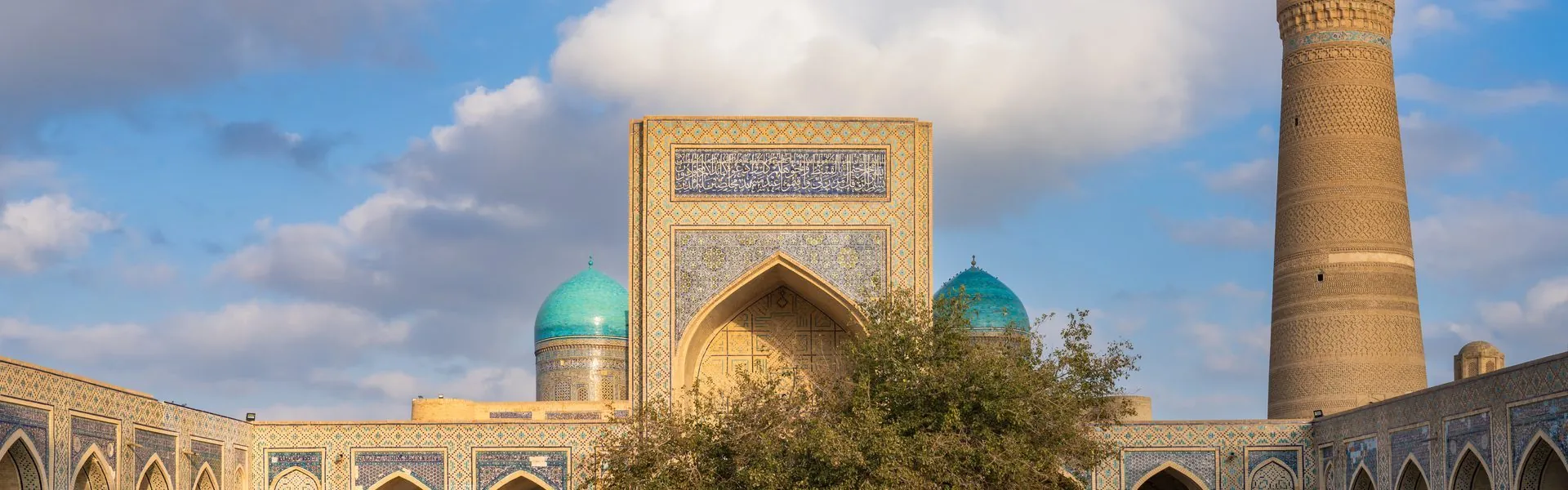
The main idea: Bukhara is short outings, not a marathon
Bukhara’s historic center is compact: Lyabi-Hauz, the trading domes, Poi-Kalyan, the Ark, Bolo-Hauz, Chor-Minor, and Samanid Park can realistically be connected on foot. But in summer, the point is not to “see everything”; it is to move through the city in 20–40-minute series, with shade and water in between.
Bukhara has a lot of stone, brick, and open squares. During the day they heat up and radiate warmth from below, so even an easy pace can feel hard. The working strategy is simple: an early start, a long midday break, and a second evening loop. If you want more general theory about heat, check out the guide to walking in heat; here, we focus specifically on Bukhara.
- Set out for the long loop before 9:30, and after 11:30 plan only shade, a cafe, a museum, or the hotel.
- Think in sections, not kilometers: 600–900 m between breaks is more comfortable in summer than one long push.
- Lyabi-Hauz, the trading domes, narrow mahallas, and Samanid Park are the main “islands” of shade.
- Do not linger on the square in front of the Ark or near Poi-Kalyan at noon: it is beautiful, but open and hot.
- Take water before you start, but do not force yourself to overdrink: it is better to sip in small portions and eat something salty.
When to go out: a schedule against overheating
The best walking window is roughly from 6:00 to 9:30. At this time the stone has not yet reached its daytime heat, and there are fewer groups on the streets. The second good window is after 17:30, when the sun is lower, facades cast longer shade, and Lyabi-Hauz comes alive without the daytime rush.
From 11:30 to 16:30, do not plan to “just walk a little farther.” In a hot, dry climate, sweat can evaporate quickly, so it may feel like everything is under control until weakness, a headache, or nausea appears. During the day, it is better to switch into recovery mode: lunch, tea, a cool room, a shower, sleep.
| Time | What to do | Why |
|---|---|---|
| 6:00–9:30 | Main walking route | Less heated stone and gentler sun |
| 9:30–11:30 | Short shaded transfers | Already hot, but you can still move in measured doses |
| 11:30–16:30 | Indoor break | Open squares overheat you fastest |
| 17:30–21:00 | Evening loop | Shade is longer, and you can slow the pace |
Do not test your limits If you flew in from a cooler climate, do not chase steps during the first 1–2 days. Heat requires adaptation. Start with 4–6 thousand steps around the old town, and add more only if you feel fine.
In this position statement on heat illnesses, the authors recommend gradual heat adaptation over 7–14 days, free access to fluids, early recognition of symptoms, and immediate cooling when overheating is suspected. The practical takeaway for a traveler: do not make your first day in Bukhara your longest route.
Casa D.J. et al., DOI: 10.4085/1062-6050-50.9.07Where to find shade in the old town
In Bukhara, shade is not evenly spread. It appears in pieces: under trees by the water, inside trading domes, in narrow streets, by high walls and colonnades. Plan your route as if you were linking these pieces into one chain. That way the walk stays beautiful without draining you.
- Lyabi-Hauz is the main start and finish: water, trees, chaikhanas, and an easy meeting point.
- The trading domes Toki Sarrofon, Toki Telpak-Furushon, and Toki Zargaron are the best shaded passages between Lyabi-Hauz and Poi-Kalyan.
- The narrow mahallas northeast of Lyabi-Hauz are good in the morning and evening, but do not go there without water and an offline map.
- Bolo-Hauz is a useful break by the pond and columns before or after the Ark.
- Samanid Park is the greenest long break near the Ismail Samani Mausoleum and Chashma-Ayub.
- Cafes, museums, and madrasa courtyards are not “cheating”; they are a normal part of a route in a hot city.
In Bukhara, a good route is not a line on the map but a chain of shade: you reach the next cool place, sit down, drink water, and only then decide whether to continue.
In an experiment in a hot, dry climate, an unshaded paved courtyard remained uncomfortable for most daylight hours. Shade from trees or a canopy noticeably reduced the duration of heat discomfort, and the combination of shade with green cover worked even better. For Bukhara, this is a direct argument: choose trees, domes, and courtyards instead of an open square.
Shashua-Bar L., Pearlmutter D., Erell E., DOI: 10.1002/joc.2177Three routes: in kilometers and steps
The steps below are a guide. I estimate roughly: 1 km ≈ 1300 steps, but your number depends on height, shoes, and pace. If you want to convert your own steps more accurately, there is a separate breakdown of how many kilometers are in 10 000 steps.
| Route | Length | When to go | Main break |
|---|---|---|---|
| Lyabi-Hauz — domes — Poi-Kalyan | 1.6–2.0 km, 2100–2600 steps | Morning or evening | Trading domes |
| Lyabi-Hauz — Ark — Bolo-Hauz — Samanid Park | 3.8–4.5 km, 5000–5900 steps | Morning only | Samanid Park |
| Lyabi-Hauz — Chor-Minor — Lyabi-Hauz | 1.6–2.2 km, 2100–2900 steps | After 18:00 | Lyabi-Hauz |
- Before you start, open an offline map and mark your hotel, Lyabi-Hauz, and the nearest major street for a taxi.
- Walk at conversation pace: if talking is hard, you are going too fast for the heat.
- Every 20–30 minutes, look for a seated break instead of standing in the sun with your phone.
- Do not try to finish all routes in one outing: it is better to do one loop in the morning and another in the evening.
Route 1: Lyabi-Hauz — domes — Poi-Kalyan
This is the best first route through Bukhara in the heat. Start at Lyabi-Hauz, walk around the water on the shady side, then head toward Toki Sarrofon and continue through the trading domes to Poi-Kalyan. The plus side is plenty of shade and small shops along the way. The minus is that Poi-Kalyan itself has open sections, so do not linger there at noon.
How to make the route cooler Do not take the widest sunny street; go through the domes and side passages instead. In Bukhara, an extra 100–200 m in the shade often feels easier than a shorter path under direct sun.
Route 2: the Ark, Bolo-Hauz, and Samanid Park
This loop is beautiful, but you should not schedule it for the middle of the day. From Lyabi-Hauz, walk through the domes to Poi-Kalyan, then on to the Ark. The square by the fortress is open: take your photo and head straight to Bolo-Hauz, where there is water and shade from trees and columns. Then continue to Samanid Park: it is not just a place to “see the mausoleum,” but somewhere you can recover before the way back.
If it is hot, do not walk back. From the park area, it is easier to take a taxi to your hotel or to Lyabi-Hauz. This is not a failed route, but normal city tactics: you cover the historic core on foot and use transport for the overheated tail.
A study in a hot desert city showed that trees and canopies sharply reduce direct solar load, and dense tree shade gives especially noticeable relief for pedestrians. For Bukhara, this supports a simple rule: Samanid Park and Lyabi-Hauz are better places for breaks than a bare stone square.
Middel A. et al., DOI: 10.1016/j.ufug.2019.126429Route 3: evening Chor-Minor
Chor-Minor sits a little away from the main tourist axis, which makes it convenient for an evening loop. From Lyabi-Hauz, walk unhurriedly northeast, choosing streets shaded by walls. There and back will be about 1.6–2.2 km. The route is easy, but take water in the evening anyway: stone walls keep radiating the day’s heat for a long time.
- Choose shoes with soft soles: stone and tile tire your feet quickly.
- Do not walk in thin beach flip-flops: on uneven surfaces they make your toes and calves tense up.
- Watch your step near thresholds, curbs, and old masonry: in the shade, contrast is worse.
- If you want to count steps, turn on your tracker before you start, not after the first photos at Lyabi-Hauz.
Water, clothing, and breaks
For summer Bukhara, the working kit is simple: a brimmed hat, sunglasses, a light long-sleeved shirt, water, a cloth or buff for your neck, and a small snack. SPF sunscreen is needed even if you are “only going for an hour”: clear skies and light stone intensify the feeling of sun.
The ACSM position stand on fluid during physical activity recommends starting exercise in normal fluid balance, drinking according to sweat losses, and avoiding both dehydration and overdrinking. The practical takeaway for a walk: drink regularly in small portions, and on a long hot day add food or a drink with sodium.
Sawka M.N. et al., DOI: 10.1249/mss.0b013e31802ca597- Drink water before you go out, but do not start with an overfull stomach.
- On the route, take 3–5 sips every 10–15 minutes, especially if your mouth is dry.
- If the walk is longer than 2 hours, eat something salty: flatbread, soup, ayran, or salted nuts.
- Save alcohol for the evening after a shower and food: during the day it worsens recovery.
- If you feel dizziness, chills, confusion, nausea, or sudden weakness, stop the walk and move into the cool.
Pace matters more than the record In a hot city, “slow” is not lazy; it is physiological. Reduce your speed by 15–30%, sit down more often, and check how you feel. That is enough to maintain the habit: steps should help you, not knock you out of the day.
How to get there and where to start
The most convenient starting point is Lyabi-Hauz. It is easy to meet there, get oriented, find water, and begin the route on the shady side. If you are staying in the old town, leave your hotel on foot. If you arrived by train, remember: passenger trains arrive at Bukhara-1 in Kagan, about 15 km from the city, so do not plan to walk from the station — take a taxi to your hotel or to Lyabi-Hauz.
- From Bukhara-1 station: take a taxi to the old town, then walk after check-in and water.
- From the airport: take a taxi to your hotel or Lyabi-Hauz; do not start a summer walk from the road outside the terminal.
- From a hotel in the old town: start before breakfast or right after a light breakfast, while the streets have not heated up.
- If you are staying outside the center: take transport to Lyabi-Hauz, the Ark, or Samanid Park, and walk within the historic zone.
A plan for one hot day
| Day block | Plan | Steps |
|---|---|---|
| Early morning | Lyabi-Hauz — domes — Poi-Kalyan | 2100–2600 |
| Late morning | Transfer to the Ark and Bolo-Hauz, short break | 1200–1800 |
| Day | Lunch, museum, hotel, sleep | minimum |
| Evening | Chor-Minor or a second loop near Lyabi-Hauz | 2100–2900 |
This kind of day gives roughly 6–8 thousand steps without feeling like a race. If you usually walk more, add an evening section, not a daytime one: in Bukhara, that is safer and more pleasant. And if you want a more classic list of city sights, see the separate route guide to walks around Bukhara.
Frequently asked questions
Can you walk around Bukhara in July?
Yes, if you treat the walk like a hot urban hike: early start, shade, water, and a long midday break. The worst idea is to do a big loop from 12:00 to 16:00.
Where is the easiest place in the old town to wait out the heat?
Lyabi-Hauz, the trading domes, cafes by the water, museum courtyards, and Samanid Park. For a break, choose somewhere you can sit, not just stand in a narrow strip of shade.
How much water should I take for a short walk?
For 1–2 hours, a small 0.5–0.75 L bottle is usually enough if you drink before leaving and can buy more water. For a long morning loop, it is better to have 1 L per person and planned stops.
Should I walk from Lyabi-Hauz to Samanid Park?
In the morning, yes: it is a good route via the Ark and Bolo-Hauz. During the day, better not. If the sun is already high, take a ride or move the park to the next morning.
What should I do if I feel unwell on the route?
Stop immediately, move into shade or indoors, drink in small sips, and cool your neck and face. If there is confusion, fainting, vomiting, or your condition does not improve, you need medical help.
Final checklist before you go out
- I am going out before 9:30 or after 17:30, not at peak heat.
- I have water, a hat, and a clear next break point.
- The route is split into short 600–900 m sections.
- I know where I can quickly get a taxi: the Ark, Lyabi-Hauz, Samanid Park.
- If I start feeling worse, I will shorten the route without guilt.
Sources
- UNESCO World Heritage Centre. Historic Centre of Bukhara: description of the historic center, Poi-Kalyan, Lyabi-Hauz, and the trading domes. whc.unesco.org
- Uzbekistan Travel. Bukhara: official tourist information about the city, climate, and main sights. uzbekistan.travel
- Uzbekistan Travel. Lyabi-Hauz ensemble: official information about Lyabi-Hauz, the square, the pool, and the infrastructure around it. uzbekistan.travel
- WeatherSpark. Climate and Average Weather Year Round in Bukhara: average temperatures, cloud cover, precipitation, wind, and solar energy. weatherspark.com
- Advantour. Bukhara Railway Station: information about Bukhara-1 station in Kagan and the distance to the city. advantour.com
- Central Asia Travel. Ismail Samani Mausoleum: the mausoleum’s location in Samanid Park and context for the western part of the historic center. centralasia-travel.com
- Sawka M.N. et al. American College of Sports Medicine position stand. Exercise and fluid replacement. Medicine & Science in Sports & Exercise, 2007. DOI: 10.1249/mss.0b013e31802ca597
- Casa D.J. et al. National Athletic Trainers' Association Position Statement: Exertional Heat Illnesses. Journal of Athletic Training, 2015. DOI: 10.4085/1062-6050-50.9.07
- Shashua-Bar L., Pearlmutter D., Erell E. The influence of trees and grass on outdoor thermal comfort in a hot-arid environment. International Journal of Climatology, 2011. DOI: 10.1002/joc.2177
- Middel A. et al. Effects of natural and artificial shade on human thermal comfort in residential neighborhood parks of Phoenix, Arizona, USA. Urban Forestry & Urban Greening, 2019. DOI: 10.1016/j.ufug.2019.126429