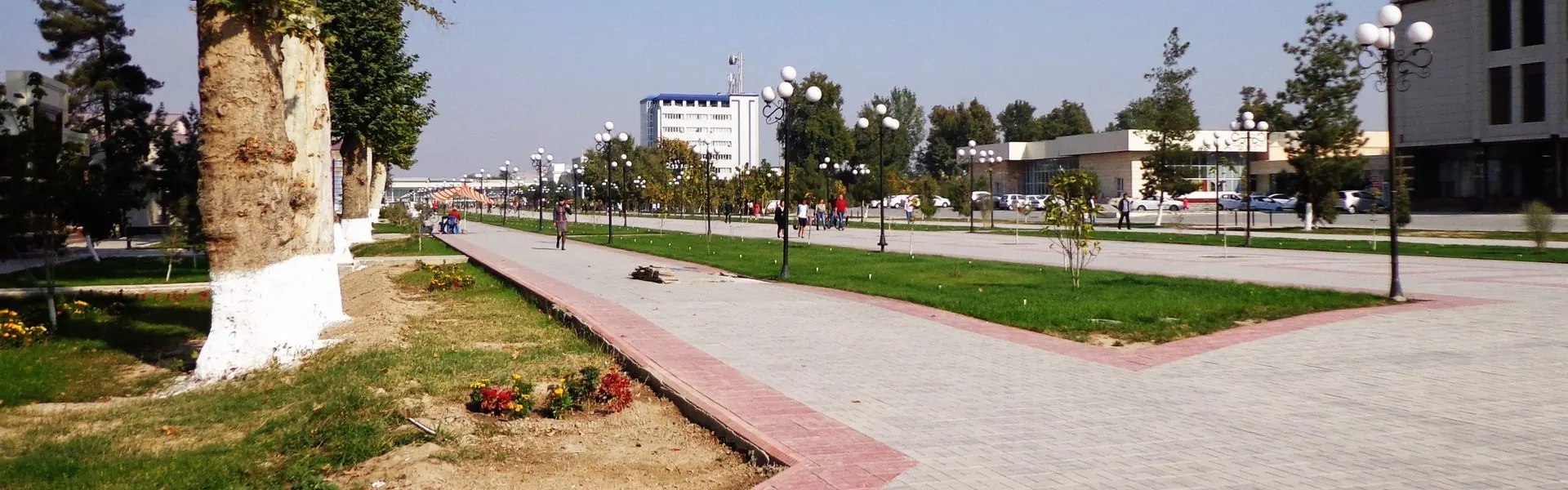
On a hot day, start with the time—not the distance
In Fergana, it's convenient to plan a walk around parks and central avenues, but even a green route can't shield you from the summer sun. Check the forecast and choose hours when the sun is less intense: usually early morning or evening. Use “before 8:00 or after 19:00” as a starting point, not a guarantee of cool weather: a lot depends on the date, cloud cover, and how you feel.
If you can only go out during the day, don't try to make up for the heat by walking faster or taking a longer loop. Choose a short circuit near a place where you can go indoors, sit down, and refill your water. If the forecast calls for extreme heat or includes a heat warning, postpone your walk or keep it brief.
These distances are planning estimates, not measurements of every path on site. Convert kilometers to steps approximately: everyone's stride is different. If you prefer counting steps, check out this guide to how many kilometers are in 10,000 steps, and allow extra distance for loops around the park.
Which routes to choose in Fergana
A short loop: Al-Farghani Park and nearby avenues
The Al-Farghani City Culture and Recreation Park is on Murabbiylar Street. If you're already in the center, walk there along the main streets; if you're starting from another neighborhood, check the current route on a map and, if needed, take a taxi or public transport. Check the bus number on the day of your walk, as routes and stops may change.
For an easy walk, follow the park's avenues, then take the nearest shady stretch of street and return the same way. Plan for about 2–3 km including a loop inside the park—roughly 3–4 thousand steps, though the exact number depends on where you start and how far you walk inside. The main advantage of this option is that you can turn back at any time without getting far from your starting point.
A longer option: the central avenue and a park-to-park route
If you feel well in the morning or evening, make a loop via the central avenue and Al-Farghani Park. One option starts at Central Park, follows the avenues toward Al-Farghani Park, then returns through the central streets. Aim for about 5 km; the exact distance depends on your starting point and the paths you choose. This isn't a required distance: shorten the loop if you start feeling hot or simply want to finish earlier.
You can find detailed directions for central streets and green spaces in the guide to routes in Fergana. Before setting out, open a map, mark your start and finish, and check whether there are benches, open cafés, or shops along the way. For a summer walk, having the option to take a break and shorten your route matters more than completing a perfect loop.
What about the waterfront? For this plan, it's more practical to rely on well-established city avenues and parks than to count on a continuous shady route by the water. Yangi Uzbekistan Park has an artificial lake, but an open area around the water doesn't necessarily mean it's cooler or shadier there.
Build your route around both sun and shade
You don't have to take the shortest route the whole way. If a couple of extra minutes gets you to a tree-lined street or a park, that detour may be a worthwhile trade-off. In a study in hot Tempe, Arizona, people in shaded areas reported feeling more thermally comfortable than those in the sun. This wasn't a measurement of conditions in Fergana specifically, but it's a good reason to choose shade when you can.
The authors compared shaded and open areas throughout the year and surveyed 1284 people. On average, people felt more thermally comfortable in the shade; the effect was observed in spring, summer, and fall. The practical takeaway for your walk: choose shady stretches and don't plan to spend a long time standing in an open square.
DOI: 10.1007/s00484-016-1172-5| Area | How to use it |
|---|---|
| A tree-lined avenue | Use it for most of your route; keep a steady pace rather than speeding up to hit a target. |
| An open intersection or square | Walk through without an unnecessary stop; don't plan a long break here. |
| A park with benches | Plan to rest in the shade and give yourself the option to turn back. |
| A shop, café, or other cool indoor space | Mark it as a backup in case the sun gets stronger or you start feeling unwell. |
“A good summer route isn't one where you push yourself to the limit; it's one where you already know where to rest and how to get back the short way.”
Before setting out, check your route on a map and, if possible, on the ground: shade moves throughout the day, and trees don't cover every stretch of street. If a sunny stretch is long, schedule it for a cooler time, walk through it without stopping, or choose a parallel street. Don't count on water or a park fountain being available: bring drinking water with you.
Plan for water and rest, not just kilometers
Start your walk before you're very thirsty: drink some water beforehand and bring a bottle. While walking, drink in small amounts when you're thirsty. You don't need to force yourself to drink a predetermined amount: the Wilderness Medical Society's recommendations for activity in the heat support drinking to thirst and warn against drinking too much.
It's easier to refill your water somewhere you've marked on a map in advance than to hope you'll happen upon a working tap. For a short outing, you can bring a small bottle; for a longer route, plan where to refill it or buy more. If you have a medically required fluid restriction, follow your doctor's individual advice rather than general guidance.
- Take a break in the shade before you feel very tired.
- Rest for as long as you need to feel ready to walk comfortably again, without feeling worse.
- Choose light clothing that doesn't restrict your movement, and wear a hat.
- Bring your phone and save your starting point in advance so you can call a taxi or take a shorter route back if needed.
A meta-analysis of 96 studies found that repeated exercise in the heat can gradually change physiological responses and perceived exertion; longer adaptation programs had a greater effect. This isn't a reason to go for a walk at midday: for an everyday walk, it's safer to choose cooler hours, slow down, and increase exertion gradually.
DOI: 10.1007/s40279-016-0538-5Practical guidance on preventing heat-related illness also recommends starting activity well hydrated, taking breaks suited to the heat, and using shade to cool down. If you haven't walked in a while or have just arrived during the hot season, start with a short, easy outing. Don't try to prove you're already “used to” the weather in a single walk.
When to shorten or stop your walk
Weakness, a headache, nausea, dizziness, or unusual tiredness are reasons to stop walking, move into the shade or a cool indoor space, and ask for help if you don't start feeling better. Don't keep going in the hope that it will “pass in a minute.” If someone becomes confused, loses consciousness, or acts unusually, it's an emergency: call an ambulance.
Don't test your limits If you feel unwell, stop walking and cool down. If you have trouble finding your way, become confused, or lose consciousness, you need urgent medical help. Don't give a person with impaired consciousness anything to drink.
If you take medication or have a condition that may affect how well you tolerate heat, talk to your doctor about summer activity. Risk and suitable exertion levels vary from person to person; advice about water and walks doesn't replace medical guidance. Read more about walking in hot weather and staying hydrated in summer in our guides to walking in the heat and summer hydration.
Frequently asked questions
What's the best time to walk in Fergana in summer?
Choose early morning or evening, when the sun is less intense. You can use before 8:00 and after 19:00 as a guide, but check the forecast and see how you feel first: sunrise and sunset times change, and the heat doesn't always go away right away.
Which route should I choose if I'm not used to walking in the heat?
Start with a short loop of about 2–3 km: Al-Farghani Park and the nearby avenues, with the option to return the same way. Walk at a comfortable pace, bring water, and mark a place to rest in advance.
Should I go to Yangi Uzbekistan Park for shade?
You can plan a separate outing there: the park has green avenues and an artificial lake. But its large area doesn't guarantee shade on every stretch. Check the route and transport on a map, choose a cooler time, and don't assume the open space by the water will automatically protect you from the sun.
Do I need to drink a specific amount of water per hour?
For an everyday walk, don't set yourself a one-size-fits-all target. Start your walk before you're very thirsty, bring water, and drink when you're thirsty. If your doctor has restricted your fluid intake, follow their advice.
In short: a plan for a hot-day walk
- Choose early morning or evening, and check the forecast.
- Start with a short loop through Al-Farghani Park and the central avenues; make the route longer only if you're comfortable.
- Alternate shady streets and parks, and walk through open areas without taking long breaks.
- Bring water, mark a place to rest, and save a short route back.
- If you feel weak, nauseous, or dizzy, stop, move into the shade, and don't force yourself to continue.
Sources
- Middel A., Selover N., Hagen B. et al. Impact of shade on outdoor thermal comfort—a seasonal field study in Tempe, Arizona. International Journal of Biometeorology, 2016. DOI: 10.1007/s00484-016-1172-5
- Tyler C. J., Reeve T., Hodges G. J., Cheung S. S. The Effects of Heat Adaptation on Physiology, Perception and Exercise Performance in the Heat: A Meta-Analysis. Sports Medicine, 2016. DOI: 10.1007/s40279-016-0538-5
- Eifling K. P. et al. Wilderness Medical Society Clinical Practice Guidelines for the Prevention and Treatment of Heat Illness: 2024 Update. Wilderness & Environmental Medicine, 2024. DOI: 10.1177/10806032241227924
- Qozgal. Where to Walk in Fergana: 10 Routes Through the Green City and to Margilan. Guide to routes in Fergana
- National Information Agency of Uzbekistan. Yangi Uzbekistan Park Opens in Fergana, July 13, 2024. About Yangi Uzbekistan Park
- Golden Pages Uzbekistan. Al-Farghani City Culture and Recreation Park in Fergana: Address. Al-Farghani Park address
