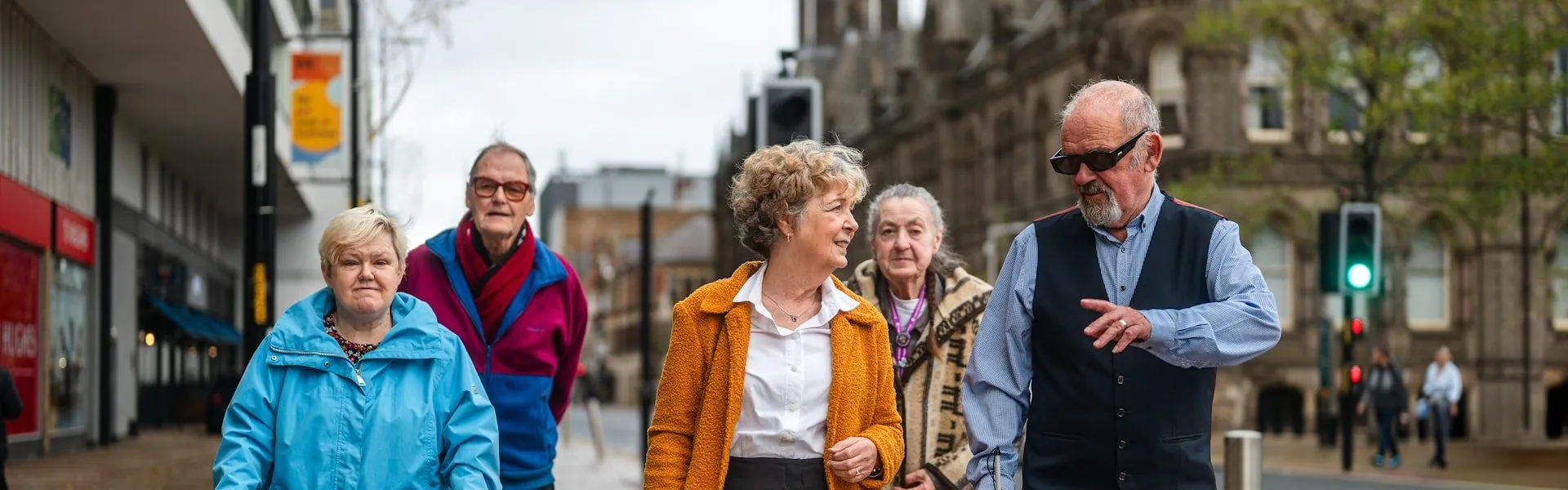
Walking with COPD is not a sport, but training for daily life
With COPD, a walk can feel like an exam: you leave home, make it half a block — and you are already short of air. This is not laziness or being “out of shape.” When the airways are obstructed, breathing out becomes harder, air can get trapped in the lungs, and the leg muscles tire more quickly. So the goal of walking is not a record, but a safe return to everyday life: getting to the store, walking around the yard, and not being afraid of stairs or the bus stop.
- Do not start with 10,000 steps; start with 5–20 total minutes of walking a day, broken into short segments.
- Working breathlessness is moderate: you can speak in short phrases, but not sing.
- “Walk — recover” intervals are often easier than one continuous walk.
- Pursed-lip breathing can help on slopes, when breathlessness speeds up, and during pauses.
- Severe breathlessness at rest, chest pain, blue lips, or confusion are not training — they are reasons to seek urgent help.
These numbers matter not on their own, but as a reference point: walking with COPD has an evidence base, but it does not work through heroics. In studies, improvements appeared where the load was dosed, symptoms were monitored, and the body was given time to adapt.
First, check basic safety
If you already have a COPD diagnosis, it is best to agree on your start with a pulmonologist or the doctor managing your treatment: especially if you have recently had a flare-up, hospitalization, pneumonia, new chest pain, fainting, marked leg swelling, or you have been prescribed oxygen. Walking should not replace inhalers, your flare-up action plan, or rehabilitation.
- Before you go out, check that you have taken your prescribed fast-acting inhaler with you, if you have one.
- Choose a flat route where you can sit down: a bench, entrance hall, yard, long corridor, or shopping center.
- Do your first walks close to home: 6 loops around the yard are better than one long route with no easy way back.
- Do not start a training walk during a cold, fever, increased phlegm, or a noticeable worsening of your usual breathlessness.
- If you have been prescribed oxygen, do not change the flow yourself: your doctor or rehab specialist should advise you on the exercise setting.
When not to “push through” a walk Stop and seek urgent medical help if breathlessness is severe even at rest, you develop chest pain or pressure, cough up blood, have bluish lips or nails, confusion, sudden severe weakness, fainting, or a high fever with worsening breathing. This is not a normal response to walking.
The ATS gives a strong recommendation that adults with stable COPD take part in pulmonary rehabilitation. For someone who finds walking difficult, this is an important signal: movement is part of treatment, but it works best as a dosed program, not as random bursts of effort.
Rochester et al., ATS clinical practice guideline, DOI 10.1164/rccm.202306-1066STChoose your pace by breathlessness, not by steps
With COPD, the most useful “sensor” is not your watch or your pace per kilometer, but your breathlessness. A handy guide is the talk test: at a safe moderate effort, you can speak in short phrases, but longer speech already interferes with breathing. There is more on this approach in the article about the talk test, but for COPD the rule is even stricter: if your breathing speeds up faster than your legs, you need to slow down.
| Feeling | How it sounds | What to do |
|---|---|---|
| Easy | you can speak in sentences | you can keep going or speed up slightly |
| Moderate | you speak in short phrases | this is the working zone for a walk |
| Hard | you speak single words | slow down or take a pause |
| Very hard | you cannot speak | stop and recover |
Do not tie your starting point to the popular goal of 10,000 steps. With breathlessness, what matters more than the number of steps is how quickly you recover after exertion. You can add steps later as a gentle diary: for example, comparing not yourself with a standard, but today’s you with you two weeks ago. If you want to understand your personal baseline, start with the article on how many steps you need.
A good walk with COPD is one after which you feel, “I could do this again tomorrow,” not “I survived.”
Intervals: the gentlest way to start
Interval walking with COPD is not sprinting. It is a way to let your breathing catch up with your legs. You walk a short segment, then slow down or stand still until breathlessness returns to a manageable level. This format is especially useful if continuous walking quickly triggers panic: the walk gains structure, and you get pauses that are allowed in advance.
- Week 1: walk for 30–60 seconds at an easy pace, then rest for 60–120 seconds. Do 6–10 repeats.
- Week 2: keep the same pace, but add 1–2 repeats or shorten some pauses if recovery feels easy.
- Week 3: try 90 seconds of walking and 60–90 seconds of recovery. Do not speed up if breathlessness is above moderate.
- Week 4: build up to 15–25 minutes of total walking, including pauses. It does not have to be continuous.
- After illness or a flare-up, step back 1–2 levels; we covered a similar principle in the guide to returning to walking after illness.
The meta-analysis included 13 randomized trials, most of them in people with COPD. Interval and continuous training produced similar results for endurance and symptoms, while intervals slightly reduced the feeling of breathlessness during exertion. The practical takeaway is simple: if continuous walking is hard, intervals are not a “shortcut” — they are a normal strategy.
Alexiou et al., DOI 10.1177/14799731211041506In a randomized trial, 8-week ground walking training improved endurance walking test time by 279 seconds more than cycle training. For a walking blog, this is important confirmation: it is worth training the very skill you need in daily life.
Leung et al., DOI 10.1016/S1836-9553(10)70040-0How to breathe during a walk
The most practical technique for breathlessness is pursed-lip breathing. Imagine you are slowly cooling tea or blowing through a thin straw: inhale through your nose for 1–2 counts, then exhale through your lips for 3–6 counts. Do not force the air out. The point is not to “pump up the lungs,” but to lengthen the exhale and reduce the feeling of air trapping.
- Start the technique before breathlessness becomes strong: for example, before a small slope or when the wind picks up.
- During a pause, lean slightly forward and rest your hands on your thighs, a railing, or the back of a bench — this helps your shoulders relax.
- Do not hold your breath when starting a step, getting up from a bench, or zipping your jacket.
- If the technique increases anxiety or dizziness, return to normal calm breathing and discuss it with a specialist.
A mini rhythm for the first minutes Try linking breathing to your steps: 2 steps — inhale, 3–4 steps — a long exhale through pursed lips. If the rhythm does not match, do not force yourself into it. With COPD, breathing matters more than a neat pattern.
In a small randomized crossover study of people with stable COPD, the 6-minute walking distance increased by an average of 34.9 meters with pursed-lip breathing, and breathing rate after the test decreased. This does not mean the technique helps everyone equally, but it is worth trying carefully.
Bhatt et al., DOI 10.1177/1479972312464244Route and conditions: remove extra triggers
With COPD, a walk can be disrupted not only by pace, but also by the environment: cold air, heat, dust, smoke, strong wind, slopes, stairs, and long stretches with no bench. So a good route should be boring at first: flat, predictable, with an easy way home. Once you have a base, you can add variety.
- The best start is a flat 3–7 minute loop near home.
- Avoid routes where the first half goes downhill and you have to return uphill.
- In hot weather, go out early in the morning or in the evening; in the cold, cover your mouth and nose with a scarf so the air is warmer.
- If the air quality is poor, choose an indoor option: a corridor, covered courtyard, shopping center, or home treadmill.
- Keep your phone, water, and medication list with you, especially if you walk alone.
Outdoors or indoors? You do not have to walk only outside. If smog, heat, or ice makes breathlessness worse, indoors is a normal substitute. You can compare the pros and cons in the article walking at home or outside.
When to stop, and when to just slow down
Mild to moderate breathlessness during walking is expected. The problem starts when you lose control: breathlessness keeps building despite slowing down, new symptoms appear, or recovery after stopping takes unusually long. Your task is not to endure to the limit, but to stop earlier.
- Slow down if your breathing becomes noisy, you move from phrases to single words, or your legs start to feel heavy.
- Take a pause if breathlessness does not decrease after 30–60 seconds of slower walking.
- Sit down if you develop trembling, severe weakness, dizziness, or a feeling of panic.
- End the walk if, after several pauses, each next minute feels harder than the previous one.
- Contact your doctor if your usual distance suddenly decreases for no clear reason and stays that way for several days.
About the pulse oximeter A pulse oximeter can be useful if your doctor has asked you to track oxygen saturation, but do not make it the only judge. Watch your symptoms. If the numbers are sharply below your usual safe range, stop and follow the plan your doctor gave you.
A 4-week plan
Below is a gentle template, not a standard you must meet. If you have severe COPD, use oxygen, recently had a flare-up, or have heart disease, reduce the volume and agree on the plan with your clinician. Each walk: 2–3 minutes of easy warm-up, the main part in intervals, then 2 minutes of very slow walking or seated recovery.
| Week | Main part | Goal |
|---|---|---|
| 1 | 30–60 sec walking + 1–2 min rest, 6–10 times | find a safe pace |
| 2 | 60 sec walking + 60–90 sec rest, 8–12 times | fear breathlessness less |
| 3 | 90 sec walking + 60–90 sec rest, 8–10 times | build total time |
| 4 | 2 min walking + 1 min recovery, 8–12 times | get closer to an everyday walk |
Progress only one parameter at a time: either you walk a little longer, rest a little less, or add one repeat. Do not change everything at once. A good diary takes 30 seconds: date, total minutes, maximum breathlessness, and how long recovery took.
Common mistakes
- Starting too fast while your breathing still feels “fresh,” then crashing after 2 minutes.
- Treating pauses as failure. With COPD, a pause is part of the method, not a weakness.
- Chasing steps on a bad day instead of preserving consistency.
- Choosing a route with nowhere to rest.
- Holding your breath on a slope, while talking, or when trying to speed up.
- Ignoring changes in phlegm, temperature, and overall condition.
If today is worse than usual, make the walk shorter or replace it with several rounds around your apartment. Consistency with COPD does not mean “the same every day”; it means adapting the load to your condition and not dropping out for long.
FAQ: walking with COPD and breathlessness
Can I walk every day with COPD?
Often, yes, if your condition is stable and your doctor has not limited activity. But “every day” does not mean equally hard every day. On a bad day, keep only short intervals or easy walking at home.
Which is better: walking slowly without stops or using intervals?
Choose the option where breathlessness stays manageable. If continuous walking quickly knocks your breathing off track, intervals are better. Over time, some intervals may naturally merge into a longer walk.
Do I need to train until I am very breathless?
No. To return to walking, the goal is moderate breathlessness that you recover from within a few minutes. Severe breathlessness does not make training “more effective”; it often gets in the way of consistency.
Can Nordic walking poles help?
Sometimes they help you keep rhythm and distribute effort, but with COPD they can also add work for the upper body. If you want to try, start on a flat surface and at a very calm pace.
What should I do if I am afraid of suffocating outside?
Start in a place where you have maximum control: a corridor, yard, entrance hall, or path close to home. Plan pauses in advance, take your phone, and do not go far in the first weeks. Fear decreases when the walk has a clear script.
Sources
- Rochester et al., 2023. American Thoracic Society clinical practice guideline on pulmonary rehabilitation in adults with chronic respiratory disease. DOI 10.1164/rccm.202306-1066ST
- McCarthy et al., 2015. Cochrane review of pulmonary rehabilitation for COPD: 65 randomized trials and 3822 participants. DOI 10.1002/14651858.CD003793.pub3
- Leung et al., 2010. Randomized trial of ground walking versus cycle training in people with COPD. DOI 10.1016/S1836-9553(10)70040-0
- Wootton et al., 2014. Randomized trial of ground walking: improved quality of life and endurance in COPD. DOI 10.1183/09031936.00078014
- Alexiou et al., 2021. Systematic review and meta-analysis of interval and continuous training in chronic respiratory disease. DOI 10.1177/14799731211041506
- Bhatt et al., 2013. Randomized crossover study of pursed-lip breathing in stable COPD. DOI 10.1177/1479972312464244
- Holland et al., 2012. Cochrane review of breathing exercises for COPD, including pursed-lip and diaphragmatic breathing. DOI 10.1002/14651858.CD008250.pub2
- American Thoracic Society, 2002. Standard for the 6-minute walk test: self-paced walking, pauses, Borg breathlessness rating, and symptom monitoring. DOI 10.1164/ajrccm.166.1.at1102
- American Lung Association. COPD action plan and signs that urgent medical care is needed. COPD Action Plan & Management Tools

