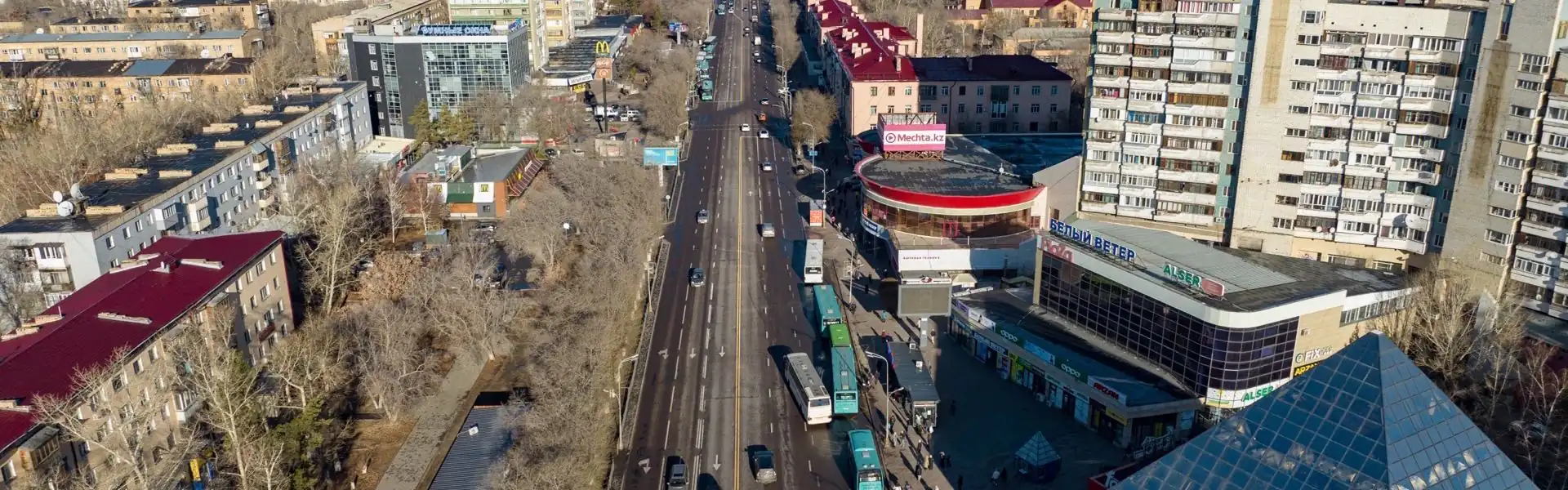
A route through mining-era Karaganda: where to start
Start at the Palace of Miners’ Culture at 32 Bukhar-Zhyrau Avenue. It’s a convenient place to take in two of the city’s main symbols right away: the palace itself and the Miners’ Glory monument on the square in front. From there, head to Central Park, walk to the Big Park Lake and continue towards Independence Square. Finish your walk at the Karaganda Regional Museum of Local History at 38 Yerubayev Street. This order links the sights into one walk rather than leaving you with a list of disconnected stops.
This is an estimate, not a marked trail The distance depends on how far you walk along the lake and park paths. The step count is approximate too: it varies with your stride length. Before setting off, check a map and see whether any paths or entrances are closed.
Getting to the start of the walk
For your navigation app, use Palace of Miners’ Culture, 32 Bukhar-Zhyrau Avenue. If you’re taking public transport, look for the “Palace of Miners’ Culture” stop: the city’s tourist portal lists it as the closest stop to the monument. City buses and shared minibuses also run along Bukhar-Zhyrau Avenue. If you’re arriving at the railway station, check the current route in an app or with the local transport information service—routes and numbers may change. Information about the monument and access to it is available on the Visit Karaganda page.
- Enter “Palace of Miners’ Culture” in your navigation app—it’s an easy-to-find starting point.
- If you’re taking a bus, choose the stop by the palace and check the current route before you leave.
- At the end of the walk, you can take public transport from the museum back through the city centre or call a taxi.
First stop: the Palace of Miners and the miners’ square
Construction of the palace began in 1940 to a design by architects Iosif Brener and Yakov Yanosh; the building was fully commissioned in 1952. In front of the façade, notice the symmetry, columned portico and sculptural details. This is more than a photogenic backdrop: it’s an expressive public centre for a city that grew around the coal industry. The history of the building and its architects is documented in a publication by the Karaganda Region Akimat.
“In Karaganda, mining history can be read not only in museums: it’s built into city squares, façades and everyday routes.”
On the square in front of the palace, look for the Miners’ Glory monument. The official description calls it one of Karaganda’s main symbols and a tribute to the work of miners in the Karaganda Coal Basin. Take a look from different angles, then cross to Central Park using the pedestrian crossing. Don’t rush across the wide street for a photo: it’s better to walk to a safe crossing and then return to a convenient spot for your picture.
Through Central Park to the lake and the city’s main axis
The entrance to Central Park is opposite the palace. Follow the paths towards Big Park Lake, using the water and wide avenues as landmarks. You don’t have to walk straight through the park: a small loop by the lake adds some greenery to your walk and gives you a chance to rest. During the warm season, cafés and some seasonal attractions operate in the park, but it’s best to check their hours in advance. Find the latest description of the park, lake and paths on the Visit Karaganda page.
- From the palace, enter the park through the nearest entrance and choose a path that leads to the lake.
- Take a short loop along the available paths by the water. Stay off the grass, and keep away from the edge if the ground is slippery.
- Continue towards Independence Square and the FC Shakhter Avenue, checking your map at junctions.
This part of the walk helps you see how the green spaces and the city’s built-up areas connect. Karaganda’s master plan describes a system of public spaces along Bukhar-Zhyrau Avenue: from Yerubayev Street to Big Park Lake, via Independence Square, the Cascade of Fountains park, FC Shakhter Avenue and the Miners’ Glory park. It’s a useful guide: you don’t need to find your way through courtyards at random—move between the marked squares and avenues. See the city master plan.
Where to take a break A bench by an avenue or the lake is a good place to catch your breath and have some water. In the warm season, you can rest at a park café, but don’t count on the same opening hours on weekdays, weekends and in the off-season.
From Independence Square to the museum
As you leave the park for the city squares, find Independence Square and the Cascade of Fountains park. The mood of the walk changes here: after the open avenues and water, you’ll see administrative façades and a more formal city layout again. Then head towards Yerubayev Street and the museum at number 38. The museum building is the final stop on the main walk; the monument to Appak Baizhanov stands in front. The museum describes him as the discoverer of Karaganda’s coal deposits. You can check information about the monument and address on the museum website.
If the museum is open and you have time, go inside: some exhibitions focus on the history of the Karaganda Coal Basin, the development of industry and the city’s growth. Opening hours and visitor arrangements may change, so check them on the official page or call the museum shortly before your visit. If you’d like to explore mining in a more hands-on way, the mine museum is in Mikhailovka, at 24/1 Magnitogorskaya Street. It’s a separate trip outside the compact city centre; check in advance whether you need to book and whether it’s currently open to visitors.
A little extra for museum lovers
You could also consider a stop at the Karaganda Regional Ecological Museum at 47 Bukhar-Zhyrau Avenue. Visit Karaganda’s guide lists industry, resource development and regional environmental issues among the museum’s themes. It’s not an essential part of the “palace — park — museum” walk, but an option if you’d like to spend more time in the city and don’t mind changing the order of your stops. Check whether the museum is open on your chosen day before planning it as a place to rest or the final stop on your walk.
| Option | What you’ll see | Best for |
|---|---|---|
| Short | The Palace of Miners, Miners’ Glory, part of the park and the lake | If you have about an hour and want to save some energy for the museum |
| Main route | The palace, monument, park, Independence Square and museum | If you want to combine architecture, history and a leisurely walk |
| With museums | The main route, plus a museum visit and a separate trip to Mikhailovka | If you’re ready to set aside most of the day and check the schedule in advance |
Why this route works well on foot
Walking has a particular advantage here: you see not only individual buildings, but also the spaces between them—the square, park, avenue and museum street. Research on urban environments looks at proximity to destinations, street connectivity, sidewalks and route appeal as factors associated with walking. This doesn’t mean that an architecture walk alone guarantees health benefits, but having a variety of stops can make walking a natural part of getting to know the city.
The authors included 40 evaluations of projects and policies related to how walkable urban environments are. Of these, 31 reported improvements in health or behaviour; three found no improvement or noted a decline. This review looks at urban interventions, not a specific route in Karaganda, so its findings shouldn’t be applied directly to this walk.
Westenhöfer J. et al. BMC Public Health. 2023;23:518. DOI: 10.1186/s12889-023-15394-4.For the walk itself, a simpler takeaway is useful: mix sections with different character. Take your time by the palace and monument to notice the details; choose a comfortable pace in the park; and don’t try to make up time while crossing between squares. If you’d like to make the day a feel-good walk as well as a sightseeing trip, keep a comfortable pace that lets you talk without getting out of breath.
In a small crossover study, 40 healthy adults completed a self-directed 30-minute brisk walk in a park and in an urban environment in Glasgow. In the park, participants had a higher average step rate and accumulated more minutes of moderate-to-vigorous activity in continuous bouts of 10 minutes or more; the duration of the walk did not differ between settings. The findings are interesting when choosing a green section of a route, but they shouldn’t be treated as a prediction for everyone or for Karaganda’s Central Park.
Sellers C.E. et al. Preventive Medicine. 2012;55(5):438–443. DOI: 10.1016/j.ypmed.2012.09.005.Before you set off: season, shoes and a backup plan
In Karaganda, the weather and ground conditions can make a big difference to how the central route feels. Wear shoes with non-slip soles, bring water and check the forecast. In winter or on a windy day, you don’t have to walk through the whole park: you can see the palace and monument, then shorten your walk using the nearest avenues. If the paths are icy, stick to cleared sidewalks and keep away from slippery banks. Find local tips in our article about walking in windy weather and smog in Karaganda; for general advice on winter footwear, see our article about ice cleats for walking.
- Save the start and finish points: the Palace of Miners’ Culture and the museum at 38 Yerubayev Street.
- Check the museum schedule and whether the mine museum is open to visitors before leaving home.
- Leave some extra time for the park: it’s easy to linger by the lake or on the avenues.
- If you’d like to adjust the route length, open our city guide to walking routes in Karaganda.
- Start at the Palace of Miners’ Culture, with the Miners’ Glory monument nearby.
- Walk through Central Park and past its lake towards Independence Square, then continue to the local history museum at 38 Yerubayev Street.
- Allow for 4–5.5 km and 1.5–2.5 hours with stops; the actual distance depends on the loop you take through the park.
- Use the park’s avenues and cafés for a break, and check museum and transport schedules before your trip.
Frequently asked questions
Can I do this walk in one hour?
Yes, if you look around the palace and monument and take a short loop through the park. Allow more time for Independence Square, the museum and breaks.
How many steps will it take?
Around 5.5–8 thousand for a distance of about 4–5.5 km. This is a rough estimate: stride length varies from person to person, so your tracker may show a number outside this range.
Where’s the best place to rest along the way?
The avenues in Central Park or the area by the lake are the easiest places to stop. Park cafés may have seasonal opening hours, so don’t rely on them as a guaranteed place to get food.
Do I need to book the mine museum in advance?
Yes. Plan it separately from your walk in the city centre, and check booking requirements, tour availability and transport to Mikhailovka before you go.
Sources
- Official publication by the Karaganda Region Akimat on the history of the Palace of Miners’ Culture and its architects. History of the Palace of Miners’ Culture
- Visit Karaganda: address and description of the Miners’ Glory monument, located by the entrance to Central Park. Miners’ Glory monument
- Visit Karaganda: description of Central Park, its lake, paths and seasonal services. Karaganda Central Park
- The museum’s official page about the monument to Appak Baizhanov; the museum address is 38 Yerubayev Street. Monument to Appak Baizhanov
- Karaganda’s master plan describes the links between Independence Square, parks, avenues, Central Park and Big Park Lake. Karaganda master plan
- Westenhöfer J. et al. Walkability and urban built environments—a systematic review of health impact assessments. BMC Public Health. 2023;23:518. DOI: 10.1186/s12889-023-15394-4
- Sellers C.E. et al. Take a walk in the park? A cross-over pilot trial comparing brisk walking in two different environments. Preventive Medicine. 2012;55(5):438–443. DOI: 10.1016/j.ypmed.2012.09.005
- Nakamura K. et al. Reference value on daily living walking parameters among Japanese adults. Geriatrics & Gerontology International. 2020;20(7):664–669. Step-length data show why converting kilometres into steps remains approximate. DOI: 10.1111/ggi.13931

