The main idea: do not chase steps in the hottest hour
In the warm season, Nukus calls for a different walking logic. Not “I left work and did 10 000 steps in one push,” but split your walk into short evening blocks: first 20–30 minutes, then another 10–15 minutes after dinner or on the way to buy water, fruit, or tea. This way you build volume without pushing your body into heat stress.
July in Nukus is the hottest month: climate summaries give an average daytime temperature of around 36 °C, and on asphalt and open squares it feels even stronger. So an evening walk starts not by the clock, but by the conditions: the sun is low, there is shade, the wind is not carrying dust, and you can speak in phrases without getting short of breath.
- Go out after the direct sun has eased: on a hot day, it is better to wait 60–90 minutes after sunset than to start right at 18:00.
- Choose loops that let you return toward the center: Berdakh Park, the Savitsky Museum, Nukus Park, the Doslyk Canal, the Soviet center.
- For 45–60 minutes, take at least 0,5 L of water; for a longer 75–90 minute walk, take 0,75–1 L and do not force yourself to drink.
- Set your pace by the talk test: if you cannot speak calmly, for Nukus in the evening it is already too fast.
- Save the Amudarya embankment for a calm sunset and company: it is open, windier, not fully developed in places, and there are mosquitoes.
When to go out: evening windows for Nukus
There is no universal “perfect time”: in May and September you can go out earlier, while in July and August it is better to wait longer. For practice, use a simple scale. If the street is still radiating heat from walls and asphalt, start in the shade or move the walk closer to night. If after the first 10 minutes sweat is pouring, your pulse is rising, and your pace is normal, that is not weakness — it is a sign to shorten the route.
| Evening conditions | What to do | Route |
|---|---|---|
| Hot, but no dust | 20–40 minutes at an easy pace | Berdakh Park or Nukus Park |
| Humid after a very hot day | 2 short outings of 15–20 minutes | Your home block + center |
| Wind and dust | Shorten the street part or go indoors | Mall, museum, walking at home |
| Cooler after sunset | 45–75 minutes, but no speeding up | Center → Savitsky → park |
| Want water and open space | Go with someone and take a flashlight | Doslyk Canal or Amudarya |
If you spent the whole day in air conditioning, then stepped straight out onto a hot street and started walking fast, your body needs time to adapt. The first 10 minutes should be slow. Then check how you feel: head, pulse, sweat, dry mouth, and ability to speak.
Routes: where to add steps in the evening
For evening Nukus, short city loops work best, where it is easy to turn off, buy water, sit on a bench, or call a taxi. If you want a general list of daytime and out-of-town options, see the separate guide where to walk in Nukus. Here the focus is different: how to walk after the heat without overheating.
- Berdakh Park: about 1,5 km in a large loop, roughly 2 500 steps. Good for a first evening outing because it is central and offers shade, benches, and a clear circuit.
- The Savitsky Museum and the square: about 1,8 km, roughly 4 000 steps if you circle the block. Convenient if you live in the center and want a flat, well-lit walk without searching for the way.
- Nukus Park on A. Navoi Street: about 3 km in a large loop, roughly 5 500 steps. Suitable for a family walk: rides, paths, and more people in the evening.
- First President Park: about 2 km, roughly 4 500 steps. Better after the sun has eased: the park is flat, but young plantings give less shade.
- The Karakalpak Theater and the Soviet center: about 2,5 km, roughly 6 000 steps. A good option if light, the urban setting, and places to stop matter to you.
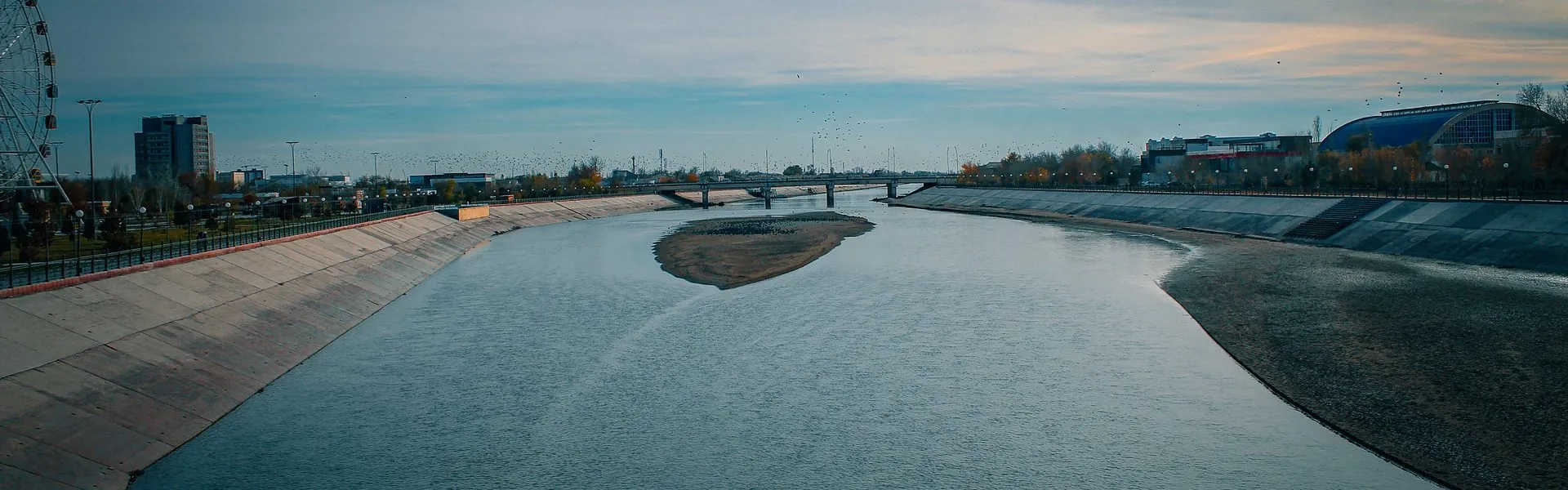
- Doslyk Canal: a calm evening line by the water. Walk it in sections; do not try to cover everything at once: it is cooler by the water, but wind and dust can change quickly.
- The Amudarya by the bridge: up to 6 km one way, about 9 000 steps. Get there by taxi 10–15 minutes from the center or by minibus toward Khodjeyli; for the evening, take sneakers, water, and company.
How to choose a well-lit and calm street
In the evening, safety matters more than a pretty line on the map. For a solo walk, choose streets with people, open cafés, shop windows, stops, and a clear sidewalk. There is no need to go into dark courtyards for “another 800 steps.” If you are walking by water or on the outskirts, it is better to go in pairs.
| Sign | Good choice | Better to avoid |
|---|---|---|
| Light | Streetlights, shop windows, open cafés | Empty dark sections |
| Surface | Flat sidewalk, park, square | Dusty roadside, broken concrete |
| People | Families, walkers, street trade | A completely empty street |
| Exit | You can quickly turn toward the center | A long stretch with no taxi |
| Noise | You can hear cars and people | Sealed headphones in both ears |
The headphone rule is simple: one earbud or quiet mode. In the evening, you need to hear cars, bicycles, dogs, people behind you, and your own breathing. There is a separate breakdown on night walking: how to walk in the dark more safely.
In Nukus, an evening walk is not a test of character. It is a skill: go out later, walk slower, drink earlier, and turn home before you feel unwell.
How much water to take and how to drink
For an easy 45–60 minute city walk, take 0,5 L of water. If you are walking 75–90 minutes, especially toward the canal or the Amudarya, take 0,75–1 L. If you sweat a lot, ate little salt, or are walking after a long hot day, add a salty snack: ayran, flatbread, cheese, or nuts. But do not drink liters “just in case”: overdrinking can also be harmful.
- 20–30 minutes before going out, drink a few sips; do not force down water.
- On the route, make 2–4 small pauses: 2–3 sips are enough.
- If your urine is very dark, you feel dizzy, or your mouth is dry, shorten the walk.
- If nausea, chills, confusion, unusual weakness appear, move into a cool place and ask for help.
- After the walk, replace fluids with food and a drink, not only water.
How to add steps without overheating
If your goal is 8 000–10 000 steps, you do not have to finish it in one evening block. In a hot city, it is smarter to build the day from pieces: 1 500–2 000 steps in the morning, 2 000–3 000 through everyday errands, and 3 000–5 000 in the evening. If you want to convert steps into kilometers, use the reference from the article how many kilometers are in 10 000 steps: stride length differs from person to person, so route numbers are always approximate.
A practical evening formula: 10 minutes of warm-up around the courtyard or nearest street, 25–35 minutes for the main loop, and 5–10 minutes of calm return. If you need another 1 000–1 500 steps, do them after dinner very slowly instead of speeding up at the end of the route.
The pace is right if you can speak in full sentences. If you want to answer in single words, slow down. For heat, this is more reliable than trying to keep your usual cool-season pace.
After dinner: a small walk instead of heroics
Evening walking after food is especially convenient in Nukus: the sun is already lower, the pace is naturally calmer, and the walk does not require a separate workout. 10–15 minutes around the block, in the park, or on the way to the shop is enough. This is not “too little” — it is a way to make movement regular.
- After a heavy dinner, wait 10–20 minutes and walk slowly.
- Do not choose open asphalt if it is still radiating heat.
- Stay close to home or a central street: the goal is to move gently, not to go far.
- If you have reflux, heaviness, or nausea, reduce the pace and distance; on this topic, see walking after meals.
Park, canal, or Amudarya: what to choose today
If the day was very hot, choose a park rather than an open embankment. Shade and greenery reduce heat load by protecting you from direct radiation and offering a gentler surface. In a dry climate, this is especially noticeable: mature trees and grassy areas are usually more comfortable than bare tiles or asphalt.
| Place | When it works well | What to watch |
|---|---|---|
| Berdakh Park | First outing after the heat | Light, benches, people |
| Nukus Park | With children and family | Crowds, bicycles, rides |
| Doslyk Canal | A quiet evening without dust | Wind, water’s edge, lighting |
| Center and theater | Walking alone after work | Crossings, cars, sidewalks |
| Amudarya | Sunset, company, sneakers | Mosquitoes, darkness, return taxi |
Nukus is a city near desert and steppe zones, and wind can quickly spoil a walk. If visibility is worse, your throat feels scratchy, or sand is blowing into your face, the evening plan changes: less street, more covered steps. Details are in the article about dust and wind in Nukus.
FAQ: common questions about evening walking in Nukus
Can I walk right after 18:00?
Sometimes yes, but in July and August it is often too early: walls, sidewalks, and asphalt are still giving off heat. Start with shade and 10 minutes at a test pace. If it feels hard, move the walk closer to sunset or split it into two short outings.
How many steps is normal to add in the evening?
For the warm season, a good target is 3 000–6 000 evening steps. If you already walked during the day, that is enough. It is better to collect 8 000–10 000 over the day rather than finish them in one hot route.
Which is better: a park or an embankment?
After a very hot day, choose a park. Water feels nicer psychologically, but the canal and the Amudarya can be exposed to wind, dust, and mosquitoes. For a solo walk, central well-lit loops are safer.
Do I need a sports drink?
For 45–60 minutes of easy walking, water and normal food before or after are usually enough. If the walk is longer, you sweat a lot, or the day was very hot, add a salty snack or ayran.
When should I stop the walk?
Immediately, if unusual weakness, dizziness, nausea, chills, confusion, a severe headache appear, or you stop sweating normally. Move into a cool place, drink small sips, and ask for help.
Bottom line: an evening routine for Nukus
- Check the heat, wind, and dust before you go out; if conditions are bad, do not argue with the weather.
- Start with 20–30 minutes in a park or the center, not with a long embankment.
- Take water: 0,5 L for an hour, more only for a long route and without forcing yourself to drink.
- Walk at a pace where you can talk; save faster efforts for the cool season.
- You can add steps in pieces: morning, errands, evening, 10 minutes after dinner.
- The best route is the one you returned home from calmly, not the one where the pedometer showed the maximum.
Sources
- Eifling KP, Gaudio FG, Dumke C. Wilderness Medical Society Clinical Practice Guidelines for the Prevention and Treatment of Heat Illness: 2024 Update. Wilderness & Environmental Medicine, 2024. DOI
- Sawka MN, Burke LM, Eichner ER, Maughan RJ, Montain SJ, Stachenfeld NS. Exercise and Fluid Replacement. Medicine & Science in Sports & Exercise, 2007. DOI
- Paluch AE et al. Daily steps and all-cause mortality: a meta-analysis of 15 international cohorts. The Lancet Public Health, 2022. DOI
- DiPietro L et al. Three 15-min bouts of moderate postmeal walking significantly improves 24-h glycemic control. Diabetes Care, 2013. DOI
- Shashua-Bar L, Pearlmutter D, Erell E. The influence of trees and grass on outdoor thermal comfort in a hot-arid environment. International Journal of Climatology, 2011. DOI
- Bull FC et al. World Health Organization 2020 guidelines on physical activity and sedentary behaviour. British Journal of Sports Medicine, 2020. DOI
- Uzbekistan Travel. Nukus: city overview, the Savitsky Museum, the park near the museum, and the history of the city. Uzbekistan Travel
- Qozgal. Where to walk in Nukus: tested city and out-of-town routes, kilometers, steps, and how to get there. Qozgal
- Updated Initial Environmental Examination, 2025. Nukus city, Amudarya, Doslyk and Kattagar canals. PDF
- Timeanddate. Climate & Weather Averages in Nukus: average monthly temperatures, wind, and precipitation. Climate data

Count your steps with Qozgal
A free app that counts your steps, keeps your streak and motivates you to walk every day.