In short: how to walk with a child in Nukus
With children in Nukus, it is better to plan not one long crossing but a short loop with a clear finish: a park, museum, café, fountain, or taxi stop. The city is flat, but the sun, dry air, and wind can quickly change how strenuous a walk feels. If you want to explore more options, see our Nukus route guide; here, we focus specifically on a family-friendly pace.
The distances below are guidelines, not exact GPS tracks: surfaces, closures, and access to individual entrances may change. For steps, use a range because adults and children have different stride lengths.
How to choose a route before leaving home
- Choose the time first: in summer, it is better to go out before 08:00–09:00 or after 19:00, leaving the middle of the day for a museum, café, or rest.
- Check not only the temperature but also the wind. For a child, an exposed waterfront in strong wind can be harder than a quiet park in the same weather.
- Mark two places where you can sit: a bench, café, museum lobby, or playground. This reduces the chance that the walk will end with sudden exhaustion.
- Take enough water for the entire route. Do not assume that the nearest kiosk will be open exactly where you need it.
- For a stroller, choose a loop that returns to the start rather than a one-way route. This way, you will not have to look for transport with a tired child.
When to shorten the walk If the child becomes unusually lethargic, stops responding, complains of a headache, nausea, or chills, or develops severe shortness of breath, move into the shade or indoors, cool them down, and seek medical help. In hot weather, do not wait until the child asks for water.
A pilot study involved 14 children aged 9–13. The authors showed that shade reduced thermal sensation and potential heat load. For Nukus, the practical takeaway is clear: a tree or canopy is not a decorative detail but a reason to choose one route over another.
DOI: 10.1016/j.buildenv.2017.09.026Family routes around Nukus
1. Berdakh Park: a short loop for your first outing
As a guide, allow for about 1,5 km and roughly 2500 steps around the large loop. This is a good option for a family just getting to know the city: you do not have to cross long exposed stretches, you can walk slowly, and you can shorten the loop at any time. The park is in the central area, so it is convenient to reach on foot from the center or by a short taxi ride.
For children aged 2–5, allow 30–50 minutes with stops. For an older child, suggest a game: find a fountain, count unusual trees, or choose three details on the surrounding buildings. This keeps the walk from turning into an instruction to walk faster.
2. The Savitsky Museum and the square: a walk with a cool backup plan
Put together a compact loop of 1,8 km and about 4000 steps: the square, the grounds around the I. V. Savitsky State Museum of Arts, and nearby quiet streets. The main advantage for a family is the option to move indoors. If it gets too hot outside, the museum can be not just a sight to visit but part of your recovery plan.
With a stroller near the museum Before you leave, check the entrance, steps, and whether you can leave the stroller inside. Even if the square itself is level, a particular entrance or sidewalk may be inconvenient. For an infant, keep the sun canopy open, but do not cover the stroller with thick fabric: it quickly becomes stuffier and hotter inside.
3. Doslyk Canal: an evening walk with attention to the edge
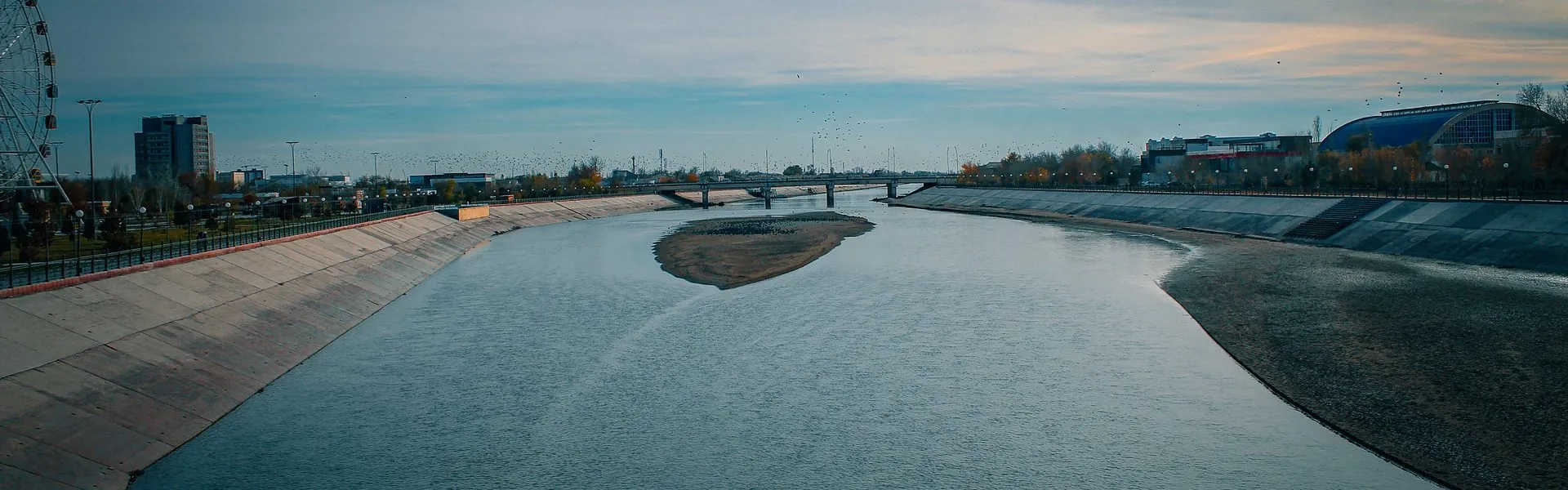
Doslyk Canal runs through central Nukus, and the walking area along it works for 2–3 km there and back. It feels like a waterfront route, but it is not a fully safe promenade for running freely: there is water nearby, some exposed sections, and uneven surfaces in places. Keep the child close, especially near bridges and descents.
The best time is a calm evening, when the sun is already lower. In April 2026, the city administration announced a project for a new 1,2-kilometer walking zone in the Doslyk area, so check the status of individual sections on site. Do not plan around future infrastructure as if it were already guaranteed to be ready.
4. Amir Timur Park: rides and short loops
Amir Timur Park is located near the railway station and Temir jol market; from the station landmark to the park is approximately 0,5–0,6 km. Inside, you can create several short loops of 2–3 km and 3000–5000 steps, then stop for rides or a snack.
This is a convenient option for a child who quickly gets bored just walking. But check the condition of the equipment and age restrictions before using the rides. In July 2026, city services separately reported increased safety measures and inspections of the park’s rides.
5. The Amu Darya and the bridge toward Khojayli: only in mild weather
A route to the Amu Darya can mean 4–6 km and 6000–9000 steps, but it is not a universal walk for small children. The river is exposed to the wind, some surfaces may be inconvenient for a regular stroller, and there is little shade. Choose this option on a calm morning or a cool autumn day when the forecast does not promise dust.
If the child is in a stroller, it is better to treat the trip to the river as a short stop at the bridge rather than a long walk along the bank. In strong wind or dusty haze, return to the city: an exposed waterfront loses out to a park or museum in this kind of weather.
In a study of children aged 8–10, higher temperatures were associated with a smaller share of active play and more time spent in the shade. At around 33 °C, the changes became more noticeable. This is not a medical ban on walking but a useful guide: on a hot day, shorten the exposed section and plan more breaks.
DOI: 10.1123/jpah.2022-0405Stroller, sling, or walking independently
| Age and format | Suitable route | Practical guide |
|---|---|---|
| 0–2 years, stroller or carrier | Berdakh Park, the Savitsky Museum, a short section of Doslyk | 30–60 minutes, shade every 10–15 minutes, no long exposed crossings |
| 2–5 years, walking plus a stroller as backup | Berdakh Park, Amir Timur Park, the square by the museum | 0,5–1,5 km of independent walking, then a stop or change of pace |
| 6–9 years | Doslyk in the evening, park and museum as one route | 2–4 km with a game, water, and a rest point chosen in advance |
| 10 years and older | Central loop, park, museum, and the Amu Darya in mild weather | 4–6 km, but assess heat and dust as more important than age |
A stroller in Nukus does not mean that the walk has to be short. It can be the base for a family route: the child walks while interested and then rests. But do not turn the entire walk into hours of sitting without breaks. A study of parents of children aged 1–5 found that a stroller can both make it easier for a family to go to the park and increase the time a child spends in a restricted position.
A qualitative study of 14 families showed that strollers are chosen because of distance, convenience, sleep, control, and the opportunity for parents to walk more themselves. The authors emphasize context: a stroller can help a family leave the house, but it should not replace a child’s opportunity to move when it is safe to do so.
DOI: 10.1186/s12889-015-1989-6Heat, water, and dust: a family protocol
In Nukus, heat is not just a number on a thermometer. Direct sun, hot surfaces, wind, and the child’s ability to notice thirst all matter. In a separate study of children aged 10–16 exercising in temperatures up to 40 °C, the risk of overheating and dehydration was comparable to that in adults. So an adult’s rule of “I still feel fine” does not work for a child here.
- For every hour of a summer walk, take extra water rather than one small bottle for the whole family.
- Make short stops in the shade before the child asks to rest.
- Do not leave the stroller in the sun for long, and check metal, plastic, and playground surfaces with your hand.
- At around 33 °C and above, choose early morning, evening, or a route with an indoor option; this is a guide for changing the plan, not a universal ban.
- If the wind picks up, visible dust appears, or there is burning in the eyes or a scratchy throat, turn back. If the child has asthma or another respiratory condition, agree on walking guidelines with a doctor in advance.
In a study, 68 children aged 10–16 and 24 adults completed 45-minute trials at 30 and 40 °C. The authors did not find that children were automatically protected from overheating or dehydration. The practical takeaway for a walk is simple: water, shade, and shortening the time matter more than completing the planned distance.
DOI: 10.1136/bjsports-2025-109832A study of children in Karakalpakstan showed a complex picture: dust exposure was high, but the connection with respiratory measures did not reduce to a simple formula. This is not a reason to ignore dust, but a reason to avoid categorical promises and consider the specific weather, the child’s well-being, and any respiratory conditions.
DOI: 10.1093/ije/dym195A good family walk in Nukus is not about the maximum number of steps. It is a route that leaves the child wanting to go out again tomorrow.
What to bring
- Water for every family member and a small bottle for the child so they can drink independently.
- A sun hat or cap, light clothing that covers the shoulders, and sunscreen.
- Wet wipes, a spare T-shirt, and a small snack without chocolate or foods that melt quickly.
- A sun canopy for the stroller, but no thick cover over the entire hood.
- A phone with an offline map and the address of the nearest museum, café, or place where you can call a taxi.
- A light scarf or mask for an adult in case of dust; do not cover small children’s faces with thick fabric in the stroller.
- For your first outing, choose Berdakh Park or a short loop near the Savitsky Museum: it is easier to stop and shorten the route there.
- Doslyk is good in the evening, but the child should stay close: it is a waterside walking area, not a place for running freely.
- The Amu Darya and exposed sections are suitable only in light wind and mild temperatures; they are less convenient with a stroller.
- In heat of around 33 °C and above, move the walk to morning or evening and add shade and an indoor option.
- A stroller can help the family walk more, but children need regular opportunities to get out, move, and change position.
- If the walk ends earlier than planned because of heat or dust, that is not a failure but the right route adjustment.
FAQ: walking with children in Nukus
Which route should I choose with a child under three?
Start with Berdakh Park or a short route near the Savitsky Museum covering 1–1,5 km. The stroller should be a backup place to rest, not the only way to spend the walk. Choose a time with minimal sun and keep the return point nearby.
Can I walk with a stroller along Doslyk Canal?
You can choose a short, checked section, but do not expect consistent surfaces along the entire length. Before leaving, check entrances and curbs, and keep the child close to the stroller near the water and bridges. For a longer walk, a park is usually easier.
Where should we go in temperatures above 35 °C?
Do not plan a long, active loop in the open sun. Choose early morning, evening, or a Savitsky Museum visit combined with a short walk around it. Take breaks in the shade, bring extra water, and watch not only the temperature but also the wind.
Is it worth going to the Amu Darya with children?
Yes, if you want a short outing with a view of the river and the forecast is calm. But do not treat it as a universal route: it is exposed to the wind, has little shade, and may be inconvenient with a regular stroller. For a preschooler, it is better to limit the visit to a short stop.
How can I tell whether a child is tired from the heat rather than simply being fussy?
Look for a combination of signs: unusual lethargy, headache, nausea, intense thirst, flushed or pale skin, refusal to continue, and unusual sleepiness. Take the child somewhere cool, let them rest, and seek medical help if there are concerning symptoms.
Sources
- Qozgal: routes through the Savitsky Museum, parks, Doslyk Canal, and the areas around Nukus. Nukus route guide
- Qozgal: walking in Nukus in wind, dust, and heat, including short family loops and the limitations of exposed routes. Dust, wind, and heat in Nukus
- Map and location guide for Amir Timur City Park near the Temir jol railway station. Amir Timur City Park on the map
- The Nukus administration reported on April 4, 2026, on a project for a 1,2-kilometer walking zone in the Doslyk area. Doslyk walking zone project
- Vanos J.K. et al. Effects of physical activity and shade on the heat balance and thermal perceptions of children in a playground microclimate. Building and Environment, 2017. DOI 10.1016/j.buildenv.2017.09.026
- Heat-Resilient Schoolyards: Relations Between Temperature, Shade, and Physical Activity of Children During Recess. Journal of Physical Activity and Health, 2023. DOI 10.1123/jpah.2022-0405
- Smallcombe J.W. et al. Thermoregulation and dehydration in children and youth exercising in extreme heat compared with adults. British Journal of Sports Medicine, 2025. DOI 10.1136/bjsports-2025-109832
- Bennion P. et al. The impact of airborne dust on respiratory health in children living in the Aral Sea region. International Journal of Epidemiology, 2007. DOI 10.1093/ije/dym195
- Birken C.S. et al. Parents’ perception of stroller use in young children: a qualitative study. BMC Public Health, 2015. DOI 10.1186/s12889-015-1989-6
