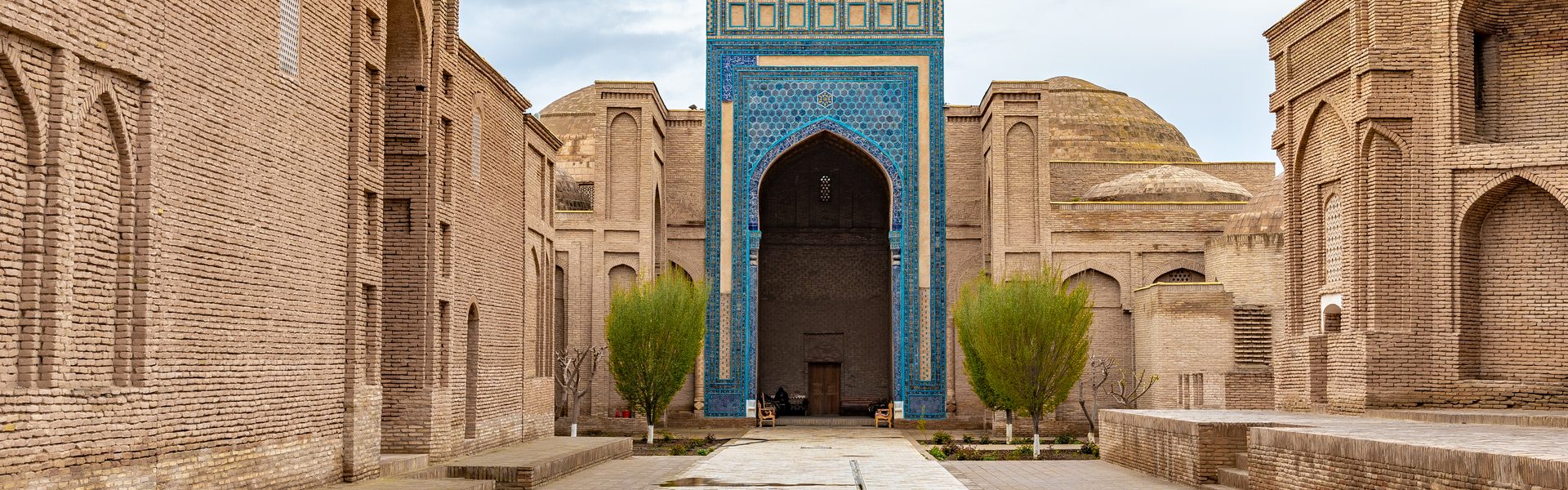
How to do Termez without highways
Termez can be misleadingly compact: on the map, the museum, mausoleums, Fayaztepa, Karatepa, and Zurmala look “almost nearby.” On the ground, this is southern Uzbekistan, a border area, open sun, dusty access roads, and stretches where walking is simply not interesting and not safe. So the best format for getting steps here is not a forced march between sites, but a set of short loops inside the monuments themselves and green places.
- Do not connect Fayaztepa, Karatepa, Zurmala, and the city on foot: travel between them by taxi or by car with waiting time.
- The main walking window is early morning; in summer, it is better to move long walks after 10:00 to a museum, shade, or evening.
- The goal for an archaeological morning is 6–9 thousand steps, not necessarily 10 thousand at any cost.
- Karatepa is located in a border zone: check access, documents, and permission in advance.
- Bring water before you leave: near archaeological zones, do not count on reliable cafés or shade.
The main rule: walk loops, ride between stops
Build your day in clusters. In the city — the Archaeological Museum, Sultan Saodat, Kokildor-Ota, and Kirk-Kiz. In the Old Termez cluster — the Al-Hakim at-Termizi Mausoleum, Fayaztepa, Karatepa with permission, and Zurmala. In the evening — the Amu Darya or a city park. This way, you save your energy for the monuments themselves instead of spending it on road shoulders.
- Save not only the site in your navigator, but also the entrance or parking point.
- Agree with the driver on short waiting time: 25–45 minutes for smaller sites, 60–90 minutes for the museum and larger complexes.
- Make a loop in every place: entrance → main site → side alley or viewpoint → back to the car.
- If you see open asphalt with no shade and no sidewalk, do not “make up your steps” there — move them to an evening embankment or park.
- Count steps roughly: 1 km of relaxed walking usually gives about 1300–1500 steps; you can check the details in the article about converting steps to kilometers.
A good walk in Termez is not when you walked more than everyone else, but when you saw more and did not overheat. In archaeological zones, steps should support the route, not turn it into a test.
Loop 1. The Archaeological Museum and a calm start
Start with the Termez Archaeological Museum. It is the right first stop: in the halls, you gather context — Bactria, the Kushan period, Buddhist finds, coins, ceramics, sculpture — and only then head to the ruins. The walking part here is short: get to the museum, make a circle around the grounds and nearby sidewalks, and return to the entrance. Use 1.2–1.8 km, 1700–2600 steps as your benchmark, without long exposed sections.
In your navigator, search for Termez Archaeological Museum or “Археологический музей Термеза.” From the center and the railway station, taking a taxi is easiest. If you have already read the general city route, compare this plan with the basic article on where to walk in Termez and keep only the morning archaeological part here.
Loop 2. Sultan Saodat, Kokildor-Ota, and Kirk-Kiz
The urban memorial cluster is convenient because the stops are close in car-route logic, but do not require a hot walk between them. At Sultan Saodat, make a slow loop along the ensemble, and do not rush through the courtyard and arches: the brickwork reads better in the morning, while the light is low. Then drive to Kokildor-Ota and Kirk-Kiz. In total, this gives 1.5–2.5 km and 2200–3700 steps if you walk inside the sites rather than between them along the road.
| Loop | On foot | Steps | Best time |
|---|---|---|---|
| Museum + nearby sidewalks | 1.2–1.8 km | 1700–2600 | morning or midday |
| Sultan Saodat + nearby stops | 1.5–2.5 km | 2200–3700 | early morning |
| Al-Hakim at-Termizi | 1.0–1.6 km | 1400–2300 | morning, sunset |
| Fayaztepa | 0.8–1.3 km | 1100–1900 | early morning only |
| Amu Darya in the evening | 2–4 km | 3000–6000 | after the heat drops |
Loop 3. Al-Hakim at-Termizi and Old Termez
The Al-Hakim at-Termizi Mausoleum is one of the most pleasant walking stops, because it has not only sacred architecture but also a park-like setting. Keep the route gentle: entrance, main mausoleum, courtyard, a view toward the Old Termez context, and a return through the shade. Do not try to “stretch” from here to other archaeological zones on foot: around Termez, distances are short on the map but heavy under the sun.
Loop 4. Fayaztepa, Karatepa, and Zurmala without heroics
Fayaztepa is the best Buddhist site for a short walking loop: ruins, a wall, a stupa, several viewpoints, and a return to the car. Plan for 0.8–1.3 km, but go slowly: dust, uneven ground, and open sun make an ordinary kilometer feel harder than in the city. Karatepa is close in archaeological theme, but not in freedom of access: the site is located in a border zone, so you cannot put it into your plan like a normal walk without checking permissions. Zurmala works well as a short 15–25 minute stop, not as a place for a long walk.
Before the trip, check the access rules for Karatepa with a guide, your hotel, or a tour operator. Open tourist sources mention the need for special permission to visit the border zone. If you do not have permission, do not argue on site and do not try to bypass checkpoints: replace Karatepa with Fayaztepa, Zurmala, and the museum.
Evening step top-up: the Amu Darya or Bobur Park
If you collected only 5–7 thousand steps in the morning, that is fine. Add the rest in the evening, when the city comes alive. The most atmospheric option is the Amu Darya embankment: a flat walk, river air, and a view of Termez’s southern geography. The second option is Bobur istirohat bog'i, a city park with greenery and family evening life. On a hot day, this is better than walking along main roads just for a number in an app.
- If you have 2000–3000 steps left: do 20–30 minutes on the embankment and stop before you get tired.
- If you need a calm loop with children: choose Bobur Park or the nearest lit city park, not an archaeological zone in the dark.
- If a dusty wind picks up: shorten the walk, cover your nose and mouth with a buff, and move your steps indoors or to the morning.
- If you specifically want an evening route in the heat, check the separate guide about evening walks in Termez in advance.
Plan for 1 morning: 6–9 thousand steps
This scenario works if you have one day in Termez and want archaeology without overheating. Leave early, eat a light breakfast, take water, and arrange a car for half a day. Important: do not try to include all the distant sites of Surkhandarya. Kampyrtepa, Jarkurgan, or Baysun are separate logistics, not “one more detour” on a morning walk.
- 06:30–07:30 — Sultan Saodat: short loop, photos, shade by the walls.
- 07:45–08:30 — Kokildor-Ota or Kirk-Kiz: choose one stop if it is already hot.
- 09:00–10:00 — Fayaztepa: a slow loop through the ruins, without going onto open roads.
- 10:20–11:20 — Archaeological Museum: cool air, context, recovery.
- After 11:30 — lunch, rest, transfers. Add steps only in the evening by the Amu Darya or in a park.
For a short morning, bring at least 1–1.5 liters of water per person, and in summer — more if you do not handle heat well. Sip before you feel thirsty, not only when your head is already spinning. For general heat rules, keep the article on how to walk in the heat close at hand.
How to get there and what to tell the driver
The simplest format is a taxi from the center, the railway station, or your hotel. For the city cluster, tell the driver: “Sultan Saodat, then Kokildor-Ota, then Kirk-Kiz, with waiting time.” For the archaeological cluster: “Fayaztepa, then Zurmala, then the museum”; add Karatepa only after checking permission. If the driver says “it is not far on foot,” look not at the kilometers, but at the sidewalk, shade, and time of day.
| Stop | How to go | Walking logic |
|---|---|---|
| Archaeological Museum | taxi to the entrance | short loop + exhibition |
| Sultan Saodat | taxi or car with waiting time | courtyard, façades, return |
| Al-Hakim at-Termizi | taxi to the complex | park + mausoleum |
| Fayaztepa | car with waiting time | ruins without going to the road |
| Zurmala | short stop by car | 10–25 minutes around the site |
| Amu Darya | taxi to the embankment | evening step top-up |
Heat, water, and borders: safety rules
Termez is a city where planning matters more than fitness. Even if you easily walk 10–12 km in Samarkand or Bukhara, the southern sun changes the load. On open archaeological sites, there is less shade, more reflected heat, and almost no chance to quickly “duck into a café.” So keep your route reversible: at any moment, you should know where the car, water, and nearest shade are.
- Start early: put archaeological zones first, and the museum closer to the hot part of the day.
- Do not walk alone in little-developed areas, and do not photograph border infrastructure.
- Wear closed shoes with a firm sole: ruins have dust, stones, and uneven surfaces.
- A hat is essential; a white long-sleeved shirt is often more comfortable than a T-shirt.
- If you feel nausea, chills, a throbbing headache, or confusion, stop the walk and get into a cool place.
- Do not argue with guards or border officers: in Termez, this is part of normal logistics, not a tourist formality.
Route FAQ
Can you walk from Fayaztepa to Karatepa?
Do not plan it as a regular walk. Even if the distance looks short, Karatepa is connected to the border regime, and the road does not offer comfortable shade. Go with a driver and check access in advance.
How many steps can you realistically get in an archaeological morning?
Usually 6–9 thousand: the museum, Sultan Saodat, one or two memorial stops, and Fayaztepa. If you want 10 thousand, add them in the evening by the Amu Darya or in a park, not on an open road.
Do you need a guide in Termez?
For the museum and Sultan Saodat, you can go independently if you have prepared in advance. For Karatepa, border-zone nuances, and archaeological context, a guide makes the day much easier.
Where is it better to walk in the heat: by the Amu Darya or in archaeological zones?
In the morning — archaeological zones; in the evening — the Amu Darya. In the middle of the day, choose the museum, rest, and transfers. The river is pleasant at sunset, but during the day open sections can also overheat.
Can you do Termez without a car?
Partly, yes: the museum, city streets, park, and embankment. But archaeological monuments and mausoleums are easier and safer to combine by taxi or by car with waiting time.
Sources
- Official Uzbekistan Travel tourist portal: an overview of Termez, key sites, cultural context, and climate features. Uzbekistan Travel — Termez
- Uzbekistan Travel: archaeological monuments of Surkhandarya, Fayaztepa, Karatepa, Kampyrtepa, and the ancient context of Termez. Uzbekistan Travel — Archaeological sites of Surkhandarya
- Central Asia Travel: a description of Termez attractions, including Sultan Saodat, the Hakim at-Termizi Mausoleum, Zurmala, Fayaztepa, and the Archaeological Museum. Central Asia Travel — Termez attractions
- CAJ / Turna: practical logistics for Termez, route clusters, distances between sites, and car connections. CAJ — Termez: Buddhist monuments and the Amu Darya
- Explorers: reference information on Karatepa and a note about the border zone and the need for special permission. Explorers — Kara-tepe
- TravelDojo: Termez city context, the Amu Darya, the embankment, and practical information for independent travelers. TravelDojo — Termez Travel Guide
- Top-Rated.Online: page for Bobur istirohat bog'i in Termez as a city park for an evening walk. Top-Rated.Online — Bobur istirohat bog'i
- Lee I-M et al. Association of Step Volume and Intensity With All-Cause Mortality in Older Women. JAMA Internal Medicine, 2019. DOI: 10.1001/jamainternmed.2019.0899
- Tudor-Locke C. et al. How many steps/day are enough? for adults. International Journal of Behavioral Nutrition and Physical Activity, 2011. DOI: 10.1186/1479-5868-8-79
- Coutts A.M. et al. Temperature and human thermal comfort effects of street trees across three contrasting street canyon environments. Theoretical and Applied Climatology, 2016. DOI: 10.1007/s00704-015-1409-y

Count your steps with Qozgal
A free app that counts your steps, keeps your streak and motivates you to walk every day.