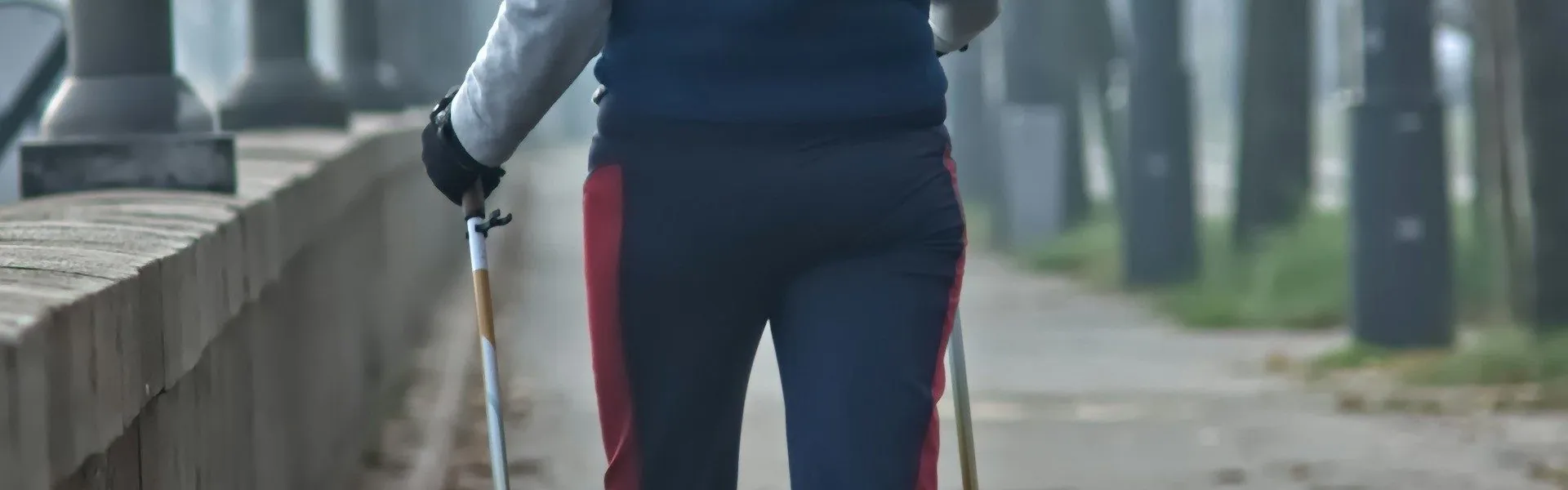
Hearing changes, but walks are still possible
With hearing loss, you may not notice an approaching car, cyclist, or someone calling out right away. And if it’s hard to tell where a sound is coming from, you may turn the wrong way. That’s why it helps to rely on more than hearing when you’re out walking: choose a familiar route in advance, look around, and take your time where pedestrian and vehicle paths cross.
This doesn’t mean every trip outside is dangerous or that you need to walk with someone. Research links hearing loss with differences in walking and balance, but the link alone doesn’t predict that a particular person will fall or have trouble with a route. The practical takeaway is simple: pay more attention to the conditions that help you walk with confidence, and adapt your route to how you feel.
In a cross-sectional study of 1180 adults aged 50–69, greater hearing loss was associated with slower walking. This is an observed association, not proof that hearing loss caused the slower pace. The authors noted that further research is needed.
DOI: 10.1016/j.gaitpost.2012.10.006These figures describe a group of participants, not an individual prediction. In the study, the association between hearing loss and walking speed doesn’t prove that a hearing aid alone will change your gait or make every route safe. If you’ve noticed that you trip more often, feel unsteady, or get dizzy, talk to a doctor. For your walks, it can help to start with something simple: choose a familiar route and think ahead about any tricky spots.
How to choose a route that’s easier to navigate
For an everyday walk, choose the route that’s easiest to navigate, not necessarily the shortest one. A good route usually has a continuous sidewalk, marked crossings, and clear traffic signals. Even pavement, good lighting, and places where you can stop without blocking the flow of people are helpful, too.
- Start with a familiar street or park loop, and add unfamiliar sections gradually.
- If you have a choice, prefer a signal-controlled crossing with a clearly visible pedestrian signal over an unsignalized crossing.
- Avoid places where parked cars, advertising structures, bushes, or construction barriers block your view.
- Watch for driveways and parking lot exits: a car can appear there, too, not just on a main road.
- In the dark, choose a well-lit route and wear clothing that stands out against the street.
- Note in advance where you can sit down or check a map without standing right at the edge of the sidewalk.
If construction or parked cars force you to walk close to traffic, it’s better to change your route ahead of time. The same goes for a section where the sidewalk suddenly ends and there’s no crossing nearby. If you’re going to a new neighborhood, check the route at home and save it on your phone, but don’t try to study the screen while walking. If indoor walks work for you, they can also be a good option on days when it’s hard to find a predictable route outside; compare the options in our article on indoor and outdoor walking.
Get familiar with a route gradually Try a new route in daylight and without rushing the first time. Make a note of turns, crossings, and places to rest. Then decide whether you feel comfortable taking it on your own, at a different time, or in different weather.
Cross streets using visible signals
At a crossing, don’t treat the sound of a car or a traffic signal as your only confirmation that it’s safe. A hearing aid may help you notice what’s around you, but it can be hard to tell the direction and distance of a sound source. So follow a series of steps that relies primarily on your vision, the traffic signal, and watching the traffic.
- Stop on the sidewalk before the curb. Don’t start crossing until you’ve checked your surroundings.
- Find the pedestrian signal and wait for the visual signal to cross. Don’t assume it’s safe just because traffic has slowed down.
- Look both ways and check that cars have actually stopped or are far enough away for you to cross calmly.
- Check separately for cars turning across the crosswalk, and for cyclists or scooter riders on intersecting paths.
- Walk straight across at a steady pace, continuing to watch traffic. Don’t speed up because someone else is in a hurry.
- If the signal is unclear, your view is blocked, or a driver doesn’t stop, wait and choose another moment or crossing.
A walk signal tells you when you’re allowed to cross, but you still need to watch for cars. Pay particular attention to turning vehicles: a driver may be looking at other cars, not pedestrians. Don’t rely only on eye contact with the driver or assume they’ll hear your footsteps. If the crossing is wide and you don’t think there’s enough time, choose a route with a more convenient signal or a pedestrian refuge island where you can stop and check the situation again.
At a crossing, hearing is an extra cue. Decide to cross based on the signal and what you can see around you.
Hearing aids on walks: support, not a guarantee
If you use a hearing aid or cochlear implant, check before heading out that it’s turned on and fits comfortably. Check the battery level; if your model uses replaceable batteries, bring a spare. In rain or heat, follow the manufacturer’s instructions for protecting your device from moisture. Don’t adjust the settings while walking, especially near a road: stop somewhere safe first, then check what needs changing.
This study compared self-reported experience and laboratory tests of sound localization across different levels of hearing aid technology. Participants reported that hearing aids helped them perceive the direction of sounds in everyday life, but more expensive features did not offer a consistent advantage over basic technology in everyday ratings. The results don’t mean you can reliably tell where a car is at a particular crossing by sound alone.
DOI: 10.1097/AUD.0000000000000473Ask an audiologist to choose and check a walking program if your current settings make outdoor sounds uncomfortably sharp or, on the contrary, muffled. Results vary between models and users, so don’t adjust the volume based on generic online advice. If your device runs out of power, breaks, or you hear less well than usual, don’t troubleshoot it in the middle of the road: stop, move to a safe place, and call someone close to you if needed.
Stay aware of your surroundings When walking near traffic, don’t play music through headphones or use a mode that distracts you from watching your surroundings. If you do listen to audio, stop before crossing and turn it off in advance. Read more in our article on headphone safety while walking.
Habits that can help you feel more confident
When you walk and read a map, have a conversation, or carry things at the same time, your attention is split between several tasks. If you have hearing loss, it may feel more comfortable to reduce distractions in unfamiliar or noisy places. Before your walk, set a few simple rules for yourself and practice them on familiar routes. That way, you’ll have fewer decisions to make near the road.
- Put your phone away while walking; check the map while standing away from foot and vehicle traffic.
- If you’re walking with a group, let your companion know in advance which cues work for you—for example, waving, approaching from the front, or gently touching your shoulder after you’ve noticed them.
- If someone calls to you from behind, stop somewhere safe and turn around instead of turning abruptly while walking.
- Choose shoes that are comfortable to walk in and make it easy to stop. Watch out for curbs, potholes, and wet or slippery areas.
- Start with a duration that feels comfortable. If fatigue makes it harder to notice traffic, take a break or end your walk.
If you’ve started to feel unsteady on walks, trip often, or get dizzy, it’s a reason not just to change your route but to talk to a specialist. Hearing loss and balance can be connected, but there are many possible causes of unsteadiness. A 2024 study found that hearing loss in older adults was associated with poorer physical function and greater gait variability when walking while doing an additional task; the study was cross-sectional and didn’t prove cause and effect. If you also have difficulty navigating visually, see our tips in the article on walking with low vision.
The authors combined data from 12 studies and found an association between hearing loss and higher odds of falling among older adults. They also noted that the studies were heterogeneous and that publication bias was possible; many of the included studies were cross-sectional. So the review helps identify an overall association, but it can’t predict an individual’s risk.
DOI: 10.1002/lary.25927What to choose in different situations
| Situation | What may work better |
|---|---|
| A new neighborhood | Check the route on a map first; walk it in daylight and without rushing. |
| A difficult unsignalized crossing | Find the nearest crossing with a clear signal and a good view. |
| A noisy or busy street | Keep your hearing aid on, put away audio, and stop more often to look around. |
| Rain, darkness, or slippery pavement | Choose a short, familiar, well-lit route or postpone your walk. |
| Unsteadiness or dizziness | Take a shorter route, bring someone along if needed, and discuss your symptoms with a doctor. |
These options aren’t strict rules for everyone. Consider what works for you: some people feel more comfortable walking along a familiar street at a quiet time, while others prefer a well-lit route with shops and places to stop. If you’ve just started using a hearing aid, you don’t have to head straight to a busy downtown area. Get used to the device in a calm setting first, and talk through any questions with an audiologist.
- Plan a route with familiar sidewalks and crossings that offer a clear view.
- At the roadside, stop, find the visual signal, check for cars, and only then start crossing.
- A hearing aid can help you notice your surroundings, but it can’t guarantee accurate sound localization.
- Avoid distractions from your phone and music near traffic; check the map only while standing somewhere safe.
- If you experience dizziness or trip often, discuss it with a specialist.
Frequently asked questions
Should I take my hearing aid off when I go outside?
It usually depends on the model, its settings, and what feels comfortable to you. Don’t remove it or change the settings just because of general advice: ask your audiologist about the best mode for walks. If the device bothers you or makes noise seem louder, stop somewhere safe and follow your personalized advice.
Can I rely on a car horn to find my way?
Don’t use a horn as your only confirmation that the road is clear: sound doesn’t always tell you the exact direction or distance. At a crossing, use the pedestrian signal, your view, and the movement of cars to guide you.
What should I do if I can’t understand the traffic signal?
Stay on the sidewalk and don’t start crossing by guesswork. Try to see the signal from a safe place; if it’s blocked or not working, wait until the situation is clear or find another crossing.
Do I need someone with me on every walk?
No. Hearing loss by itself doesn’t mean you can’t walk alone. Choose support based on the situation: a companion may be helpful on an unfamiliar route, if you’re feeling unwell, or simply if it makes you feel more comfortable.
Sources
- Li L, Simonsick EM, Ferrucci L, Lin FR. Hearing loss and walking speed in US adults. Gait & Posture, 2013. DOI: 10.1016/j.gaitpost.2012.10.006
- Johnson JA, Xu J, Cox RM. Effects of hearing aid technology on everyday sound localization. Ear & Hearing, 2017. DOI: 10.1097/AUD.0000000000000473
- Jiam NTL, Li C, Agrawal Y. Hearing loss and falls: a systematic review and meta-analysis. The Laryngoscope, 2016. DOI: 10.1002/lary.25927
- Kolasa S et al. Gait and balance in older adults with age-related hearing loss. Gait & Posture, 2024. DOI: 10.1016/j.gaitpost.2024.07.301

