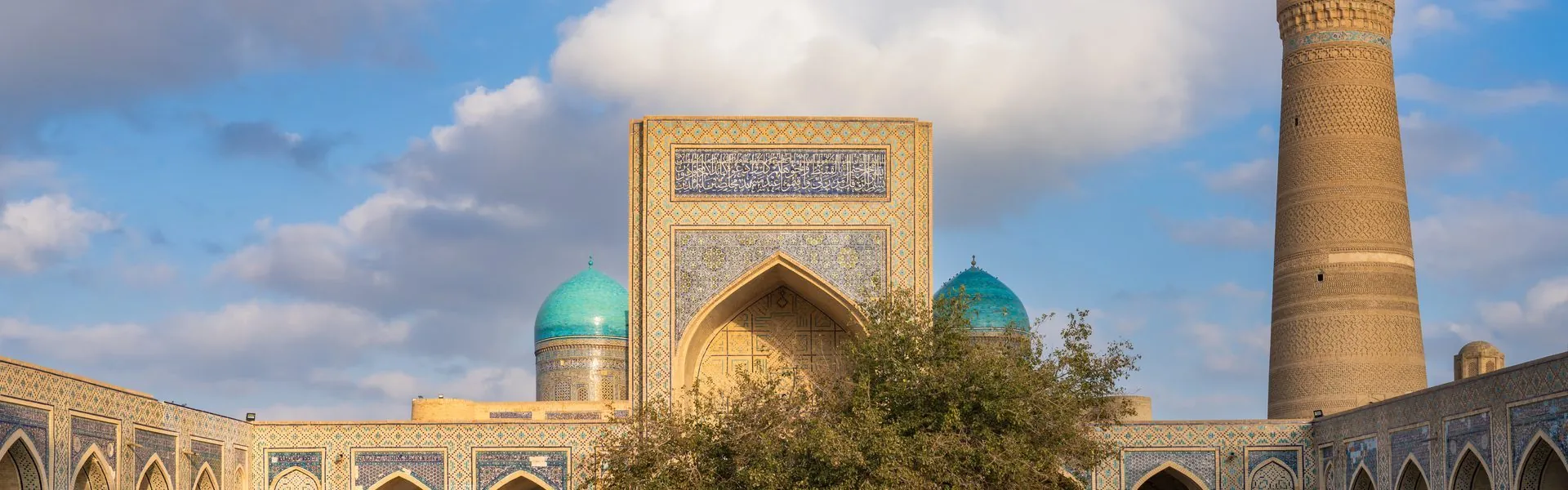
Bukhara with a child is a walk from break to break
Bukhara’s historic center is compact: you can connect the main sights on foot without constantly taking a car. But for a family, the length of the route isn’t the only thing that matters. The old city has uneven surfaces, open sunny squares, narrow streets and plenty of places where you’ll want to linger. So the best plan isn’t a list of ten monuments, but several short stretches of 20–35 minutes with stops chosen in advance.
- Start at Lyabi-Hauz: it’s the easiest place to make a short loop, sit in the shade and gauge your child’s mood.
- In hot weather, choose early morning or evening; in the middle of the day, move to the trading domes, a café or your hotel.
- Leave extra time if you have a toddler in a stroller: cobblestones and curbs noticeably slow you down.
- Don’t aim for a specific step count. On a family walk, it matters more that your child drinks, rests and still wants to keep going.
Choose your rhythm first, not a list of sights
For a child, a walk through Bukhara works better as a chain of small missions: reach the pond, find blue mosaics, count the wooden columns, choose a place for juice. Meanwhile, you get the most important thing — the chance to walk slowly instead of turning the historic center into a forced march.
- Plan one main attraction per stretch, not for the entire day.
- After 20–30 minutes of walking, suggest a short break: water, shade, a bench or a cool indoor space.
- Turn back before your child starts getting fussy. Returning along a familiar route is usually easier.
- Leave at least one backup option in your schedule: a park, café or taxi to the hotel.
The distances below are map-based estimates adapted for a family. The step counts will vary: a child takes more steps than an adult over the same distance. So treat the figures as a range, not a target. You can check the basic historic-center layout in Qozgal’s walking routes in Bukhara.
| Route | Distance | Estimated steps | Best for |
|---|---|---|---|
| Lyabi-Hauz loop | 0,8 km | 1 300–1 800 | First introduction, toddler, stroller |
| Lyabi-Hauz — trading domes — Poi Kalyan | 2,3–3 km | 3 500–5 500 | Morning or cool evening |
| Ark — Bolo-Hauz — Samanid Park | 3–3,5 km one way | 5 000–7 000 | Route with a taxi back |
| Samanid Park — Shahrud Canal | 1,5–2,5 km | 2 500–4 500 | Break in a green area and walk by the water |
| Lyabi-Hauz — Chor Minor — back | about 2,8 km | 4 000–5 500 | Quiet walk through residential neighborhoods |
Five family routes through Bukhara
1. Lyabi-Hauz: the easiest start
The Lyabi-Hauz ensemble is arranged around a pond and includes Kukeldash Madrasah, as well as the Nodir Divan-Begi Madrasah and khanqah. It’s a convenient starting point: there’s open space, cafés and an easy way to shorten the walk. Uzbekistan’s national tourism portal also notes that the square remains one of the central public spaces in old Bukhara and offers a way to wait out the heat by the water.
- Take one relaxed loop around the hauz — about 0,8 km, or 1 300–1 800 children’s steps.
- Stop in the shade and ask your child to find birds, geometric patterns and different shades of blue on the façades.
- Don’t let your child run near the water’s edge: the pond is a beautiful landmark, not a playground.
- If your child gets tired, it’s easy to end the walk here and return to the hotel or café.
2. The trading domes and Poi Kalyan
From Lyabi-Hauz, head toward the trading domes and then continue to the Poi Kalyan ensemble. This route works well on a hot day: part of it passes beneath the domes, where you can slow down, look at crafts and take a break without making a separate museum visit. The round trip to Poi Kalyan is about 2,3–3 km, or roughly 3 500–5 500 children’s steps.
With a child, you don’t have to go inside every building. Choose one goal — for example, seeing the Kalyan Minaret — and turn the walk into a game of observation: find three types of arches, listen to the sounds of the market and choose the most unusual ornament. On the open square at Poi Kalyan, stop only briefly: in summer, the stone and sunlight quickly intensify the heat.
3. The Ark, Bolo-Hauz and Samanid Park
Once your child is comfortable in the city, you can walk from Lyabi-Hauz through the trading domes and Poi Kalyan to the Ark citadel, then head to Bolo-Hauz and continue to Samanid Park. One way is about 3–3,5 km. For a preschooler, plan this as a one-way walk rather than one that requires walking back: you can take a taxi on the return.
The Ark is a good place for a long break before visiting the citadel. Inside, there may be stairs, cramped rooms and a lot of information, so agree with your child in advance: see one or two halls instead of trying to see everything. After that, Bolo-Hauz makes a good short goal, while Samanid Park is a place to recover, have a snack and move around freely.
4. Samanid Park and Shahrud Canal
Samanid Park is the most practical option when historic buildings have lost their appeal. It’s near the Samanid Mausoleum and Chashma-Ayub; maps also show the park by Shahrud Canal. Here, you can swap the sightseeing pace for a regular walk: follow the paths, find a cool spot, look at the water and give your child a little freedom to move independently.
There isn’t a classic riverside promenade in Bukhara’s historic center. If you want a walk by the water, focus on the section of Shahrud Canal near the park rather than expecting a long, continuous embankment. Allow 1,5–2,5 km through the park and along nearby paths. Before you go, check the condition of the paths and whether the attractions are operating: city infrastructure can change.
5. Lyabi-Hauz — Chor Minor — back
Chor Minor is away from the main tourist axis. The round trip from Lyabi-Hauz is about 2,8 km, or 4 000–5 500 children’s steps. This option is good for the evening: the route passes through quieter residential neighborhoods, and the small building with four towers easily becomes a clear goal for a child — find four identical elements.
How not to overload the route If your child is under five or used to short walks, choose Lyabi-Hauz — trading domes — back or just Samanid Park. Split the longer route to the Ark and park over two days.
In a field study of children playing in warm conditions, shade reduced thermal sensation and the risk of heat strain. For a walk through Bukhara, this doesn’t mean you can keep going without breaks in the shade: the point is to plan your route around shaded areas and cool indoor spaces in advance.
DOI: 10.1016/j.buildenv.2017.09.026Heat: plan for cooling, not kilometers
In summer in Bukhara, an open sunny square can be much harder on a child than the same stretch beneath a domed roof or in a park. So save open spaces for morning and evening, and choose shade, a café, a museum or a return to the hotel in the middle of the day. For more on local conditions and choosing the right time, see Qozgal’s guide to heat and shade in Bukhara.
- Bring a separate bottle of water for your child and offer drinks regularly, before they become very thirsty.
- Clothing should be light and loose; a hat and sunscreen will also help.
- Agree on breaks in advance: for example, after each attraction, look for shade and drink some water.
- Don’t cover the stroller with thick fabric. It blocks airflow and can make it hotter inside.
- If it gets too hot, don’t try to compensate by walking more slowly. Shorten the route, go somewhere cool or leave.
The authors observed 162 healthy children aged 7–14 during different activity levels and transitions between sun and shade. The study shows that a child’s age, level of movement and environmental conditions affect their thermal sensation. There is no universally safe pace for every child — your child’s condition matters more than the plan.
DOI: 10.1016/j.scs.2024.105574A review of 47 studies found a small positive effect of family programs on children’s physical activity. The authors also highlighted the role of family constraints, parental motivation, goal-setting and reinforcement. For a trip, the simple takeaway is this: children find it easier to keep walking when the adult joins in the game instead of only counting kilometers.
DOI: 10.1111/obr.12362Safety on the streets, by the water and at monuments
The historic center looks calm, but that doesn’t mean you can let your child wander far. Narrow streets see cars, motorcycles, bicycles and tour groups. Hold your child’s hand near intersections, don’t let them run out of an alley and explain one simple rule in advance: stop at the curb and wait for an adult.
- Near Lyabi-Hauz and the canals, keep your child within arm’s reach of the water.
- Inside madrasahs and mosques, watch out for stairs, low thresholds and slippery stone.
- Don’t leave the stroller across a passage in the trading domes: leave room for other people.
- Take a photo of your child in the clothes they’re wearing that morning, so you can show it quickly if needed.
- If your child develops a headache, nausea, dizziness, unusual weakness or irritability, stop, take them somewhere cool and begin cooling them down. Confusion, loss of consciousness, seizures or very hot skin require urgent medical attention.
A good family route through Bukhara isn’t a line from monument to monument, but a chain of places where you can stop, cool down and feel like walking again.
How to keep your child engaged along the way
Bukhara’s history becomes easier to understand when a child doesn’t just listen to an explanation but searches for things independently. Don’t turn the walk into a lesson: one small task for each stretch is enough.
- At Lyabi-Hauz: find three different patterns and give them names.
- In the trading domes: choose something a traveler on the Silk Road might have bought.
- At Poi Kalyan: count how many shades of blue you can see on the façade.
- At the Ark: imagine the citadel is a city within a city, and decide where the kitchen, gates and ruler’s room would be.
- In Samanid Park: create a sound map — water, birds, footsteps, music and conversations.
- On the way back: let your child choose their favorite place of the day and explain why.
How to get to the old city
If you’re staying in the historic center, start walking from your hotel and use Lyabi-Hauz as an easy meeting point. Between the main sights of the old city, a taxi is often less convenient than walking: a car can’t pull right up to your destination in the narrow lanes.
Arriving by train? Pay attention to the station name. Bukhara-1 is in Kagan, about 12–15 km from the old city, so with luggage it makes sense to take a taxi or ask your hotel in advance to arrange a transfer. From the airport to the Lyabi-Hauz area is usually closer — roughly 5–6 km by road. On a hot day, don’t try to save money on a short ride: a taxi can preserve energy for the walk itself.
Before you head out Open your navigation app, check the opening hours of your chosen museums and ask the hotel where the nearest shop, pharmacy and child-friendly place are. It’s best to double-check opening hours and road conditions on the day of your walk.
Frequently asked questions
How many kilometers should we plan for the first day?
For your first walk, 1–3 km with breaks is enough. Start at Lyabi-Hauz or Samanid Park and add more only according to how your child is doing.
Can you walk around Bukhara with a stroller?
Yes, but choose short stretches and a stroller with wheels that can handle uneven surfaces confidently. In the old city, it’s useful to have a baby carrier or at least the option to fold the stroller quickly. More route tips are available in the article about walking with a stroller.
When is the best time to walk in summer?
Early morning and evening are usually more comfortable. During the hottest hours, move the walk to the shade, trading domes, cafés or a cooler part of the day. Pay attention not only to the forecast but also to your child’s behavior.
Do I need to count my child’s steps?
No. Steps are useful only as a guide to route length. If your child is tired, slows down, stops drinking or becomes fussy from the heat, the walk is already long enough, regardless of the counter.
What should I do if my child overheats?
Take them to shade or a cool indoor space, reduce activity, offer small sips of water and cool their skin. If they become confused, faint, have seizures or their condition suddenly worsens, seek urgent medical help.
- Lyabi-Hauz is the best starting point for a short family walk.
- Samanid Park and Shahrud Canal are a good backup plan when the monuments have become tiring.
- The route to the Ark and onward to the park is more convenient one way, with a taxi for the return.
- In Bukhara, children need shade, water, clear goals and the chance to stop — not records.
Sources
- Vanos J. K., Herdt A. J., Lochbaum M. R. Effects of physical activity and shade on the heat balance and thermal perceptions of children in a playground microclimate. Building and Environment, 2017. DOI 10.1016/j.buildenv.2017.09.026
- Li Y., Wang X., Li J. and colleagues. Developing thermal prediction models for children in outdoor environments. Sustainable Cities and Society, 2024. DOI 10.1016/j.scs.2024.105574
- Brown H. E., Atkin A. J., Panter J. and colleagues. Family-based interventions to increase physical activity in children: a systematic review, meta-analysis and realist synthesis. Obesity Reviews, 2016. DOI 10.1111/obr.12362
- Masini A., Marini S., Gori D. and colleagues. Evaluation of school-based interventions of active breaks in primary schools: a systematic review and meta-analysis. Journal of Science and Medicine in Sport, 2020. DOI 10.1016/j.jsams.2019.10.008
- World Health Organization recommendations on protecting children and adults from heat: shade, regular drinking and moving activity to cooler times. WHO: Heatwaves — how to stay cool
- Uzbekistan’s national tourism portal: the Lyabi-Hauz ensemble and its sights. Uzbekistan Travel: Lyabi-Hauz
- Map of Samanid Park and nearby sights, including the Samanid Mausoleum and Chashma-Ayub; OpenStreetMap data. Mapcarta: Samanid Park
- Map and description of Samanid Park by Shahrud Canal. Yandex Maps: Samanidov Park
- Practical route map for Bukhara’s historic center with estimated distances between Lyabi-Hauz, Poi Kalyan, the Ark, Bolo-Hauz, Chor Minor and Samanid Park. Qozgal: walking routes in Bukhara
- Information about the location of Bukhara-1 station in Kagan and its distance from the old city. Travel Uzbekistan: Bukhara-1 station

