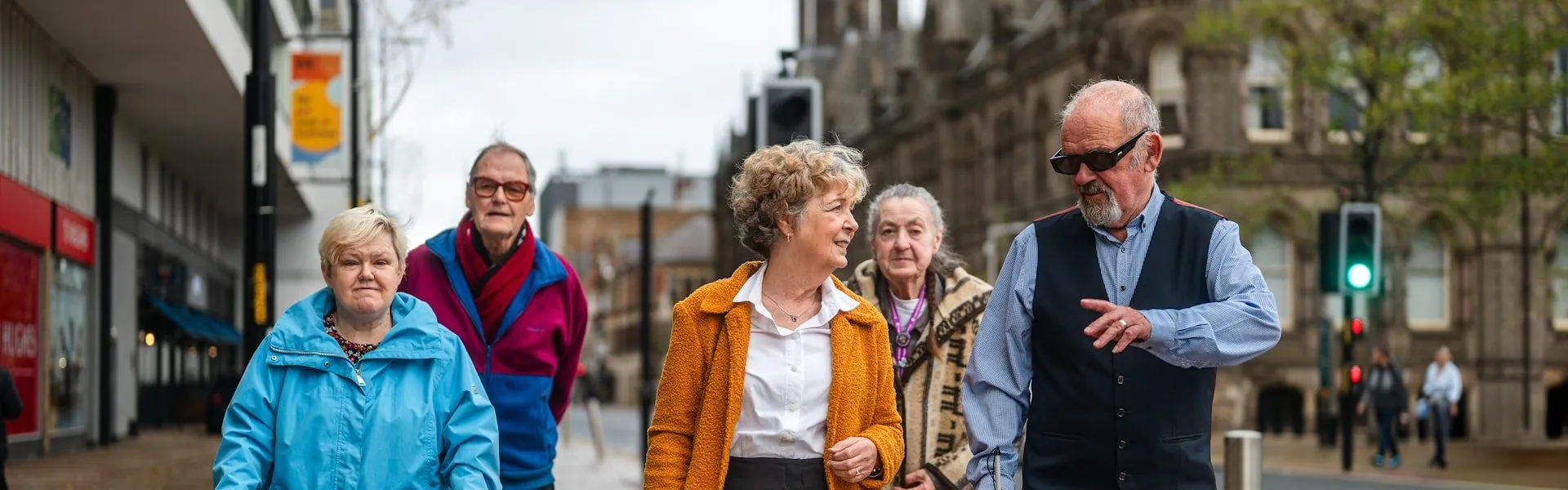
The short answer
Walking is the best foundational activity for an older person. It preserves mobility and independence, supports muscles and bones, trains the heart and brain, helps control blood sugar and blood pressure, and adds active years to your life. It's worth starting at any age — the body responds to movement at 60 and at 80 alike. One important caveat: for resistance to falls, it's worth adding simple balance exercises to your walking — more on that below
Walking preserves mobility
This is the key result: the ability to cover a few hundred meters without stopping is exactly what independence is. Getting to the pharmacy, to the grandkids, to the bus. Walking protects that ability
Fewer falls — but you need balance
Falls are the main threat in older age: a hip fracture often triggers a sharp decline in health. The good news is that this is largely preventable
So the formula is this: walking + balance + a bit of strength. Walking builds your legs and endurance, while balance exercises teach the body not to fall
What else walking gives you after 60
- Slows sarcopenia — the age-related loss of muscle that weakens the legs and makes every step heavier
- Strengthens bones — weight-bearing load slows osteoporosis and lowers fracture risk
- Protects the heart — it lowers blood pressure and cardiovascular risk (see walking and blood pressure)
- Protects the brain — it improves memory and lowers dementia risk (see walking and the brain)
- Lifts your mood and improves sleep, eases anxiety and loneliness — especially if you walk with company
- Helps your joints — contrary to fears, movement feeds cartilage and eases osteoarthritis (see is walking bad for your knees)
How much to walk
You don't need to chase "10,000." In older adults the longevity benefit plateaus much earlier — at roughly 6,000-8,000 steps a day, with a meaningful gain already starting at 4,000. Reference points:
- Starting out: if you're barely active right now — 5-10 minutes a day, adding little by little
- Goal: about 150 minutes of moderate walking a week in total (20-30 minutes a day)
- Pace: use the "talk test" — walk so your breathing has sped up but you can still talk
- In chunks: three 10-minute walks are no worse than one long one and are easier to handle
How to walk safely
- Comfortable, stable shoes with a non-slip sole — this lowers fall risk (how to choose — in the piece on walking shoes)
- Flat, familiar routes without ice, potholes or steep descents; on icy days it's better to stay home or walk in a gym/mall
- Support when needed — a cane or trekking poles add stability; that's not embarrassing, it's sensible
- Add balance and strength: standing up from a chair without using your hands, heel-to-toe walking in a straight line, calf raises holding a support — a couple of minutes at home
- Not alone at first and with a phone in your pocket; drink water, don't go out in extreme heat
- Keep your posture — head up, eyes ahead rather than at your feet (more in walking technique)
Check with your doctor first if you have heart disease, marked dizziness, recent falls, a recent joint replacement or severe shortness of breath. That's not a ban, but a way to tune the load to you
Bottom line
After 60, walking stops being "just a stroll" and becomes the main investment in your independence. It preserves the ability to walk and care for yourself, supports muscles, bones, heart and brain. And together with simple balance exercises, it noticeably lowers the risk of falls and fractures
You don't need records: 20-30 minutes of easy walking a day in comfortable shoes on a flat path is enough. The best age to start is the one you're at now. Every step today is independence tomorrow
Sources
- Pahor M, Guralnik JM, Ambrosius WT et al. "Effect of structured physical activity on prevention of major mobility disability in older adults: the LIFE study randomized clinical trial." JAMA, 2014. → JAMA Network
- Sherrington C, Fairhall NJ, Wallbank GK et al. "Exercise for preventing falls in older people living in the community." Cochrane Database of Systematic Reviews, 2019. → Cochrane
- Paluch AE, Bajpai S, Bassett DR et al. "Daily steps and all-cause mortality: a meta-analysis of 15 international cohorts." The Lancet Public Health, 2022. → Elsevier
- Cunningham C, O'Sullivan R, Caserotti P, Tully MA. "Consequences of physical inactivity in older adults: a systematic review of reviews and meta-analyses." Scandinavian Journal of Medicine & Science in Sports, 2020. → Wiley
- Bull FC, Al-Ansari SS, Biddle S et al. "World Health Organization 2020 guidelines on physical activity and sedentary behaviour." British Journal of Sports Medicine, 2020. → BMJ

Count your steps, stay on your feet
Qozgal automatically counts every step and helps you keep a manageable daily goal. Free