Why a walk by the Irtysh needs a plan
In Pavlodar, walking along the Irtysh is almost a ready-made habit: you head to the Central Waterfront, choose a direction, and collect steps without complicated logistics. But the waterfront is long, open, crowded in places, and the weather can sharply change how the route feels. So the goal is not to finish at any cost, but to build a calm 20–60-minute walk that brings you back with energy, not frozen fingers, overheating, or a slippery quest.
- For daily steps, choose the most predictable route: an even surface, a clear turn-back point, and a warm indoor place or bus stop nearby.
- When it's windy by the Irtysh, make the first half of your walk against the wind and return with the wind.
- In winter, shorten your stride, don't keep your hands in your pockets, and don't chase pace: stability matters more than speed.
- In summer, plan your walk for morning or evening, take water, and use Gorsad or side streets for shade.
- The steps in the table are rounded: for an exact conversion, check how many kilometers are in 10 000 steps.
Weather by the Irtysh: what to check in 30 seconds
Pavlodar's climate has strong contrasts: in the climate database, January averages about −16,7 °C, July has an average high of about 27,7 °C, and absolute summer peaks have reached 42 °C. The average annual wind speed is listed as 3,1 m/s, but on the open waterfront gusts feel harsher than between buildings. Before going out, check temperature, wind, precipitation, sidewalk condition, and feels-like temperature.
- If the wind is strong and cold, choose a short loop with a quick turn-back: Central Square → main descent → 10–15 minutes along the water → back.
- If it was above zero at night and below zero in the morning, treat tiles and descents as potentially slippery even without visible snow.
- If in summer it is above 28–30 °C and the sun is high, don't plan a long open section by the water at midday.
- If wet snow or rain is followed by wind, protect your chest and neck: wet clothes cool you quickly.
- If there is an event near Ertis Promenade, don't keep an even pace in the crowd — shift to Gorsad or a quieter section.
Go out as if you can shorten the route at any moment. In Pavlodar, this matters in winter and between seasons: if the surface turns icy, the wind gets stronger, or wet snow starts, turning back is smart tactics.
Routes for 20, 30, 45, and 60 minutes
Below are city routes that are easy to build without sports training. For the step estimate, I use a broad everyday range: about 1300–1500 steps per 1 km. If your stride is short, you'll be closer to the upper end; if it's long, closer to the lower end. For more options, see Pavlodar routes.
| Route | Length and steps | How to get there | Best time |
|---|---|---|---|
| Main descent → upper terrace → back | 1,4–2,0 km, 1800–3000 steps | Start from Central Square and the main descent | 20–30 minutes, morning or lunch in winter |
| Central Waterfront → River Station | 2,5–3,5 km, 3300–5200 steps | Finish landmark: 2/2 Akademik Chokin St. | 30–45 minutes, if the surface is dry |
| Ertis Promenade → viewpoint → back | 1,8–2,8 km, 2400–4200 steps | Head to the Ertis Promenade stage | Summer evenings, go around the crowd |
| Gorsad → Central Square → Irtysh | 3,0–4,0 km, 4000–6000 steps | Start in the City Garden; the river is about 1 km away | Heat, wind, walking with kids |
| New waterfront by Gusiny Perelet | 2,0–3,0 km, 2600–4500 steps | Landmarks: House of Investors, Aimanov St., railway bridge | 45 minutes, dry weather and daylight |
These are safe urban templates, not competitive GPS tracks. Before your first walk, open the map, check repairs, closures, and the nearest turn-back point. Wind, ice, and crowds matter more than a neat round number.
Route 1: a central loop without heroics
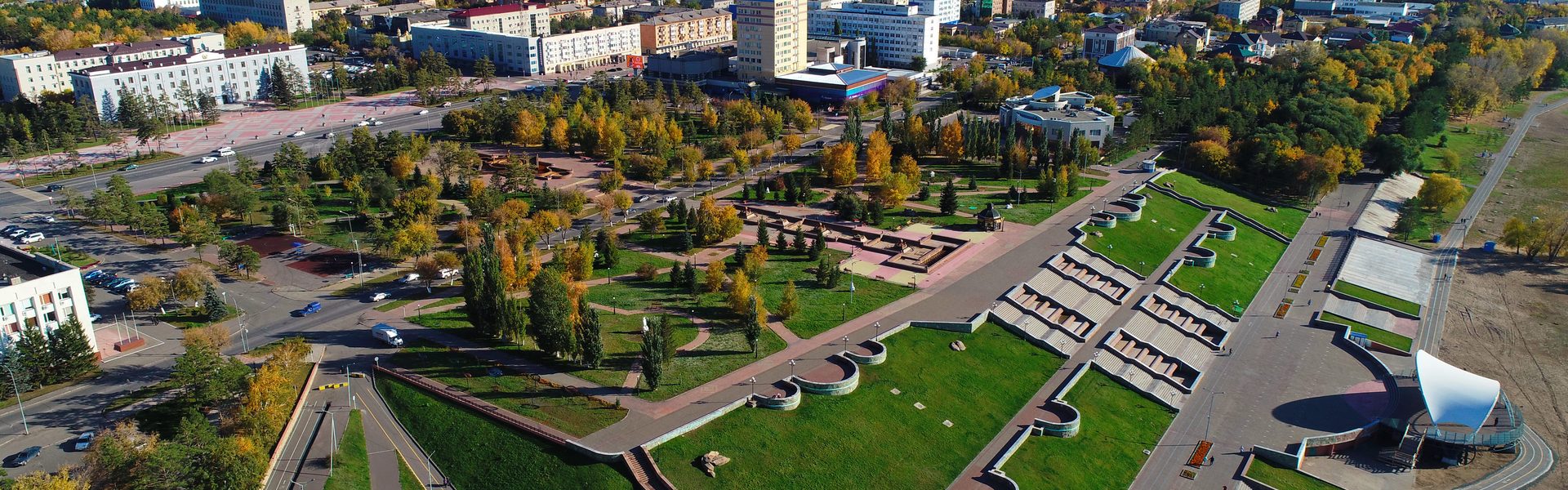
The easiest daily option is a short loop near the main descent on the Central Waterfront. The waterfront is arranged in terraces: the upper part is closer to the square, the main terrace connects the alleys, and below it is the beach area. On a dry day, follow the upper line, go down to the viewpoint, walk 10–15 minutes by the water, and return. On a windy day, stay near the center: you still have a quick exit to the square, cafés, transport, and sheltered streets.
- Walk softly for the first 5 minutes: check how your shoes grip tiles, snow, or a damp surface.
- If the wind is in your face, keep a conversational pace and don't open your jacket, even if you feel warm.
- On stairs and descents, put your phone away: one hand should be free for balance.
- On the way back, judge fatigue by breathing and stability, not by the number of steps.
- If you want more volume, do a second short loop instead of heading to the far end.
A good Pavlodar walk is not when you defeated the wind. It's when you left yourself a warm, even, and safe way back in advance.
Route 2: the River Station and a long, even line
If the surface is dry and the wind is moderate, build a longer route from the central waterfront to the River Station at 2/2 Akademik Chokin Street. This works well for 30–45 minutes: walk one way at an easy pace, turn back earlier if the wind picks up, and return on familiar ground. In winter, don't make it your first walk after snowfall: test the short central loop first.
Start against the wind while you're dry and warm. Returning with the wind is easier, and the risk of getting chilled at the end is lower. If you do the opposite, the last 10 minutes may feel worse than the whole route.
Route 3: Gorsad plus the Irtysh when you want shade
The City Garden is a good backup when it is too hot, slippery, or noisy by the water. Sources describe Gorsad as Pavlodar's old city park with alleys and attractions; it is about 1 km from the waterfront. Build the route like this: 10–15 minutes along the alleys, then an easy walk to Central Square and a short exit to the Irtysh. You'll get 3–4 km without one long open section.
- For a walk with a child or an older relative, keep Gorsad as the main part and the Irtysh as a short bonus.
- If the park is crowded near the attractions, walk along the outer alleys and don't force the pace.
- In the heat, plan water in advance: a fountain or café does not replace the bottle you carry.
- After rain, watch tiles and wooden sections: they can be slippery even without ice.
Pace: there is benefit even if you don't speed up
For daily walking in Pavlodar, you don't need training mode. A pace is enough if you can speak in phrases but feel that you're walking with purpose. On a flat, dry waterfront you can speed up a little; on ice, in a crowd, on stairs, and in strong wind, slow down deliberately. If you track steps, remember: health is linked to regularity and total volume, not to beating yesterday every day.
Winter: ice, snow, and open sections
In winter, the main mistake is walking out of summer habit: long stride, headphones, hands in pockets, and phone in front of your eyes. By the Irtysh, wind, stairs, descents, and packed shiny snow are added to the mix. Your task is to reduce fall risk: a shorter stride, lower pace, and more attention to the surface. If you need volume, walk 2 short loops on a clean section instead of one long route with icy surprises.
- Choose shoes with a soft winter sole and noticeable tread; leave smooth sneakers for the dry season.
- On ice, place your foot almost on the whole sole instead of jabbing the heel forward with a long stride.
- Don't keep your hands in your pockets: balance matters more than warmth, so wear mittens instead.
- Go around shiny patches, ramps, sloped tiles, and areas near stairs where ice often forms.
- If you carry a bag, distribute the weight symmetrically or use a backpack.
- After a fall, head pain, wrist pain, hip pain, or a strong bruise, don't try to walk it off — shorten the walk and seek help if warning symptoms appear.
If there is freezing rain, a strong blizzard, poor visibility, sharp side wind, or you already feel unstable, don't prove anything to your step counter. Replace the walk with stairs, a shopping-center walk, or a home warm-up. For cold days, read how to walk in winter without freezing.
Summer and between seasons: heat, dust, sudden changes
In summer, the waterfront tempts you with its length, but open sections heat you quickly. In July, the average high in Pavlodar is about 27,7 °C, and historical peaks above 40 °C remind us: in heat, walking should be shorter and smarter. The best window is early morning or evening, when tiles are not so hot. Between seasons, the problem changes: ice in the morning, puddles by day, and freezing again in the evening.
- In the heat, start with 20–30 minutes, not an hour-long walk along the whole waterfront.
- Take water even on a short route: wind by the water can mask thirst.
- Wear a cap or sun hat, sunglasses, and a light layer that covers your shoulders.
- If you feel dizziness, chills, nausea, or unusual weakness, move into the shade and stop.
- After a dusty wind, choose sheltered streets, Gorsad, or walk after the dust has settled.
- If you track heat in detail, check how to walk in the heat.
Morning is for distance, evening is for pleasure, noon is only for a short transfer. If you want 60 minutes, split them into two walks of 30: it is easier to collect steps without overheating.
Gear for the Pavlodar waterfront
Clothing for the Irtysh should solve 3 tasks: prevent slipping, block wind, and avoid overheating. The practical principle is layers. In winter: base layer, insulation, windproof jacket, hat, buff, and mittens. In spring and autumn: a light wind jacket and shoes you don't mind getting wet. In summer: breathable clothing, a hat, water, and sun protection. All year round, wear shoes in which you've already done a few short walks.
| Condition | What to wear | What to change in the route |
|---|---|---|
| Wind by the water | Windproof jacket, buff, mittens | Take a short loop, start against the wind |
| Ice and packed snow | Winter sole, tread, free hands | Shorten your stride, remove stairs and descents |
| Heat and sun | Cap, water, light breathable clothing | Morning or evening, more Gorsad shade |
| Wet tiles | Shoes with grippy soles, no long trousers | Slow down, go around sloped sections |
| Crowd near Ertis Promenade | Comfortable shoes, minimum bags | Shift to the upper terrace or the park |
How to build a daily habit
WHO recommends that adults get 150–300 minutes of moderate aerobic activity per week. In Pavlodar, that can be 5 walks of 30 minutes or 3 short weekday walks plus one longer weekend route. You don't have to walk by the water every time. Make the Irtysh your anchor for beautiful days, and in wind, black ice, and heat use Gorsad, courtyards, sheltered streets, and indoor options. That way the habit survives the season.
- Choose a basic 20-minute loop that you can do even on a tired day.
- Add one 45–60-minute walk only in good weather and with a normal surface.
- Keep 2 routes on your phone: a beautiful one by the Irtysh and a safe backup in a park or indoors.
- Watch not only your steps, but also how you feel afterward: sleep, fatigue, mood, and legs.
- If you missed a day, don't compensate with an hour on ice — just return to the short loop tomorrow.
- Pavlodar's waterfront is excellent for daily steps, but wind, ice, and heat change the load.
- The best route has a quick turn-back point and a clear alternative.
- 20–60 minutes of walking is enough to fit movement into the week without athlete mode.
- In winter, stability wins; in summer, timing and water win; between seasons, checking the surface wins.
- A step counter helps, but you make the safety decision, not the number on the screen.
How many steps can you get in 30 minutes on the Pavlodar waterfront?
Usually about 3000–4500 steps if you walk calmly and without long stops. On ice, in a crowd, or in strong wind, it will be less — and that's normal. Don't speed up for the number if the surface is unsafe.
When is the best time to walk by the Irtysh in winter?
Daylight hours are best, when you can see tiles, ice, and descents. After snowfall, a thaw, and a night below zero, choose a short central loop or Gorsad. In the evening on the open waterfront, the risk of missing ice is higher.
Can you walk along the Irtysh in strong wind?
Yes, if the route is short, your clothing protects against wind chill, and you have a quick turn-back option. Start against the wind and return with the wind. If gusts knock your stride off or your hands and face get cold, shorten the walk.
What should you choose in summer: the waterfront or Gorsad?
In the morning and evening, the waterfront works well. At noon, Gorsad or shady streets are better: open tiles by the water heat up, and the wind can hide overheating. For a long walk, take water and a hat.
Do you need trekking poles on the Pavlodar waterfront?
For a normal 20–60-minute walk, not necessarily. Poles can help if you already know how to use them, but on ice they do not replace good shoes and a short, stable stride. If you're interested, read about Nordic walking poles.
Sources
- PavlodarNews.kz: article about the Central Waterfront, Ertis Promenade, and a length of more than 6 km. PavlodarNews.kz
- Forbes Kazakhstan: news item about the waterfront section, Gusiny Perelet, and the length of 6,2 km after expansion. Forbes.kz
- Komandirovka.ru: description of Pavlodar's Irtysh waterfront, terraces, main alley, and viewpoint. Komandirovka.ru
- WildTicket Asia: reference on Pavlodar City Park of Culture and Recreation, Gorsad, and the distance to the waterfront. WildTicket Asia
- Weather and Climate: Pavlodar climate normals for temperature, wind, precipitation, snow, and weather phenomena. Weather and Climate
- World Health Organization 2020 guidelines on physical activity and sedentary behaviour. British Journal of Sports Medicine, 2020. DOI: 10.1136/bjsports-2020-102955. DOI
- Paluch A.E. et al. Daily steps and all-cause mortality: a meta-analysis of 15 international cohorts. The Lancet Public Health, 2022. DOI: 10.1016/S2468-2667(21)00302-9. DOI
- Slaght J. et al. Walking Cadence to Exercise at Moderate Intensity for Adults: A Systematic Review. Journal of Sports Medicine, 2017. DOI: 10.1155/2017/4641203. DOI
- The walking speed of pedestrians on various pavement surface conditions during winter. Transportation Research Part D, 2021. DOI: 10.1016/j.trd.2021.102934. DOI
- Hsu J. et al. Assessing the performance of winter footwear using a new maximum achievable incline method. Applied Ergonomics, 2015. DOI: 10.1016/j.apergo.2015.03.016. DOI

Count your steps with Qozgal
A free app that counts your steps, keeps your streak and motivates you to walk every day.