Why walking with neuropathy needs a plan
Peripheral neuropathy is not just an unpleasant tingling. When the nerves in your feet send signals less effectively, you may notice a pebble in your shoe, chafing, an overheated sole, or uneven pavement too late. That’s why walking with numb feet is not about heroics or “I’ll just push through.” It’s about a smart route, skin protection, and honest feedback from your body.
The good news: research does not support the idea that people with neuropathy need to automatically avoid walking. In randomized studies, programs with walking and foot exercises helped improve distance, step count, and walking speed — as long as feet were checked regularly, footwear was appropriate, and load was increased gradually.
With reduced sensation, the main question before a walk is: “Are my feet protected and checked today?” If yes, you can go calmly. If not, solve the problem first instead of adding steps.
First, rule out situations when you should not walk
Before you plan your steps, check your feet. With neuropathy, the skin can be harmed before you feel pain. Be especially careful with walks if you have diabetes, have had a foot ulcer, have toe deformities, significant calluses, or have already been prescribed therapeutic footwear.
- Do not go for a walk if you have an open wound, a weeping blister, blood on your sock, a cracked heel, or an area of skin that quickly becomes red again.
- Contact a doctor urgently if your foot becomes hot, swollen, red, changes shape, or you develop a new limp — with neuropathy, pain may be mild even when the problem is serious.
- Postpone long routes if you have a fever, infection, severe dizziness, sudden weakness, or new numbness that has moved above the feet.
- If the numbness appeared recently, is progressing quickly, or affects one side of the body, don’t write it off as “tiredness” — you need a medical evaluation of the cause.
With neuropathy, no pain does not mean no injury. Don’t rely only on how you feel; also use a skin check, step stability, and how your feet look after the walk.
If you have diabetes, it helps to know your foot-risk category from your doctor or podiatrist. International IWGDF guidelines advise people at risk of ulcers not to walk without appropriate foot protection and to wear properly fitted footwear. It sounds boring, but this is exactly where walking becomes — or does not become — a safe habit.
Shoes: your main layer of protection
With numb feet, shoes are not an accessory — they are protective gear. You need a pair that reduces friction, does not squeeze your toes, does not slip at the heel, and does not create local “hot spots.” If you want a separate breakdown of the basics, see Qozgal’s guide to walking shoes; here are the rules specifically for neuropathy.
- Wear closed shoes with a wide toe box: your toes should not hit the front, overlap, or rub against the upper.
- Check inner seams, insole folds, and rough edges. Run your hand inside the shoe before every walk.
- Choose socks without a rough seam, made from fabric that wicks moisture. Damp skin chafes faster.
- Don’t walk barefoot, in flip-flops without heel support, or for a long time right away in new shoes. Test a new pair for 10–15 minutes.
- If you have had ulcers, significant calluses, or foot deformities, regular sneakers may not be enough — ask about therapeutic footwear and pressure-relieving insoles.
| Feature | Better for walking | Risky with neuropathy |
|---|---|---|
| Toe box | Wide, toes have room | Narrow, presses on the big toe or little toe |
| Heel | Secured, does not slip | Flip-flops or clogs with no heel control |
| Inside | Smooth, insole lies flat | Seam, fold, pebble, worn-out insole |
| Sole | Stable, moderately firm | Too thin, slippery, or badly worn down |
| First outing | 10–15 minutes and a skin check | A one-hour walk right away in a new pair |
Where to walk: the surface matters more than a pretty route
For feet with neuropathy, the best route is predictable. A level path, good lighting, and the option to get home quickly are worth more than a long, beautiful loop over cobblestones. If you like being outdoors, choose a park with asphalt or a rubberized surface. If it is icy, dark, or full of potholes outside, a short indoor walk in a mall, hallway, covered track, or at home is better.
- Start with a level surface: a track, smooth asphalt, or a wide sidewalk without curbs.
- Avoid sand, gravel, cobblestones, wet tiles, ice, and steep downhills until your stability has been tested.
- Do not walk on hot sand or scorching asphalt: with reduced sensation, you may notice a burn too late.
- For your first walks, choose a 5–10 minute loop near home, not an out-and-back route where you have to return through fatigue.
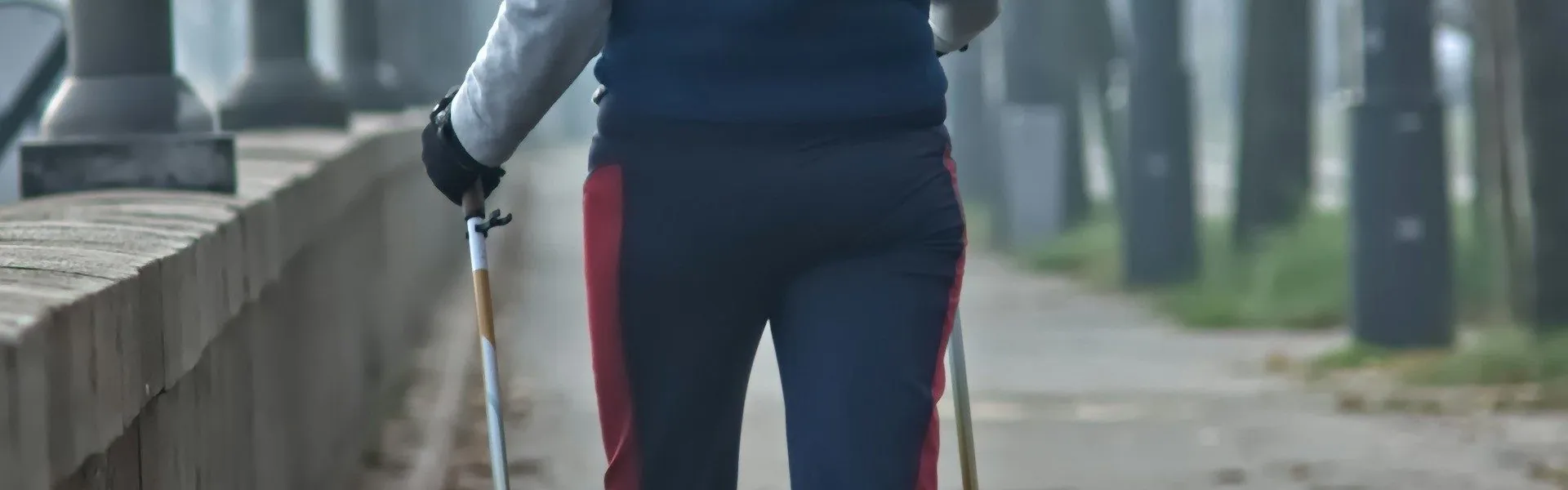
- If you are afraid of falling, use Nordic walking poles only after a short technique session or a consultation with a specialist.
If you cannot walk the route confidently while talking calmly and looking ahead, the surface is still too challenging. First, return to a level path and short segments.
Pace and volume: increase slowly
With neuropathy, you cannot rely only on the rule “I walk as long as it feels nice.” Burning may not worsen right away, and a blister can appear without pain. So it is better to set your load by time and steps. Start with an amount after which the skin on your feet looks the same as before the walk. For one person that may be 5 minutes, for another 20.
A practical rule: increase your volume by no more than 10% about once every 1–2 weeks, if walks leave you with no new calluses, redness, swelling, or worse stability. If you use a pedometer, don’t immediately chase 10,000 steps. With neuropathy, the goal is not a record — it is consistency without skin damage.
- Week 1: find a safe minimum — for example, 5–10 minutes of walking 4–5 times a week.
- Week 2: keep the same pace, but add 1–2 minutes to the walk only if your foot skin is clear.
- Week 3: add a second short outing in a day or extend one route, but don’t change shoes, surface, and pace all at once.
- Week 4: if everything is calm, move toward 20–30 minutes of easy or moderate walking on most days of the week.
- Any new redness, blister, or chafing means one step back in the plan — not a reason to “break in” the shoes.
- Walk only in closed, checked shoes and socks without rough seams.
- Choose a level, dry, well-lit surface.
- Increase time or steps gradually, not based on mood.
- Check your feet before and after every walk.
- Stop if you see a new wound, blister, swelling, blood on your sock, or a sudden change in gait.
- If you have had a foot ulcer, agree on walking volume and footwear with a specialist.
Before, during, and after your walk
Make foot care part of your ritual, like your keys and phone. It takes two minutes and lowers the risk of unpleasant surprises. If you cannot see the sole well, use a mirror or ask someone close to help. With diabetes, this check is especially important: ADA recommendations emphasize that some neuropathies can be symptom-free, and an injury to an insensate foot can easily go unnoticed.
- Before you go out: look at the sole, heel, side edges, and areas between the toes. Check for cracks, a blister, redness, an ingrown nail, or weeping skin.
- Check the inside of your shoe by hand: a pebble, insole fold, or grain of sand can cause a blister.
- Walk more slowly than usual for the first 5 minutes. You need to assess stability, not hit your pace right away.
- During the walk, use a conversational pace: if you can speak in phrases without breathlessness, the intensity is right.
- After the walk, take off your socks and check your skin again. A red spot that does not fade is a signal to reduce load and check your shoes.
Do not pop it before a walk or cover it “just in case” so you can keep going. Reduce the load, protect the skin, and work out the cause: shoes, socks, moisture, or too sharp an increase in steps. More details are in the article about walking blisters.
How to add balance and strength
Walking trains endurance, but with neuropathy, balance, foot strength, and ankle control often suffer too. So the best plan is not just “walk more,” but combine walks with gentle exercises. Do them near a wall, chair, or handrail so you don’t practice falling instead of stability.
- Calf raises at a support: 1–2 sets of 8–10 reps, without pain or jerking.
- Heel-to-toe rocking by a wall: slowly, so you can feel foot control.
- Sit-to-stand from a chair: strengthens the thighs and helps you stand up without losing balance.
- Tandem stance at a support: one foot in front of the other, 10–20 seconds, only if it is safe.
- A short ankle warm-up before going out: foot circles, toe flexion and extension, and a few calm steps at home.
A 4-week plan
This plan is suitable if you have no open wounds, active ulcer, significant swelling, fever, new severe numbness, and your doctor has not forbidden activity. If you are returning after illness or a long break, move even more gently — our guide on how to return to walking after illness may help.
| Week | Walking | Safety check | Exercises |
|---|---|---|---|
| 1 | 5–10 minutes, level loop, 4–5 days | Check feet before and after | 2 exercises at a support |
| 2 | +1–2 minutes to successful walks | No redness or new calluses | Add sit-to-stand |
| 3 | 10–20 minutes or 2 short outings | Don’t change shoes and route at once | Balance at a support 3 times a week |
| 4 | 20–30 minutes if well tolerated | If skin is calm, keep the routine | Keep strength work and warm-up |
If chafing appears in any week, return to the previous volume and check your shoes. If you develop a wound, blood, increasing redness, an unpleasant smell, discharge, or a hot swollen foot, do not train “through it.” With neuropathy, the right pause often preserves months of future walks.
Questions and answers
Can I walk every day with peripheral neuropathy?
Yes, if you have no wounds, active ulcer, acute swelling, and your doctor has not limited your activity. Start with short walks and pay attention not only to how you feel, but also to the skin on your feet after walking.
What should I do if my feet burn during a walk?
Slow down, shorten the route, and check your shoes. Burning can be a symptom of neuropathy, but it can also worsen from friction, overheating, or swelling. If the sensation is new, sudden, or continues after rest, discuss it with a doctor.
Is a treadmill safer than walking outdoors?
Not always. A treadmill is level and has handrails, but the belt moves on its own, and with reduced sensation it is easier to miss fatigue or a stumble. If you use a treadmill, start at a low speed, attach the safety key, and do not walk without shoes.
Does everyone with numb feet need orthopedic insoles?
No. But if you have diabetes, have had ulcers, have significant calluses, toe deformities, or high-pressure areas, insoles and therapeutic footwear should be fitted by a specialist. The strongest ulcer-prevention research applies to high-risk groups.
How can I tell if I am increasing steps too quickly?
Signals include new calluses, red spots after a walk, swelling, fatigue that changes your gait, or fear of falling. In that case, reduce your volume by 20–30% and return to a level surface.
Can I walk with poles?
Yes, if the poles improve stability rather than confuse your step. Practice the technique first on a level path. If you have already had falls, start with a physiotherapist consultation and read the breakdown of walking, balance, and falls.
Sources
- Pop-Busui R., Boulton A.J.M., Feldman E.L. et al. Diabetic Neuropathy: A Position Statement by the American Diabetes Association. Diabetes Care, 2017. DOI: 10.2337/dc16-2042
- LeMaster J.W., Mueller M.J., Reiber G.E. et al. Effect of Weight-Bearing Activity on Foot Ulcer Incidence in People With Diabetic Peripheral Neuropathy. Physical Therapy, 2008. DOI: 10.2522/ptj.20080019
- Mueller M.J., Tuttle L.J., LeMaster J.W. et al. Weight-Bearing Versus Nonweight-Bearing Exercise for Persons With Diabetes and Peripheral Neuropathy. Archives of Physical Medicine and Rehabilitation, 2013. DOI: 10.1016/j.apmr.2012.12.015
- Monteiro R.L., Ferreira J.S.S.P., Silva É.Q. et al. Foot–ankle therapeutic exercise program can improve gait speed in people with diabetic neuropathy. Scientific Reports, 2022. DOI: 10.1038/s41598-022-11745-0
- de Oliveira Lima R.A., Piemonte G.A., Nogueira C.R., Nunes-Nogueira V.S. Efficacy of exercise on balance, fear of falling, and risk of falls in patients with diabetic peripheral neuropathy. Archives of Endocrinology and Metabolism, 2021. DOI: 10.20945/2359-3997000000337
- Bus S.A., Sacco I.C.N., Monteiro-Soares M. et al. Guidelines on the prevention of foot ulcers in persons with diabetes (IWGDF 2023 update). Diabetes/Metabolism Research and Reviews, 2024. DOI: 10.1002/dmrr.3651
- van Netten J.J., Raspovic A., Lavery L.A. et al. Prevention of foot ulcers in persons with diabetes at risk of ulceration: A systematic review and meta-analysis. Diabetes/Metabolism Research and Reviews, 2024. DOI: 10.1002/dmrr.3652
- Ahmed S., Barwick A., Butterworth P., Nancarrow S. Footwear and insole design features that reduce neuropathic plantar forefoot ulcer risk in people with diabetes. Journal of Foot and Ankle Research, 2020. DOI: 10.1186/s13047-020-00400-4
- Ulbrecht J.S., Hurley T., Mauger D.T., Cavanagh P.R. Prevention of Recurrent Foot Ulcers With Plantar Pressure–Based In-Shoe Orthoses. Diabetes Care, 2014. DOI: 10.2337/dc13-2956
- Alissa N., Shipper A.G., Zilliox L., Westlake K.P. A Systematic Review of the Effect of Physical Rehabilitation on Balance in People with Diabetic Peripheral Neuropathy Who are at Risk of Falling. Clinical Interventions in Aging, 2024. DOI: 10.2147/CIA.S459492

Count your steps with Qozgal
A free app that counts your steps, keeps your streak and motivates you to walk every day.