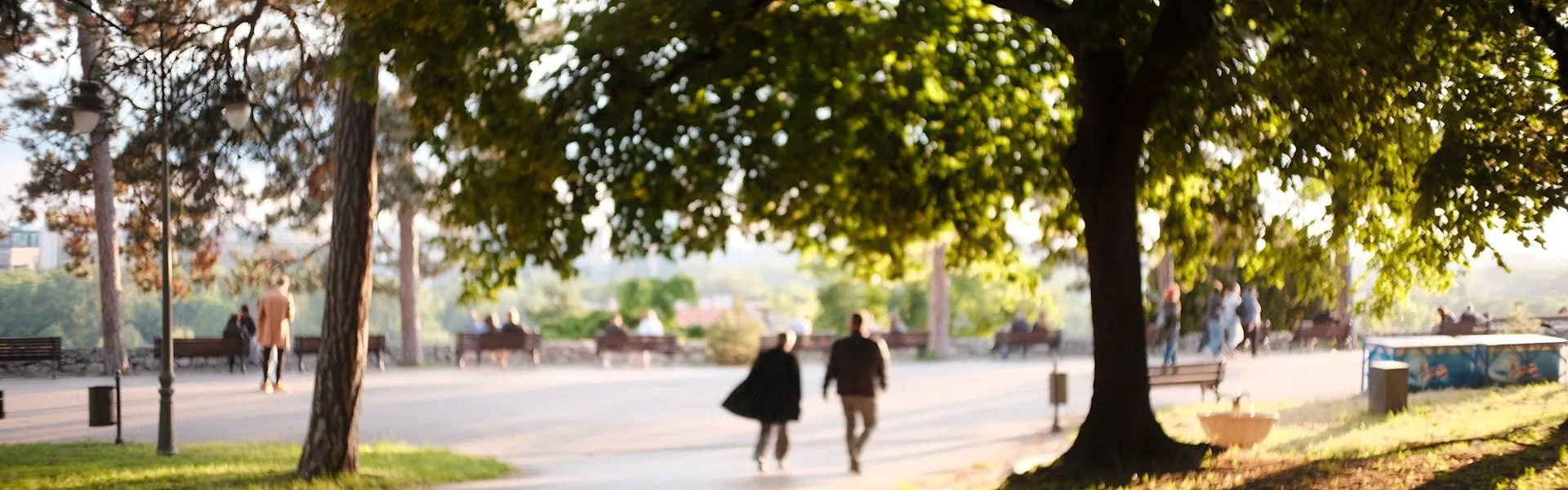
A comfortable walk isn’t about the miles
The same street can feel different from one day to the next: it may be quiet today, but tomorrow there could be roadworks, loud music, or more people than usual. For an autistic person, comfort depends not only on the length of the route, but also on the sensory environment, predictability, the chance to stop, and the freedom to change the plan.
Sensory preferences vary from person to person. Sudden sounds and bright light bother some people; others are especially sensitive to smells, touch, wind, or uneven surfaces. Another person may seek movement and intense sensations. Don’t assume in advance what will feel unpleasant: ask if they can answer, or notice together which conditions help.
A successful walk isn’t the one that covers the most ground. It’s one where the person feels calm enough, safe, and interested.
Important: walking doesn’t treat autism and shouldn’t be used to make someone get used to unpleasant stimuli. It can be a way to relax, get from place to place independently, or enjoy an activity—if that’s what the person wants.
First, find out what affects comfort
Before choosing a route, try to work out together what makes a walk easier and what makes it harder. Don’t rely only on words: a person may communicate overload through a gesture, a card, a communication device, trying to leave, or a change in behavior. These signals don’t explain everything on their own, so it’s better to calmly check what’s happening rather than immediately dismissing the reaction as being difficult or refusing.
- Sound: traffic, alarms, barking dogs, loud groups, construction work.
- Light and weather: glare, flickering, heat, cold, wind, or sudden rain.
- Smells and physical sensations: smoke, food, damp clothes, uncomfortable shoes, seams, and tags.
- Space and movement: narrow sidewalks, crowds, bicycles, unexpected touch.
- Predictability: an unfamiliar turn, a closed path, having to wait a long time, or a sudden change of plans.
You don’t have to keep a detailed diary. Sometimes it’s enough to make a quick note after a walk: where things felt calmer, when it got harder, and what helped the person continue or made them want to stop. Compare similar situations and take the person’s own opinion into account. One difficult outing doesn’t mean every walk will be the same.
The authors surveyed parents of children in two age groups. Parents noted that sensory features of the environment and social demands can make it harder for children to participate in community life. This study didn’t test specific walking routes, but it supports a practical takeaway: consider not just the person, but also the conditions around them. The findings are based on parent reports, not a universal list of stimuli that will suit everyone.
Simpson K, Adams D. Disability and Rehabilitation. 2024.Choose a route that feels calm and is easy to leave
For a first walk, look for a route that’s easy to understand and easy to cut short if needed—not necessarily the prettiest one. A familiar path with a few places to stop may work better than a new park, even if it has fewer trees. If the walk is for a specific purpose, like going to the store, plan both the route and a backup way home.
| Option | What may make it comfortable | What to check in advance |
|---|---|---|
| A quiet street or familiar yard | Familiar landmarks, a short way home | Traffic, dogs, unexpected roadworks |
| A park at a quiet time | You can walk more slowly and stop | Crowds, noisy play areas, path conditions |
| A short loop near home | Easy to end the walk without a long trip back | Crossings, safe places to pause |
If street noise is a problem, try a quieter time or a route farther from traffic. If walking somewhere secluded feels unsettling, choose a familiar place where there are people around but you can step aside. There’s no single universally “sensory-friendly” route: follow the person’s preferences and change one condition at a time.
- Check the surface, crossings, lighting, places to rest, and whether it’s easy to return quickly.
- Consider not just the distance, but also wait times at crossings, noise, and traffic volume.
- If the person likes maps, show them the route in advance; if maps feel overwhelming, use a simple description or familiar landmarks.
- Noise protection, a cap, or sunglasses may help if the person prefers them. Don’t use an accessory against their wishes.
Try the route with no pressure You could visit the new place first, walk just a short stretch, or agree only to leave home and decide what to do next once you’re there. Getting familiar with a route shouldn’t become a promise to walk the whole thing.
Prepare for the walk—and leave room to choose
Letting someone know about an upcoming outing may reduce uncertainty if they find it helpful to know what will happen in advance. You could use a photo of the place, a short note, a map, a timer, a verbal plan, or another familiar way of communicating. Don’t impose a visual schedule on someone it doesn’t suit.
- Say or show where you’re going and what the route will roughly be like.
- Point out what might change: for example, the path is sometimes closed, or the bus may be delayed.
- Offer a choice the person can use: take the short or long loop, pause, or head back.
- Agree in advance how the person can let you know they want to stop or end the walk.
- If the plan changes, explain it clearly and offer an understandable alternative instead of promising that everything is still the same.
A small study involving two students found that visual supports were associated with a quicker transition to the next activity; the authors studied transitions at home and in community settings. This is a useful example, but it doesn’t prove that a schedule will work for everyone. Treat prompts as an experiment: try a format the person is familiar with, and keep using it only if it really helps.
The study used visual prompts to support two students as they moved between activities at home and in community settings. The authors reported a shorter delay before transitions; the study was small and its findings can’t be generalized to all autistic people. The practical takeaway isn’t that pictures are a must, but that having clear information in advance can sometimes help.
Dettmer S et al. Focus on Autism and Other Developmental Disabilities. 2000.Extend the walk gradually—and only if the person agrees
You don’t have to start with a goal of walking a set number of steps. Choose an option that leaves the person with enough energy and the desire to go again. It could be a short walk to a nearby landmark, one loop around a familiar place, or going out only during a calmer part of the day. A comfortable starting point for one person may be a few minutes; another may first need to get familiar with the route when it’s not crowded.
If several walks go comfortably and the person wants to go farther, add a short stretch or try one new element—for example, a different path while keeping the same duration. Don’t change the route, time, company, and duration all at once: it makes it harder to tell what affected the experience.
- Count more than distance as a success: choosing independently, taking a break, or returning calmly all matter.
- Stop before the person gets very tired if that’s what they prefer; rest is part of the plan, not a failure.
- If the longer walk proved too difficult, go back to the familiar option without blame.
- Don’t turn gradually increasing the distance into a required program: the person may not want to walk farther.
Research on physical activity and autism covers different activities and motor skills, but its findings can’t automatically be applied to ordinary walks or used to promise behavioral effects. A systematic review of interventions noted that the studies varied and the evidence had quality limitations. So the guide here is comfort and the person’s own goal—not the idea that walking is a form of “treatment.”
The review included 41 studies of motor and physical activity interventions for autistic children. The authors noted that the overall quality of evidence was low and called for more rigorous research. The review doesn’t establish that walking treats autism or suits everyone; it shows why we shouldn’t overstate the effects of any particular activity.
Ruggeri A et al. Autism. 2020.These numbers describe different studies; they’re not a benchmark, a goal for a walk, or proof of a one-size-fits-all approach. Parents of children in two age groups took part in the participation study; the physical activity review included 41 studies, while the visual prompt findings came from a very small sample. The cards above give more details and explain the limitations.
If things get difficult: stop and reassess
When the person clearly wants to stop, first help them get somewhere safer and calmer. If you can, reduce the sensory load: move away from the source of noise, take a break, shorten the route, or head home. Don’t demand an explanation in the moment, and don’t use continuing the walk as a test of endurance.
Later, when the person feels comfortable communicating, you can talk together about what happened and what they’d like to do differently next time. Sometimes the solution is simple: leave earlier, bring a favorite item, choose a different crossing, or check in advance whether the park is open. If the behavior was unexpected, don’t assume there was only one reason without checking.
Safety comes before the route Keep traffic safety in mind and make sure the person can quickly communicate that they need to stop or leave. If they have individual mobility or health-related risks, discuss a suitable support plan with a professional who knows them. Noise protection shouldn’t prevent them from noticing danger near the road.
In brief
- Choose the time and route to suit the person’s sensory preferences, not a set of universal rules.
- Explain the sequence of events and possible changes in advance, using a method that works for the person.
- Plan for breaks, a short way home, and the option to end the walk.
- Extend the walk gradually, and only if the person wants to.
- Walking can be an enjoyable activity or a way to get around, but it doesn’t treat autism.
Frequently asked questions
Do you have to walk every day to see a benefit?
There’s no universal schedule that everyone has to follow. Choose how often to walk based on the person’s wishes, well-being, circumstances, and actual goal. If a walk isn’t right for them right now, don’t turn it into a requirement.
Should you deliberately choose quiet places?
Only if that’s more comfortable for the person. A quiet place helps some people, while others enjoy busy streets or activity around them. It’s better to ask and observe than to rule out every noisy space in advance.
What if the usual route is suddenly closed?
Explain the change in simple words or in a familiar way, offer another route, and give the person time to choose. If the new situation is overwhelming, you can skip the walk or go home; you don’t have to complete the original plan at all costs.
Are headphones or earplugs helpful?
They may be comfortable if the person chooses them and they help. Make sure they can still cross the road safely and notice important signals. If needed, consider a less isolating option or choose a route with less traffic.
Sources
- Simpson K, Adams D. Parent-reported environmental factors and strategies to support the participation of autistic children in home and community activities. Disability and Rehabilitation. 2024. DOI: 10.1080/09638288.2023.2261843
- Dettmer S et al. The use of visual supports to facilitate transitions for students with autism. Focus on Autism and Other Developmental Disabilities. 2000. DOI: 10.1177/108835760001500307
- Ruggeri A et al. A systematic review of motor and physical activity interventions and their effects on motor outcomes in autistic children. Autism. 2020. DOI: 10.1177/1362361319885215
- Bagatell N et al. Sensory processing and community participation among autistic adults. Frontiers in Psychology. 2022. DOI: 10.3389/fpsyg.2022.876127