A few minutes for a word between walks
Even on your most active days there are pauses: lunch, a bus ride, the evening after a walk or a whole rest day. Most of the time they vanish into a social media feed that never ends and rarely gives you any real rest. A short word puzzle works differently: it has a goal, rules and an ending. One of the most unusual newcomers to the genre is called WorDungeon: it's Wordle turned into a descent through a dungeon full of bosses
First, let's take an honest look at what research says about word puzzles and the brain, what it doesn't say, and how walking is linked to thinking. Then we'll explain how WorDungeon works, how to get through the first floors and how to combine the game with your walks
What science knows about word puzzles
Many people have heard that crosswords protect your memory. In the online PROTECT study, researchers from Exeter asked 19,078 healthy people aged 50 to 93 how often they do word puzzles and gave them nine tests of attention, memory and thinking. The more often someone did these puzzles, the better their results were on average, and those who never did them performed worst of all. But this is a one-time snapshot, not an experiment: it may simply be that people with livelier minds are more likely to enjoy puzzles. Whether puzzles affect how our thinking changes with age remains to be seen
107 people with mild cognitive impairment trained at home for 12 weeks: some did crosswords on a computer, others played cognitive games, and then there were six more booster sessions. After 78 weeks, the crossword group's ADAS-Cog score fell from 9.59 to 8.61, while the games group's rose from 9.53 to 9.93, and on this scale lower means better. A caveat: there was no group without training, so the study compared two kinds of activity with each other
Devanand DP et al., NEJM Evidence, 2022Now for what science doesn't promise. In an online experiment published in Nature, 11,430 people spent six weeks training on memory, logic and attention tasks. Their scores went up in every exercise, but the skill didn't carry over to other tasks, not even similar ones. A 2016 review came to a similar conclusion: the trained task gets better, while everyday thinking barely changes. So think of WorDungeon as a pleasant break and some English vocabulary practice, not as a pill against aging. That said, it does have a few useful sides
- A change of focus: for a few minutes you think about one word instead of a dozen open tabs
- A clear ending: a floor ends in a win or a loss, so it's easier to stop than when you're scrolling a feed
- English spelling: the game only accepts real words, and after a fight it shows you the hidden word and its meaning in English
- The logic of elimination: every guess rules out letters and positions, and you learn to pick the move that gives the best hints
- A bit of competitive spirit: the weekly leaderboard gives you a reason to come back and go deeper
Walking and thinking: what's proven and what isn't
Walking has more evidence behind it. In a randomized trial with 120 older adults, half of the participants walked for 40 minutes three times a week for a year, and the front part of their hippocampus, the brain region linked to memory, grew by about 2%. In the other half, who did stretching, the hippocampus shrank over the year. Spatial memory improved in both groups, but in the walkers its improvement was linked to the growth of the hippocampus. The break itself helps too: a meta-analysis of 22 samples with 2,335 participants found that breaks of up to 10 minutes slightly boost vigor and reduce fatigue, although overall performance after them doesn't noticeably improve
Stanford researchers ran four experiments. When participants walked on a treadmill, scores on a test of thinking up unusual uses for an everyday object went up for 81% of them. But on a task where you need to find one word linked to three given ones, walking improved results for only 23%. The creative boost partly lingered when people sat down right after walking, and a walk outdoors worked the same way
Oppezzo M, Schwartz DL, J Exp Psychol Learn Mem Cogn, 2014Steps first, then a floor Wordle is closer to the second task in this study: it has only one right answer, so don't expect to start guessing letters faster after a walk. The benefit of the “walk first, play second” order lies elsewhere: your break doesn't turn into yet another hour of sitting. Play on a bench or at home, but not on the go. For more on walks and ideas, read our article on walking and creativity
How WorDungeon works
If you'd like to try a break like this, start with WorDungeon. It comes from the creators of Worduel, the one-on-one word duel we've already written about. Here you play alone. Each floor has a boss who hides an English word and changes the rules: a duel on a shared board, two or four words at once, a clock, hints that lie or hide in fog. You start with three lives. Fail a challenge and you lose a life, then the boss picks a new word. Win and you choose one of three relics, and their effects stack. A run lasts until your last life, and the leaderboards track two results: the deepest floor and the highest score
| What we compare | Regular Wordle | Worduel | WorDungeon |
|---|---|---|---|
| Format | One word a day | A duel with a live opponent | A descent through floors of bosses |
| Rules | Always the same | Shared board, 45 seconds per move | Each of the 50 bosses has its own |
| Word length | 5 letters | 5 letters | 4 to 7 letters |
| Word language | English | 13 languages to choose from | English |
| How much you can play | One game a day | As much as you like | Until you run out of lives |
| Bragging rights | Your daily streak | Your rating | Depth and score |
| Price | Free | Free | Free, no account needed |
One dungeon floor after a walk, not instead of it
Your first runs: tips for beginners
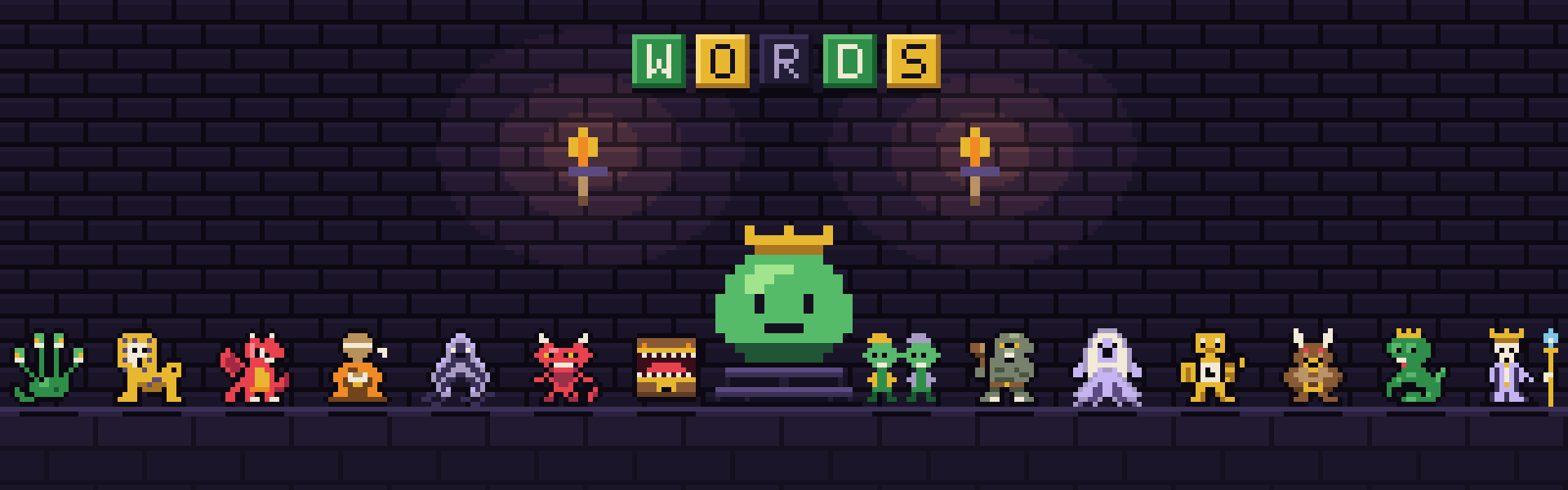
The first floors introduce the mechanics one at a time. Slime King on the first floor gives you the classic: a five-letter word in six tries. Then The Mimic challenges you to a duel with 45 seconds per move, Twin Goblins give you two words at once, and Hourglass Djinn starts the clock. Among the relics, the most beginner-friendly are Keen Mind, which gives you an extra try in every fight, and Healing Draught, which gives you a life right away. Save charges like Torchlight, which reveals a letter in its correct spot, for the tough bosses, and Secret Passage lets you skip a floor and still pick a relic
- Open wordungeon.com in your phone or computer browser: you don't need an account, and your high scores are stored on your device
- If your language isn't detected automatically, choose it in the settings, while the words in the game stay in English
- Flip through “How to Play”: four short screens about tiles, bosses, relics and high scores
- Tap “Start Run” and read the boss card before every fight
- Walk first, then play, and set yourself a limit, say one run. When it's time to go, hit pause: the run will wait for you
- To have your name show up on the leaderboard, save it: from 3 to 16 characters
- Word puzzle fans do better on thinking tests on average, but cause and effect hasn't been proven here
- Training mainly improves the task you trained, so a game won't replace either a walk or a doctor
- Walking has more evidence behind it: a year of walks three times a week enlarged the hippocampus of older adults by about 2%
- WorDungeon turns Wordle into a roguelike: 50 bosses, three lives and relics that stack
- The game is free and runs in your browser without an account, the words are English and the interface is in your language
- The best combo: a walk first, then one run, but not on the go
Frequently asked questions
Is WorDungeon really free?
Yes. Play in your browser at wordungeon.com, no sign-up or account needed. Your high scores are stored on your device, and you only save a name for the leaderboard if you want to
Is there a phone app?
The browser version works on any phone with nothing to install. The creators are also releasing WorDungeon as an iPhone app, and if it isn't in your country's App Store yet or you have an Android phone, play in the browser: it's the same game
What language are the words in?
The hidden words are English, from 4 to 7 letters long. The interface is translated into 100 languages, including Russian, Kazakh, Uzbek, Kyrgyz, Tajik and Uyghur
How is WorDungeon different from Worduel?
Worduel is a duel with a live opponent: you and your rival take turns on a shared board. WorDungeon is a solo game: you make your way down floor by floor, and the duels there are run by the bosses themselves
What happens after floor 50?
The bosses come back with rarer words, so the dungeon has no bottom. There's no limit on the lives you find along the way
Do word puzzles protect against dementia?
There's no convincing evidence of that. Puzzle fans do better on tests on average, but it may simply be that people with lively minds are more likely to enjoy puzzles. If you're worried about your memory, see a doctor: that matters more than any game. And regular walking and good sleep certainly won't hurt
Sources
- Brooker H et al. “An online investigation of the relationship between the frequency of word puzzle use and cognitive function in a large sample of older adults”, International Journal of Geriatric Psychiatry, 2019 Int J Geriatr Psychiatry 2019
- Devanand DP et al. “Computerized Games versus Crosswords Training in Mild Cognitive Impairment”, NEJM Evidence, 2022 NEJM Evidence 2022
- Owen AM et al. “Putting brain training to the test”, Nature, 2010 Nature 2010
- Simons DJ et al. “Do ‘Brain-Training’ Programs Work?”, Psychological Science in the Public Interest, 2016 Psychol Sci Public Interest 2016
- Erickson KI et al. “Exercise training increases size of hippocampus and improves memory”, PNAS, 2011 PNAS 2011
- Albulescu P et al. “‘Give me a break!’ A systematic review and meta-analysis on the efficacy of micro-breaks for increasing well-being and performance”, PLoS ONE, 2022 PLoS ONE 2022
- Oppezzo M, Schwartz DL. “Give your ideas some legs: The positive effect of walking on creative thinking”, Journal of Experimental Psychology: Learning, Memory, and Cognition, 2014 J Exp Psychol LMC 2014


